


Human immunodeficiency virus testing practices among buprenorphine-prescribing physicians
- PMID: 22367499
- PMCID: PMC3447983
- DOI: 10.1097/ADM.0b013e31824339fc
Human immunodeficiency virus testing practices among buprenorphine-prescribing physicians
Abstract
Background: Despite the Centers for Disease Control and Prevention recommendations for annual HIV testing of at-risk populations, including those with substance use disorders, there are no data on the human immunodeficiency virus (HIV) testing practices of buprenorphine-prescribing physicians.
Objective: To describe HIV testing practices among buprenorphine-prescribing physicians.
Methods: We conducted a cross-sectional survey of physicians enrolled in a national system to support buprenorphine prescribing between July and August 2008. The electronic survey included questions on demographics; clinical training and experience; clinical practice; patient characteristics; and physician screening practices, including HIV testing.
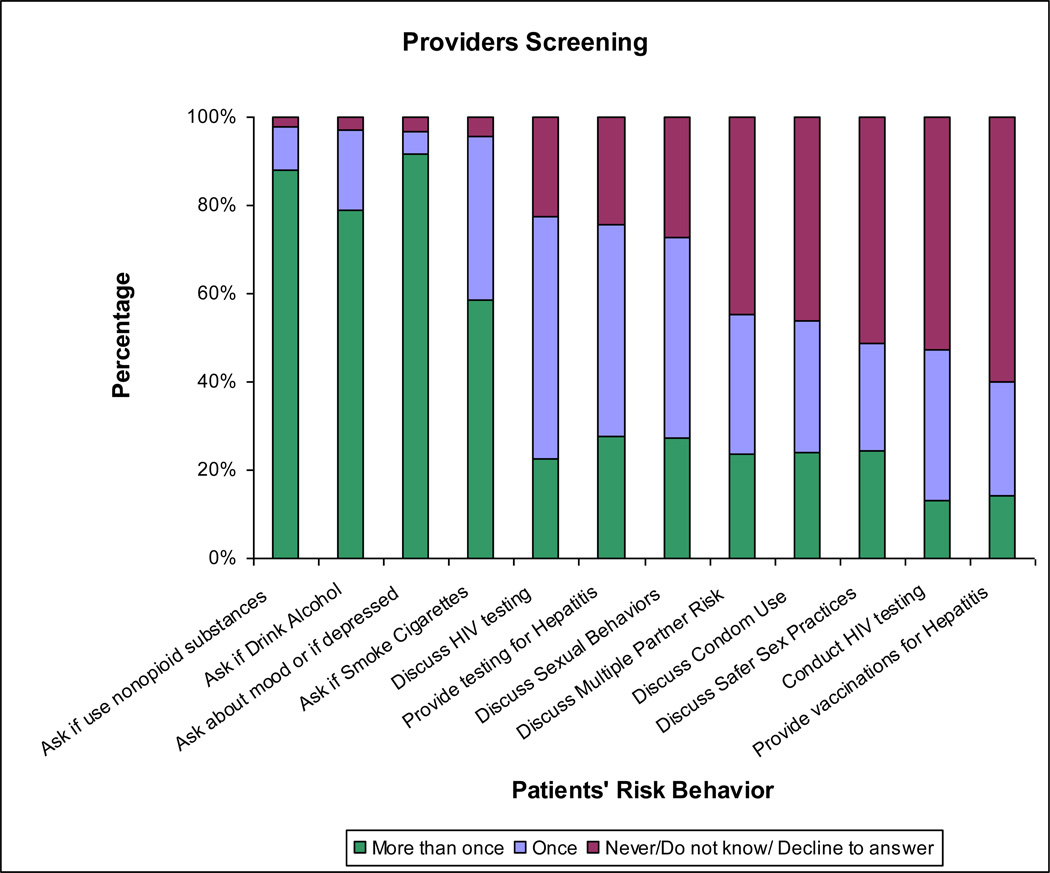
Results: Only 46% of 382 respondent physicians conducted HIV testing. On univariate analysis, physicians who conducted HIV testing were more likely to report addiction specialty training (33% vs 19%, P = 0.001), practicing in addiction settings (28% vs 16%, P = 0.006), and having treated more than 50 patients with buprenorphine (50% vs 31%, P < 0.0001) than those who did not. Compared with physicians who did not conduct HIV testing, physicians who conducted HIV testing had a lower proportion of buprenorphine patients who were white (75% vs 82%, P = 0.01) or dependent upon prescription opioids (57% vs 70%, P < 0.0001). In multivariate analysis, physicians who conducted HIV testing were more likely to have treated more than 50 patients with buprenorphine (odds ratio = 1.777, 95% CI 1.011-3.124) and had fewer patients dependent upon prescription opioids (odds ratio = 0.986 95% CI 0.975-0.998) than physicians who did not.
Conclusions: Interventions to increase HIV testing among physicians prescribing buprenorphine are needed.
Conflict of interest statement
The authors have no conflicts of interest.
Figures
Similar articles
-
Buprenorphine prescribing for opioid use disorder in medical practices: can office-based out-patient care address the opiate crisis in the United States?Addiction. 2019 Nov;114(11):1992-1999. doi: 10.1111/add.14733. Epub 2019 Jul 25. Addiction. 2019. PMID: 31307111 Free PMC article.
-
Training HIV physicians to prescribe buprenorphine for opioid dependence.Subst Abus. 2006 Sep;27(3):13-8. doi: 10.1300/J465v27n03_03. Subst Abus. 2006. PMID: 17135176
-
Evaluation of medications used for opioid use disorder in emergency departments: A cross-sectional analysis of the 2020 National Hospital Ambulatory Medical Care Survey.Am J Emerg Med. 2024 Aug;82:52-56. doi: 10.1016/j.ajem.2024.05.015. Epub 2024 May 20. Am J Emerg Med. 2024. PMID: 38795424
-
Why don't physicians test for HIV? A review of the US literature.AIDS. 2007 Jul 31;21(12):1617-24. doi: 10.1097/QAD.0b013e32823f91ff. AIDS. 2007. PMID: 17630557 Review.
-
HIV testing among individuals with a severe mental illness: review, suggestions for research, and clinical implications.Psychol Med. 2009 Mar;39(3):355-63. doi: 10.1017/S0033291708003930. Epub 2008 Jul 8. Psychol Med. 2009. PMID: 18606051 Free PMC article. Review.
Cited by
-
HIV testing in the nation's opioid treatment programs, 2005-2011: the role of state regulations.Health Serv Res. 2014 Feb;49(1):230-48. doi: 10.1111/1475-6773.12094. Epub 2013 Jul 16. Health Serv Res. 2014. PMID: 23855724 Free PMC article.
-
Spillover effects of HIV testing policies: changes in HIV testing guidelines and HCV testing practices in drug treatment programs in the United States.BMC Public Health. 2016 Jul 29;16:666. doi: 10.1186/s12889-016-3322-4. BMC Public Health. 2016. PMID: 27473519 Free PMC article.
-
Perceived Impacts of the Affordable Care Act: Perspectives of Buprenorphine Prescribers.J Psychoactive Drugs. 2017 Apr-Jun;49(2):111-121. doi: 10.1080/02791072.2017.1295335. Epub 2017 Mar 15. J Psychoactive Drugs. 2017. PMID: 28296579 Free PMC article.
-
A mixed methods study of HIV-related services in buprenorphine treatment.Subst Abuse Treat Prev Policy. 2017 Aug 16;12(1):37. doi: 10.1186/s13011-017-0122-5. Subst Abuse Treat Prev Policy. 2017. PMID: 28814313 Free PMC article.
-
Integration of care for HIV and opioid use disorder.AIDS. 2019 Apr 1;33(5):873-884. doi: 10.1097/QAD.0000000000002125. AIDS. 2019. PMID: 30882491 Free PMC article.
References
-
- American Psychiatric Association. Diagnostic and Statistical Manual of Mental Disorders. 2000
-
- Branson BM, Handsfield HH, Lampe MA, et al. Revised recommendations for HIV testing of adults, adolescents, and pregnant women in health-care settings. MMWR Recomm Rep. 2006;55(RR-14):1–17. quiz CE11-14. - PubMed
Publication types
MeSH terms
Substances
Grants and funding
- DA009803/DA/NIDA NIH HHS/United States
- DA022398/DA/NIDA NIH HHS/United States
- K01 DA022398/DA/NIDA NIH HHS/United States
- DA020576-01A1/DA/NIDA NIH HHS/United States
- DA025991/DA/NIDA NIH HHS/United States
- K24 DA000445/DA/NIDA NIH HHS/United States
- R01 DA020576/DA/NIDA NIH HHS/United States
- R01 DA025991/DA/NIDA NIH HHS/United States
- R01 DA019511/DA/NIDA NIH HHS/United States
- DA019511-01/DA/NIDA NIH HHS/United States
- Z01 DA000445/ImNIH/Intramural NIH HHS/United States
- R01 DA009803/DA/NIDA NIH HHS/United States
LinkOut - more resources
Full Text Sources
Medical
