. 2012 Feb 22;485(7396):55-61.
doi: 10.1038/nature10912.

The translational landscape of mTOR signalling steers cancer initiation and metastasis

Affiliations

The translational landscape of mTOR signalling steers cancer initiation and metastasis

Andrew C Hsieh et al. Nature. .

Abstract

The mammalian target of rapamycin (mTOR) kinase is a master regulator of protein synthesis that couples nutrient sensing to cell growth and cancer. However, the downstream translationally regulated nodes of gene expression that may direct cancer development are poorly characterized. Using ribosome profiling, we uncover specialized translation of the prostate cancer genome by oncogenic mTOR signalling, revealing a remarkably specific repertoire of genes involved in cell proliferation, metabolism and invasion. We extend these findings by functionally characterizing a class of translationally controlled pro-invasion messenger RNAs that we show direct prostate cancer invasion and metastasis downstream of oncogenic mTOR signalling. Furthermore, we develop a clinically relevant ATP site inhibitor of mTOR, INK128, which reprograms this gene expression signature with therapeutic benefit for prostate cancer metastasis, for which there is presently no cure. Together, these findings extend our understanding of how the 'cancerous' translation machinery steers specific cancer cell behaviours, including metastasis, and may be therapeutically targeted.


Figures
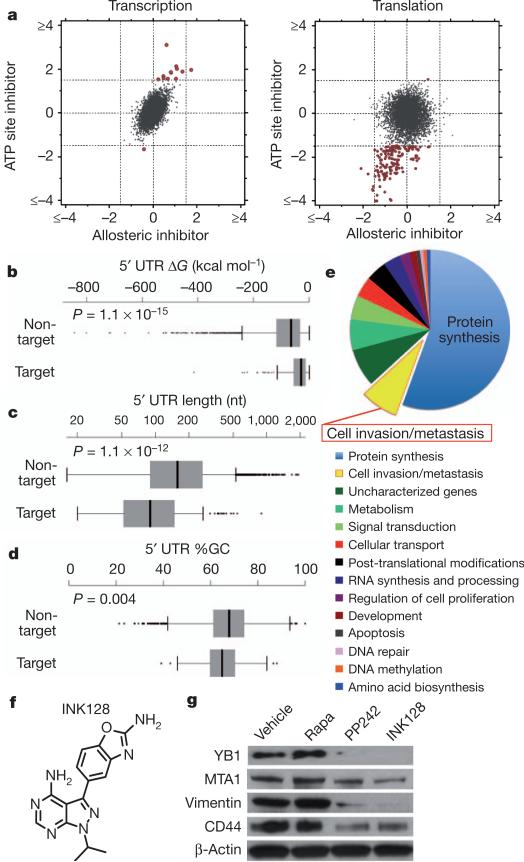
Figure 1
Figure 1. Ribosome profiling reveals mTOR-dependent specialized translational control of the prostate cancer genome
a, Representative comparison of mRNA abundance and translational efficiency after a 3-h treatment with an ATP site inhibitor (PP242) versus an allosteric inhibitor (rapamycin). b–d, Free energy, length and percentage G+C content of the 5′ UTRs of mTOR target versus non-target mRNAs (error bars indicate range, non-target n = 5,022, target n = 144, two-sided Wilcoxon). e, Functional classification of translationally regulated mTOR-responsive mRNAs. f, Chemical structure of INK128. g, Representative western blot from three independent experiments of mTOR-sensitive invasion genes in PC3 cells after a 48-h drug treatment. Rapa, rapamycin.
Figure 2
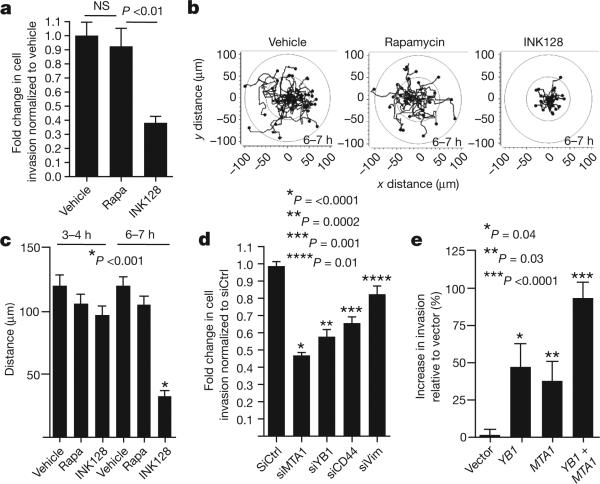
Figure 2. mTOR promotes prostate cancer cell migration and invasion through a translationally regulated gene signature
a, Matrigel invasion assay in PC3 cells: 6-h pre-treatment followed by 6 h of cell invasion (n = 6, ANOVA). b, c, Migration patterns and average distance travelled by GFP-labelled PC3 cells during hours 3–4 and 6–7 of drug treatment (n = 34 cells per condition, ANOVA). d, Matrigel invasion assay in PC3 cells after 48 h of knockdown of YB1, MTA1, CD44, or vimentin followed by 24 h of cell invasion (n = 7, t-test). e, Matrigel invasion assay in BPH-1 cells after 48 h of overexpression of YB1 and/or MTA1, followed by cell invasion for 24 h (n = 7, t-test). Rapa, rapamycin. All data represent mean ± s.e.m. NS, not statistically significant.
Figure 3
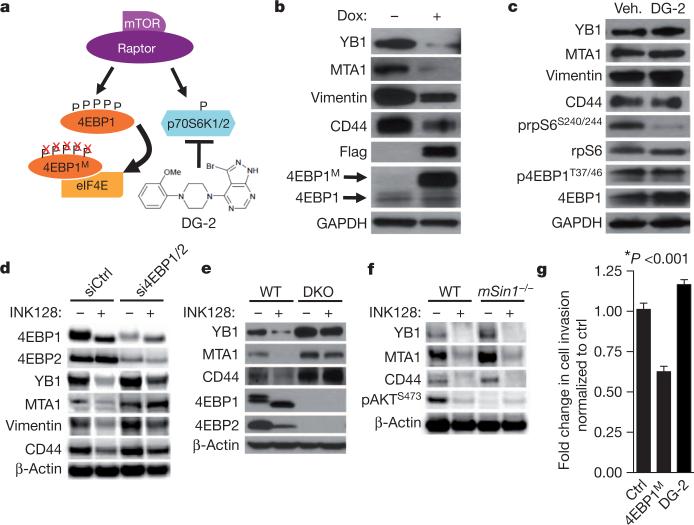
Figure 3. The 4EBP1–eIF4E axis controls the post-transcriptional expression of mTOR-sensitive invasion genes
a, Schematic of the pharmacogenetic strategy to inhibit p70S6K1/2 or eIF4E hyperactivation. b, Representative western blot from three independent experiments of PC3 4EBP1M cells after 48-h doxycycline induction of 4EBP1M. c, Representative western blot from three independent experiments of PC3 cells after 48-h DG-2 treatment. d, Representative western blot from three independent experiments of PC3 cells after 48 h of 4EBP1/4EBP2 knockdown followed by 24-h INK128 treatment (see quantification of independent experiments in Supplementary Fig. 23a). e, Representative western blot from three independent experiments of wild type (WT) and 4EBP1/4EBP2 double knockout (DKO) MEFs treated with INK128 for 24 h. f, Representative western blot from two independent experiments of wild-type and mSin1–/– (also called Mapkap1tm1Bisu) MEFs after 24-h INK128 treatment. g, Matrigel invasion assay upon 48-h doxycycline induction of 4EBP1M, or treatment with DG-2 compared to control (n = 6 per condition, t-test). All data represent mean ± s.e.m.
Figure 4
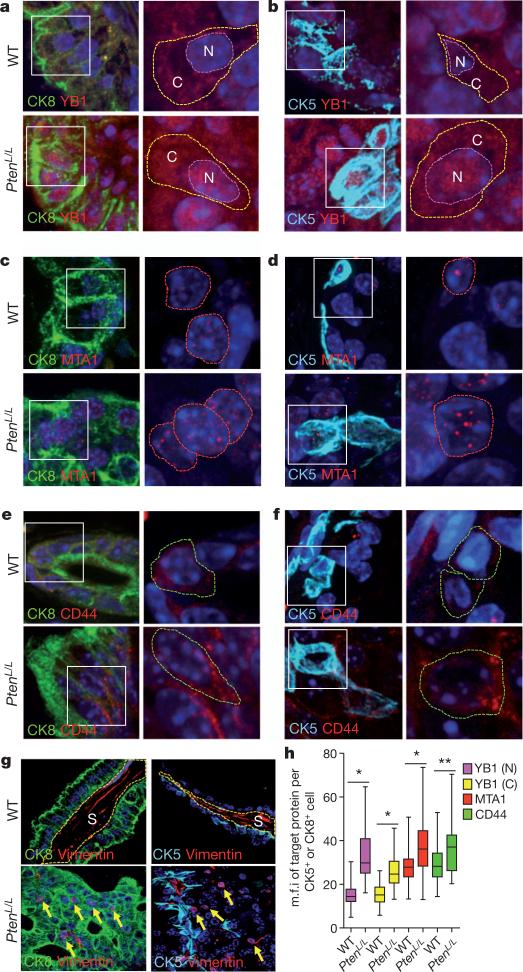
Figure 4. mTOR hyperactivation augments translation of YB1, MTA1, CD44 and vimentin mRNAs in a subset of pre-invasive prostate cancer cells in vivo
Left: immunofluorescent images of CK8/DAPI or CK5/DAPI with YB1 (a, b), MTA1 (c, d), or CD44 (e, f) co-staining in 14-month-old wild-type and PtenL/L mouse prostate epithelial cells. White boxes outline the area magnified in the right panel. Right: magnified immunofluorescent images of YB1 (a, b), MTA1 (c, d) and CD44 (e, f) co-stained with DAPI in wild-type and PtenL/L mouse prostate epithelial cells. Dotted lines encircle the cytoplasm (C) and/or the nucleus (N). g, Representative immunofluorescent images of CK5 or CK8 co-staining with vimentin in 14-month-old wild-type and PtenL/L mouse prostate epithelial cells. S, stroma; yellow arrows indicate perinuclear vimentin. h, Box plot of YB1 (N = nuclear, C = cytoplasmic), MTA1 and CD44 mean fluorescence intensity (m.f.i.) per CK5+ or CK8+ prostate epithelial cell in wild-type and PtenL/L mice (three mice per arm, n = 43–303 cells quantified per target gene, error bars indicate range (see Supplementary Fig. 25b); *P < 0.0001, **P = 0.0004, t-test).
Figure 5
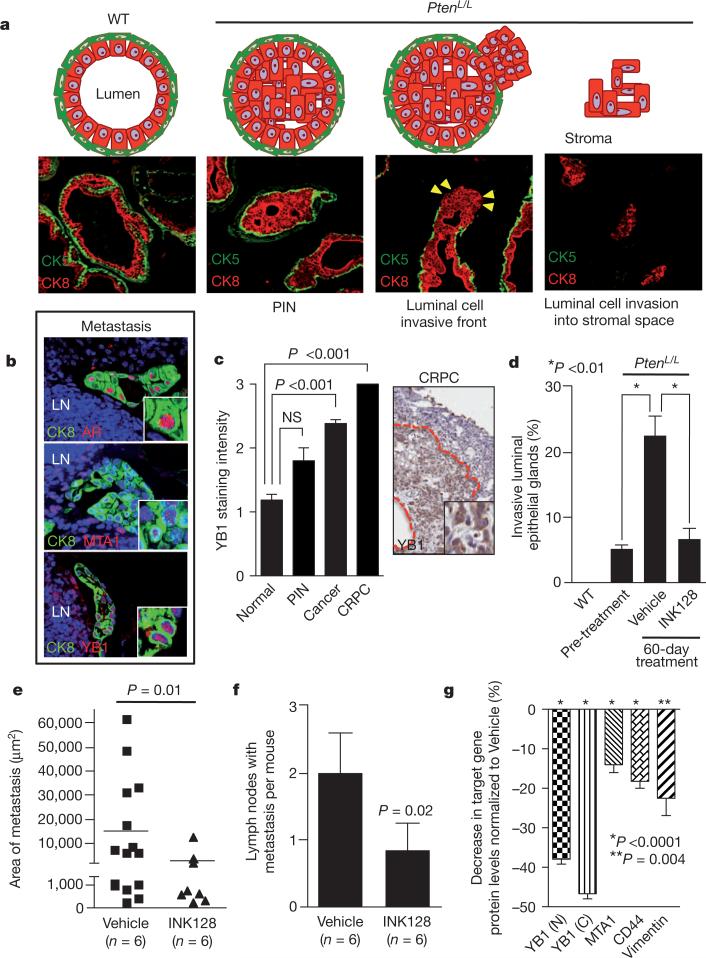
Figure 5. Complete mTOR inhibition by INK128 treatment prevents prostate cancer invasion and metastasis in vivo
a, Diagram and images of normal prostate gland, pre-invasive PIN and invasive prostate cancer. CK8/CK5, luminal/basal epithelial cells, respectively. Yellow arrowheads indicate invasive front. b, Immunofluorescent images of 14-month-old PtenL/L lymph node (LN) metastasis co-stained with CK8/androgen receptor (AR), CK8/YB1 and CK8/MTA1. c, Left: human tissue microarray of YB1 protein levels in normal (n = 59), PIN (n = 5), cancer (n = 99) and CRPC (n = 3) (ANOVA). Right: immunohistochemistry of YB1 in human CRPC demarcated by the red line (inset shows nuclear and cytoplasmic YB1). d, Quantification of invasive prostate glands in wild-type and PtenL/L mice before (12-months old) and after (14-months old) 60 days of INK128 treatment (n = 6 mice per arm, ANOVA). e, f, Area and number of CK8/AR+ metastases in draining lymph nodes in 14-month-old PtenL/L mice after 60 days of INK128 treatment (n = 6 mice per arm, t-test). g, Percentage decrease of YB1 (N = nuclear, C = cytoplasmic), MTA1, CD44, or vimentin protein levels (determined by quantitative immunofluorescence, Supplementary Fig. 25b) in CK8+ or CK5+ prostate cells (CK8+ only for vimentin) in INK128-treated 14-month-old PtenL/L mice normalized to vehicle-treated mice (n = 3 mice per arm, t-test). All data represent mean ± s.e.m.

Comment in

  • Cancer biology: The director's cut.
    Gentilella A, Thomas G. Gentilella A, et al. Nature. 2012 May 2;485(7396):50-1. doi: 10.1038/485050a. Nature. 2012. PMID: 22552093 No abstract available.

References

    1. Brown EJ, et al. Control of p70 s6 kinase by kinase activity of FRAP in vivo. Nature. 1995;377:441–446. - PubMed
    1. Gingras AC, Kennedy SG, O'Leary MA, Sonenberg N, Hay N. 4E–BP1, a repressor of mRNA translation, is phosphorylated and inactivated by the Akt(PKB) signaling pathway. Genes Dev. 1998;12:502–513. - PMC - PubMed
    1. Kim DH, et al. mTOR interacts with raptor to form a nutrient-sensitive complex that signals to the cell growth machinery. Cell. 2002;110:163–175. - PubMed
    1. Sarbassov DD, et al. Rictor, a novel binding partner of mTOR, defines a rapamycin-insensitive and raptor-independent pathway that regulates the cytoskeleton. Curr. Biol. 2004;14:1296–1302. - PubMed
    1. Gingras AC, Raught B, Sonenberg N. Regulation of translation initiation by FRAP/mTOR. Genes Dev. 2001;15:807–826. - PubMed

Publication types

MeSH terms

Associated data