


Recent findings about the Yersinia enterocolitica phage shock protein response
- PMID: 22367931
- PMCID: PMC3356110
- DOI: 10.1007/s12275-012-1578-7
Recent findings about the Yersinia enterocolitica phage shock protein response
Abstract
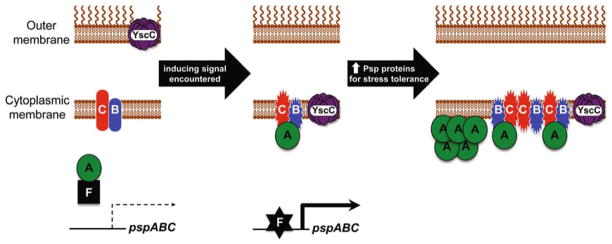
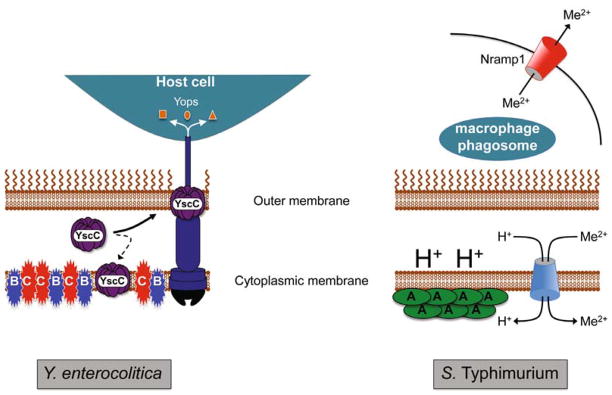
The phage shock protein (Psp) system is a conserved extracytoplasmic stress response in bacteria that is essential for virulence of the human pathogen Yersinia enterocolitica. This article summarizes some recent findings about Y. enterocolitica Psp system function. Increased psp gene expression requires the transcription factor PspF, but under non-inducing conditions PspF is inhibited by an interaction with another protein, PspA, in the cytoplasm. A Psp-inducing stimulus causes PspA to relocate to the cytoplasmic membrane, freeing PspF to induce psp gene expression. This PspA relocation requires the integral cytoplasmic membrane proteins, PspB and PspC, which might sense an inducing trigger and sequester PspA by direct interaction. The subsequent induction of psp gene expression increases the PspA concentration, which also allows it to contact the membrane directly, perhaps for its physiological function. Mutational analysis of the PspB and PspC proteins has revealed that they both positively and negatively regulate psp gene expression and has also identified PspC domains associated with each function. We also compare the contrasting physiological roles of the Psp system in the virulence of Y. enterocolitica and Salmonella enterica sv. Typhimurium (S. Typhimurium). In S. Typhimurium, PspA maintains the proton motive force, which provides the energy needed to drive ion importers required for survival within macrophages. In contrast, in the extracellular pathogen Y. enterocolitica, PspB and PspC, but not PspA, are the Psp components needed for virulence. PspBC protect Y. enterocolitica from damage caused by the secretin component of its type 3 secretion system, an essential virulence factor.
Figures
References
-
- Akiyama Y, Kihara A, Ito K. Subunit a of proton ATPase F0 sector is a substrate of the FtsH protease in Escherichia coli. FEBS Lett. 1996;399:26–28. - PubMed
-
- Brissette JL, Weiner L, Ripmaster TL, Model P. Characterization and sequence of the Escherichia coli stress-induced psp operon. J Mol Biol. 1991;220:35–48. - PubMed
-
- Cornelis GR. The Yersinia Ysc-Yop “Type III” weaponry. Nat Rev Mol Cell Biol. 2002;3:742–754. - PubMed
Publication types
MeSH terms
Substances
Grants and funding
LinkOut - more resources
Full Text Sources
Miscellaneous
