


Adherence to varenicline among African American smokers: an exploratory analysis comparing plasma concentration, pill count, and self-report
- PMID: 22367976
- PMCID: PMC3432278
- DOI: 10.1093/ntr/ntr333
Adherence to varenicline among African American smokers: an exploratory analysis comparing plasma concentration, pill count, and self-report
Abstract
Introduction: Measuring adherence to smoking cessation pharmacotherapy is important to evaluating its effectiveness. Blood levels are considered the most accurate measure of adherence but are invasive and costly. Pill counts and self-report are more practical, but little is known about their relationship to blood levels. This study compared the validity of pill count and self-report against plasma varenicline concentration for measuring pharmacotherapy adherence.
Methods: Data were obtained from a randomized pilot study of varenicline for smoking cessation among African American smokers. Adherence was measured on Day 12 via plasma varenicline concentration, pill count, 3-day recall, and a visual analogue scale (VAS; adherence was represented on a line with two extremes "no pills" and "all pills").
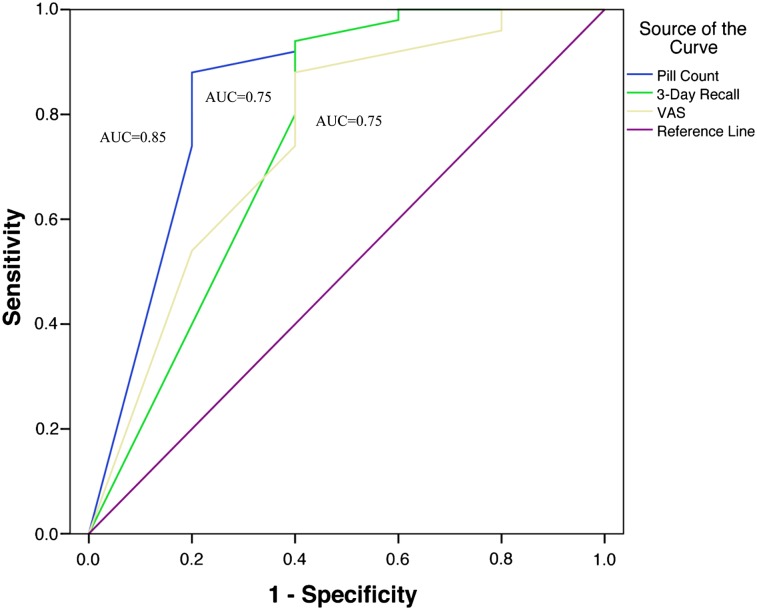
Results: The sample consisted of 55 African American moderate to heavy smokers (average 16.8 cigarettes/day, SD = 5.6) and 63.6% were female. Significant correlations (p < .05) were found between plasma varenicline concentration and pill count (r = .56), 3-day recall (r = .46), and VAS (r = .29). Using plasma varenicline concentration of 2.0 ng/ml as the cutpoint for adherence, pill count demonstrated the largest area under the receiver operating characteristic curve (AUC = 0.85, p = .01) and had 88% sensitivity (95% CI = 75.0-95.0) and 80% specificity (95% CI = 30.0-99.0) for detecting adherence.
Conclusions: Of 3 commonly used adherence measures, pill count was the most valid for identifying adherence in this sample of African American smokers. Pill count has been used across other health domains and could be incorporated into treatment to identify nonadherence, which, in turn, could maximize smoking cessation pharmacotherapy use and improve abstinence rates.
Figures
References
-
- Ahluwalia JS, Harris KJ, Catley D, Okuyemi KS, Mayo MS. Sustained-release bupropion for smoking cessation in African Americans. Journal of the American Medical Association. 2002;288:468–474. doi:10.1001/jama.288.4.468. - PubMed
-
- Ahluwalia JS, Okuyemi K, Nollen N, Choi WS, Kaur H, Pulvers K, et al. The effects of nicotine gum and counseling among African American light smokers: A 2 × 2 factorial design. Addiction. 2006;101:883–891. doi:10.1111/j.1360-0443.2006.01461.x. - PubMed
-
- Amico KR, Fisher WA, Cornman DH, Shuper PA, Redding CG, Konkle-Parker D.J.,, et al. Visual analog scale of ART adherence: Association with 3-day self-report and adherence barriers. Journal of Acquired Immune Deficiency Syndromes. 2006;42:455–459. doi:10.1097/01.qai.0000225020.73760.c2. - PubMed
-
- Bangsberg DR, Hecht FM, Charlebois ED, Chesney M, Moss A. Comparing objective measures of adherence to HIV antiretroviral therapy: Electronic medication monitors and unannounced pill counts. AIDS and Behavior. 2001;5:275–281. doi:http://dx.doi.org/10.1023/A:1011396711486.
Publication types
MeSH terms
Substances
Grants and funding
LinkOut - more resources
Full Text Sources
Medical
