. 2012 Feb;71(2):278-82.
doi: 10.1002/ana.22630.

Adenosine A2A receptor gene disruption protects in an α-synuclein model of Parkinson's disease

Affiliations

Adenosine A2A receptor gene disruption protects in an α-synuclein model of Parkinson's disease

Anil Kachroo et al. Ann Neurol. 2012 Feb.

Abstract

To investigate the putative interaction between chronic exposure to adenosine receptor antagonist caffeine and genetic influences on Parkinson's disease (PD), we determined whether deletion of the adenosine A(2A) receptor in knockout (KO) mice protects against dopaminergic neuron degeneration induced by a mutant human α-synuclein (hm(2)-αSYN) transgene containing both A53T and A30P. The A(2A) KO completely prevented loss of dopamine and dopaminergic neurons caused by the mutant α-synuclein transgene without altering levels of its expression. The adenosine A(2A) receptor appears required for neurotoxicity in a mutant α-synuclein model of PD. Together with prior studies the present findings indirectly support the neuroprotective potential of caffeine and more specific A(2A) antagonists.


Conflict of interest statement

Conflict of Interest: No conflict of interest

Figures

Fig.1
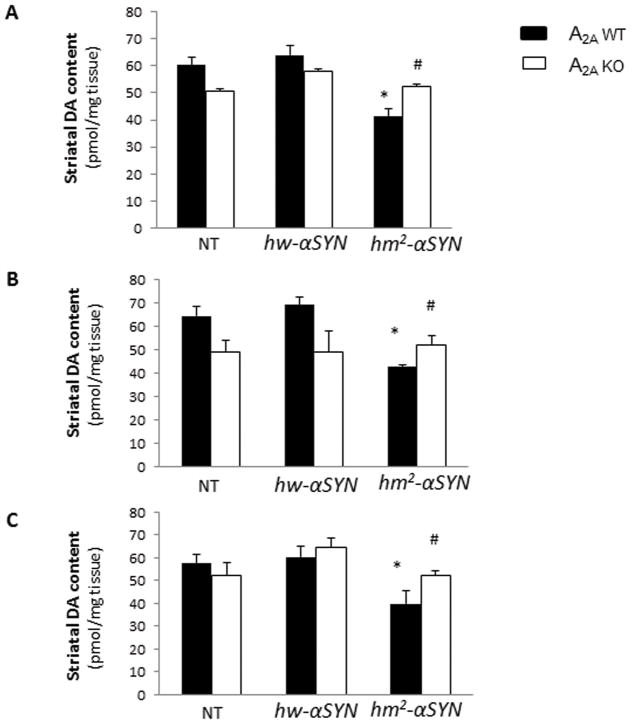
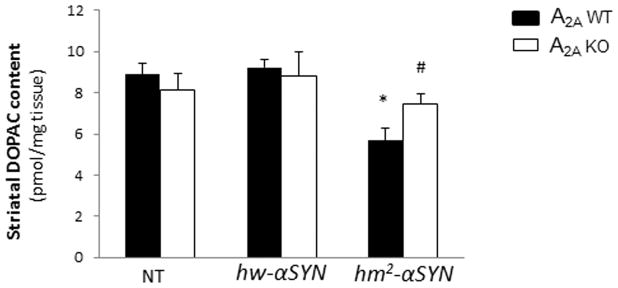
Fig.1. Mutant α-synuclein-induced striatal dopamine and DOPAC loss requires the A2A receptor
(A) Striatal dopamine (DA) content was measured at 20–24 months of age in non-transgenic (NT) mice and those transgenic for the wild-type (hw-αSYN) and the double mutant (hm2-αSYN) human synuclein gene. See Materials and Methods section for numbers of mice/group. *p<0.001 vs NT and hw-αSYN; #p<0.01 vs A2AWT [hm2-αSYN]; individual one-way ANOVAs with transgene as the between factor and subsequent post hoc analysis to determine differences between transgenic groups within an A2A genotype; and unpaired t-test for within transgene comparison between A2A genotypes. (B) Striatal DA level for male mice. *p<0.01 vs NT and hw-αSYN; #p<0.01 vs A2AWT [hm2-αSYN]; individual one-way ANOVAs with transgene as the between factor and subsequent post hoc analysis to determine differences between transgenic groups within an A2A genotype; and unpaired t-test for within transgene comparison between A2A genotypes (C) Striatal DA level for female mice. *p<0.05 vs NT and hw-αSYN; #p<0.05 vs A2AWT [hm2-αSYN]; individual one-way ANOVAs with transgene as the between factor and subsequent post hoc analysis to determine differences between transgenic groups within an A2A genotype; and unpaired t-test for within transgene comparison between A2A genotypes. (D) Striatal DOPAC content for male and female mice.*p<0.001 vs NT and hw-αSYN; #p<0.05 vs A2AWT [hm2-αSYN]; individual one way ANOVAs with transgene as the between factor and subsequent post hoc analysis to determine differences between transgenic groups within an A2A genotype; and unpaired t-test for within transgene comparison between A2A genotypes.
Fig.1
Fig.1. Mutant α-synuclein-induced striatal dopamine and DOPAC loss requires the A2A receptor
(A) Striatal dopamine (DA) content was measured at 20–24 months of age in non-transgenic (NT) mice and those transgenic for the wild-type (hw-αSYN) and the double mutant (hm2-αSYN) human synuclein gene. See Materials and Methods section for numbers of mice/group. *p<0.001 vs NT and hw-αSYN; #p<0.01 vs A2AWT [hm2-αSYN]; individual one-way ANOVAs with transgene as the between factor and subsequent post hoc analysis to determine differences between transgenic groups within an A2A genotype; and unpaired t-test for within transgene comparison between A2A genotypes. (B) Striatal DA level for male mice. *p<0.01 vs NT and hw-αSYN; #p<0.01 vs A2AWT [hm2-αSYN]; individual one-way ANOVAs with transgene as the between factor and subsequent post hoc analysis to determine differences between transgenic groups within an A2A genotype; and unpaired t-test for within transgene comparison between A2A genotypes (C) Striatal DA level for female mice. *p<0.05 vs NT and hw-αSYN; #p<0.05 vs A2AWT [hm2-αSYN]; individual one-way ANOVAs with transgene as the between factor and subsequent post hoc analysis to determine differences between transgenic groups within an A2A genotype; and unpaired t-test for within transgene comparison between A2A genotypes. (D) Striatal DOPAC content for male and female mice.*p<0.001 vs NT and hw-αSYN; #p<0.05 vs A2AWT [hm2-αSYN]; individual one way ANOVAs with transgene as the between factor and subsequent post hoc analysis to determine differences between transgenic groups within an A2A genotype; and unpaired t-test for within transgene comparison between A2A genotypes.
Fig.2
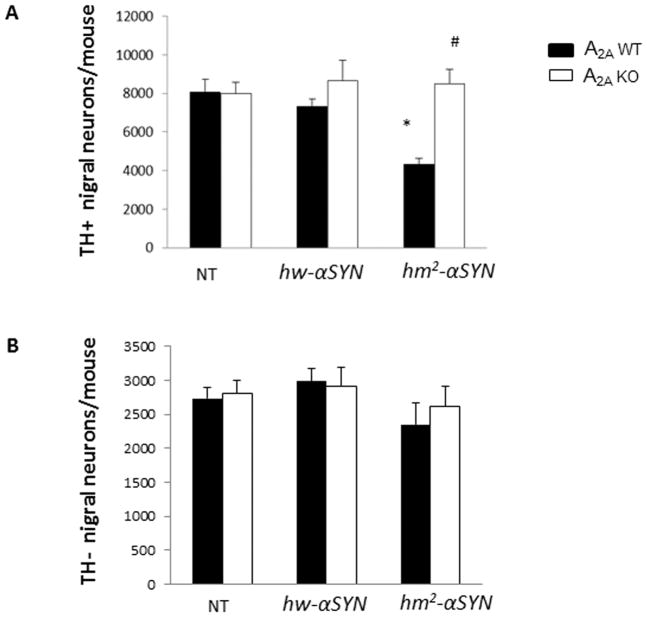
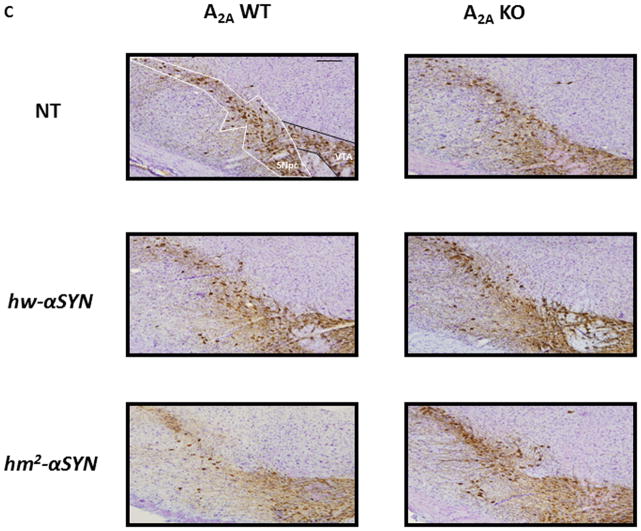
Fig.2. Dopaminergic neuron degeneration induced by transgenic mutant human α-synuclein is prevented in mice lacking the adenosine A2A receptor
(A) Stereological cell counts of TH-immunoreactive (TH+) neurons from male mouse brains. See Materials and Methods section for numbers of mice/group. *p<0.01 vs NT and hw-αSYN; #p<0.01 vs A2AWT [hm2-αSYN]; individual one-way ANOVAs with transgene as the between factor and subsequent post hoc analysis to determine differences between transgenic groups within an A2A genotype; and unpaired t-test for within transgene comparison between A2A genotypes (B) TH-nigral (Nissl) neurons were assessed in brain sections from male mice. p>0.05; one way ANOVA with post hoc analysis and t-test. (C) Representative photomicrographs showing chromogenically stained TH+ and TH-neurons of the SNpc. Scale Bar = 60μm.
Fig.2
Fig.2. Dopaminergic neuron degeneration induced by transgenic mutant human α-synuclein is prevented in mice lacking the adenosine A2A receptor
(A) Stereological cell counts of TH-immunoreactive (TH+) neurons from male mouse brains. See Materials and Methods section for numbers of mice/group. *p<0.01 vs NT and hw-αSYN; #p<0.01 vs A2AWT [hm2-αSYN]; individual one-way ANOVAs with transgene as the between factor and subsequent post hoc analysis to determine differences between transgenic groups within an A2A genotype; and unpaired t-test for within transgene comparison between A2A genotypes (B) TH-nigral (Nissl) neurons were assessed in brain sections from male mice. p>0.05; one way ANOVA with post hoc analysis and t-test. (C) Representative photomicrographs showing chromogenically stained TH+ and TH-neurons of the SNpc. Scale Bar = 60μm.
Fig. 3
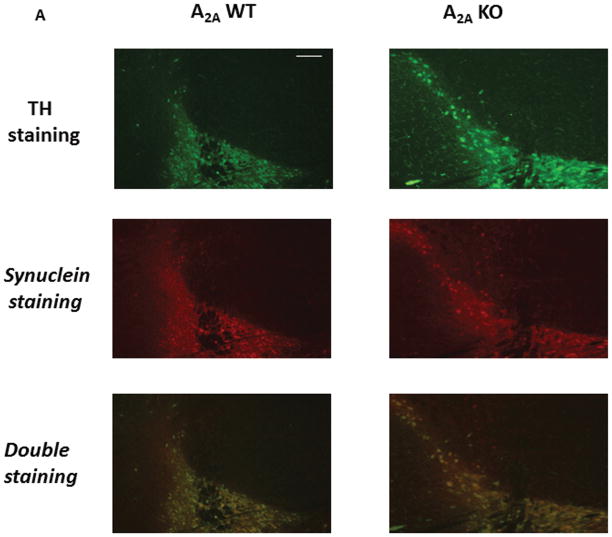
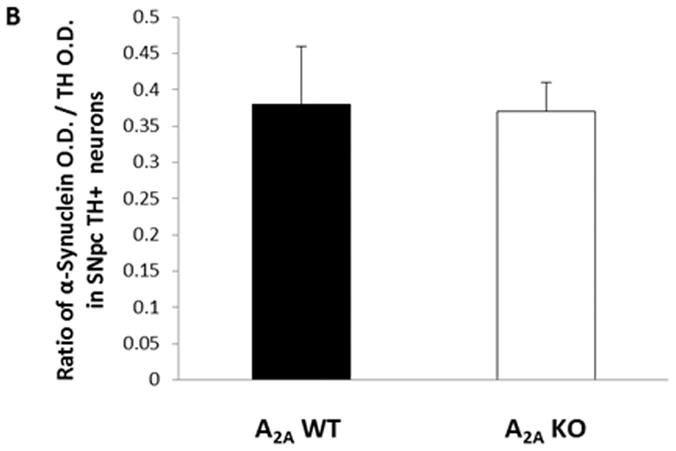
Fig. 3. Absence of mutant α-synuclein-induced neurodegeneration in A2AKO mice is not due to reduced expression of mutant α-synuclein
Brain sections from mice transgenic for the double mutant (hm2-αSYN) human synuclein gene were used. Double label fluorescence IHC for expression of TH and α-synuclein was performed. (A) Fluorescent images (10×) generated from double label staining for TH (green), α-synuclein (red), and merged (yellow) are shown. (B) Ratio of α-synuclein O.D/TH+ O.D. in SNpc TH+ neurons; p>0.05; Student’s t-test. Scale Bar = 60μm.
Fig. 3
Fig. 3. Absence of mutant α-synuclein-induced neurodegeneration in A2AKO mice is not due to reduced expression of mutant α-synuclein
Brain sections from mice transgenic for the double mutant (hm2-αSYN) human synuclein gene were used. Double label fluorescence IHC for expression of TH and α-synuclein was performed. (A) Fluorescent images (10×) generated from double label staining for TH (green), α-synuclein (red), and merged (yellow) are shown. (B) Ratio of α-synuclein O.D/TH+ O.D. in SNpc TH+ neurons; p>0.05; Student’s t-test. Scale Bar = 60μm.

References

    1. Ascherio A, Zhang SM, Hernan MA, et al. Prospective study of coffee consumption and risk of Parkinson’s disease in men and women. Ann Neurol. 2001;50(1):56–63. - PubMed
    1. Chen JF, Xu K, Petzer JP, et al. Neuroprotection by caffeine and A(2A) adenosine receptor inactivation in a model of Parkinson’s disease. J Neurosci. 2001;21:RC143, 1–6. - PMC - PubMed
    1. Xu K, Xu Y-H, Chen JF, et al. Neuroprotection by caffeine: time course and the role of its metabolites in the MPTP model of Parkinson’s disease. Neurosci. 2010;167(2):475–81. - PMC - PubMed
    1. Aguiar LMV, Nobre HV, Jr, Macedo DS, et al. Neuroprotective effects of caffeine in the model of 6-hydroxydopamine lesions in rats. Pharmacology, Biochemistry and Behavior. 2006;84:415–419. - PubMed
    1. Kachroo A, Irizarry MC, Schwarzschild MA. Caffeine protects against combined paraquat and maneb-induced dopaminergic neuron degeneration. Experimental Neurology. 2010;223:657–661. - PMC - PubMed

Publication types