


Clinical Features and Seroepidemiology of Anti-HDV Antibody in patients With Chronic Hepatitis B Virus Infection in Iran: A Meta-Analysis
- PMID: 22368679
- PMCID: PMC3282028
- DOI: 10.5812/kowsar.1735143X.805
Clinical Features and Seroepidemiology of Anti-HDV Antibody in patients With Chronic Hepatitis B Virus Infection in Iran: A Meta-Analysis
Abstract
Context: Hepatitis delta virus (HDV) leads to the most severe form of chronic viral hepatitis.
Objectives: To determine the prevalence of HDV and create pooled estimations of possible risk factors, a systematic review was conducted to collect all epidemiological studies on HDV among chronic hepatitis B patients in Iran.
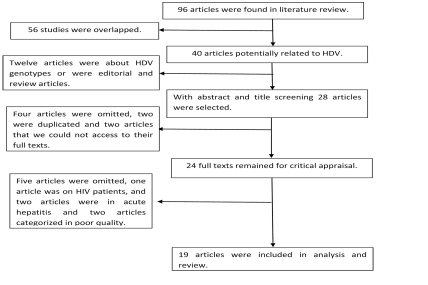
Data sources: In this systematic review, databases such as PubMed, Embase, ISI, Google scholar, and Iranian databases (MagIran, Iranmedex, and SID) were searched.
Study selection: Studies that clearly stated information about the number of HBsAg positive patients infected with HDV were selected.
Data extraction: The name of the city, the author's name, year of study, HDV detection method, sample size, HBsAg positive frequency, mean age, total prevalence of HDV, and risk factors were extracted.
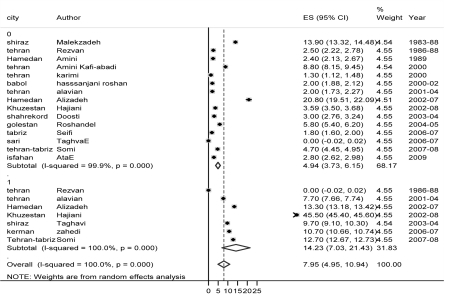
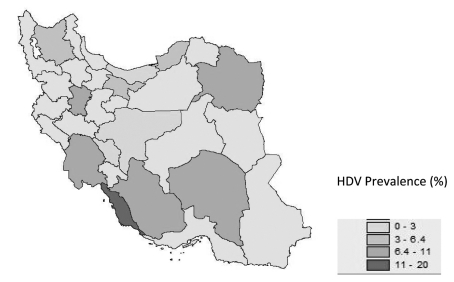
Results: The pooled HDV prevalence was 7.8% (95% CI: 5.89 - 9.71). In the survey-data analysis, HDV prevalence was 6.61%. HDV prevalence was 30.47% (95% CI: 9.76 to 51.19), 14.4% (95% CI: 7.72 to 21.07), and 4.94% (95% CI: 3.73 to 6.15) in cirrhotic, chronic-hepatitis, and inactive-carrier patients, respectively. Pooled ORs were calculated for several factors common to Iranian HBsAg-positive patients, including history of blood transfusion [OR: 1.1 (95% CI: 0.40 to 2.98)], intravenous drug abuse [OR: 1.6 (95% CI: 0.78 to 3.21)], previous hemodialysis [OR: 1.72 (95% CI: 0.79 to 3.76)], and HBeAg-positive status [OR: 1.26 (95% CI: 0.66 to 2.4)].
Conclusions: The prevalence of HDV is less common in Iran than in endemic regions such as Italy and Turkey; however, it is a severe form of hepatitis in HBsAg-positive patients. The most probable route of HDV transmission is hematologic, which suggests the importance of blood screening for HDV, especially in groups with numerous blood transfusions.
Keywords: Epidemiology; Hepatitis D; Iran; Meta-Analysis; Revalence; Review.
Figures
References
-
- Sagnelli E, Coppola N, Scolastico C, Filippini P, Santantonio T, Stroffolini T, Piccinino F. Virologic and clinical expressions of reciprocal inhibitory effect of hepatitis B, C, and delta viruses in patients with chronic hepatitis. Hepatology. 2000;32(5):1106–10. - PubMed
-
- Fattovich G, Boscaro S, Noventa F, Pornaro E, Stenico D, Alberti A, Ruol A, Realdi G. Influence of hepatitis delta virus infection on progression to cirrhosis in chronic hepatitis type B. J Infect Dis. 1987;155(5):931–5. - PubMed
-
- Romeo R, Del Ninno E, Rumi M, Russo A, Sangiovanni A, de Franchis R, Ronchi G, Colombo M. A 28-year study of the course of hepatitis Delta infection: a risk factor for cirrhosis and hepatocellular carcinoma. Gastroenterology. 2009;136(5):1629–38. - PubMed
-
- Alavian SM, Alavian SH. Hepatitis D virus Infection; Iran, Middle East and Central Asia. Hepat Mon. 2005;5(4):137–43.
-
- Farci P. Delta hepatitis: an update. J Hepatol. 2003;39(Suppl 1):S212–9. - PubMed
LinkOut - more resources
Full Text Sources