Compensatory expressive behavior for facial paralysis: adaptation to congenital or acquired disability
- PMID: 22369116
- PMCID: PMC4576912
- DOI: 10.1037/a0026904
Compensatory expressive behavior for facial paralysis: adaptation to congenital or acquired disability
Abstract
Objective: Although there has been little research on the adaptive behavior of people with congenital compared to acquired disability, there is reason to predict that people with congenital conditions may be better adapted because they have lived with their conditions for their entire lives (Smart, 2008). We examined whether people with congenital facial paralysis (FP), compared to people with acquired FP, compensate more for impoverished facial expression by using alternative channels of expression (i.e., voice and body).
Research method/design: Participants with congenital (n = 13) and acquired (n = 14) FP were videotaped while recalling emotional events.
Main outcome measures: Expressive verbal behavior was measured using the Linguistic Inquiry Word Count (Pennebaker, Booth, & Francis, 2007). Nonverbal behavior and FP severity were rated by trained coders.
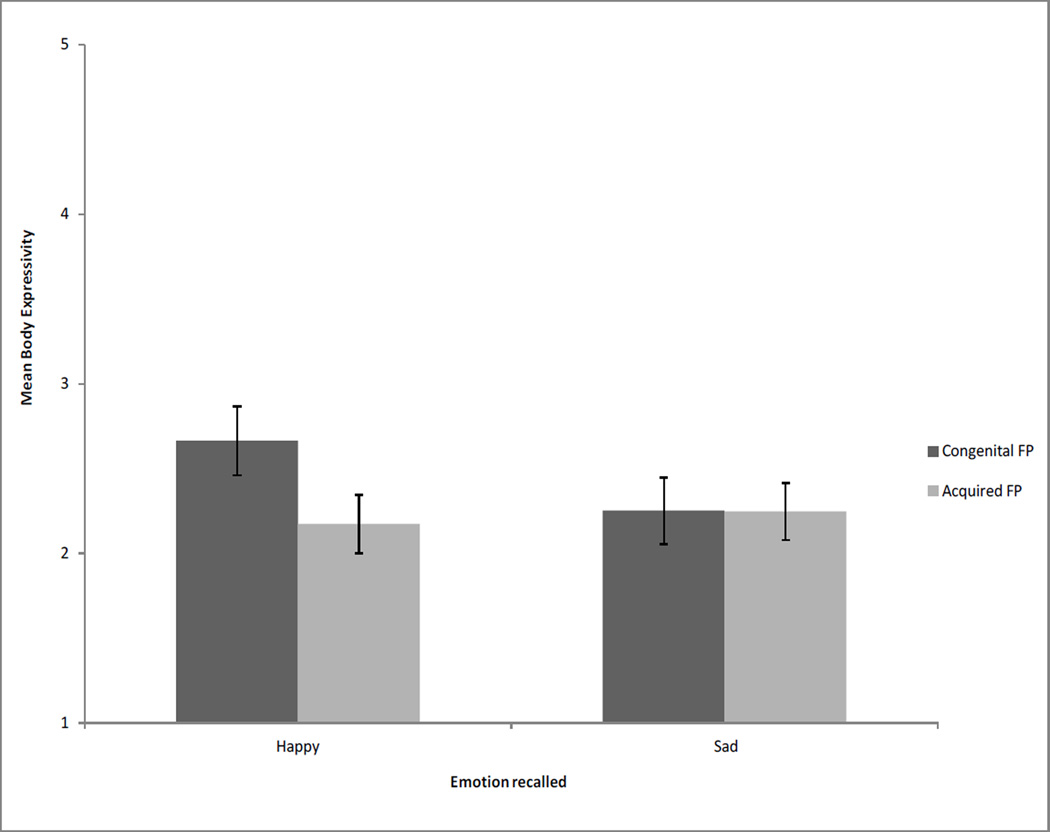
Results: People with congenital FP, compared to acquired FP, used more compensatory expressive verbal and nonverbal behavior in their language, voices, and bodies. The extent of FP severity had little effect on compensatory expressivity.
Conclusions/implications: This study provides the first behavioral evidence that people with congenital FP use more adaptations to express themselves than people with acquired FP. These behaviors could inform social functioning interventions for people with FP.
Figures
References
-
- Alfano DP, Neilson PM, Fink MP. Long-term psychosocial adjustment following head or spinal cord injury. Cognitive and Behavioral Neurology. 1993;6(2):117.
-
- Ambady N, Bernieri FJ, Richeson JA. Toward a histology of social behavior: Judgmental accuracy from thin slices of the behavioral stream. Advances in Experimental Social Psychology. 2000;32:201–271.
-
- Bjelland I, Dahl AA, Haug TT, Neckelmann D. The validity of the Hospital Anxiety and Depression Scale: An updated literature review. Journal of Psychosomatic Research. 2002;52:69–77. - PubMed
-
- Bleicher JN, Hamiel S, Gengler JS, Antimarino J. A survey of facial paralysis: Etiology and incidence. Ear, Nose, & Throat Journal. 1996;75(6):355–358. - PubMed
-
- Bogart KR, Matsumoto D. Living with Moebius syndrome: Adjustment, social competence, and satisfaction with life. Cleft Palate-Craniofacial Journal. 2010;47(2):134–142. - PubMed