. 2012 Mar 21;23(3):604-9.
doi: 10.1021/bc200648m. Epub 2012 Mar 8.

Near-infrared theranostic photoimmunotherapy (PIT): repeated exposure of light enhances the effect of immunoconjugate

Affiliations

Near-infrared theranostic photoimmunotherapy (PIT): repeated exposure of light enhances the effect of immunoconjugate

Makoto Mitsunaga et al. Bioconjug Chem. .

Abstract

Armed antibody-based targeted molecular therapies offer the possibility of effective tumor control with a minimum of side effects. Photoimmunotherapy (PIT) employs a monoclonal antibody-phototoxic phthalocyanine dye, IR700 conjugate, that is activated by focal near-infrared (NIR) light irradiation after antibody binding to the targeted tumor cell surface leading to rapid necrotic cell death. Therapy by single NIR light irradiation was effective without significant side effects; however, recurrences were seen in most treated mice probably because of inhomogeneous distribution of panitumumab-IR700 immunoconjugate in the tumor, leading to ineffective PIT. We describe here an optimized regimen of effective PIT method for the same HER1-overexpressing tumor model (A431) with fractionated administration of panitumumab-IR700 conjugate followed by systematic repeated NIR light irradiation to the tumor based on timing of antibody redistribution into the remnant tumor under the guidance of IR700 fluorescence signal. Eighty percent of the A431 tumors were eradicated with repeated PIT without apparent side effects and survived tumor-free for more than 120 days even after stopping therapy at day 30. Therapeutic effects were monitored using IR700 fluorescent signal. PIT is a promising highly selective and clinically feasible theranostic method for treatment of mAb-binding tumors with minimal off-target effects.


Conflict of interest statement

Disclosure of Potential Conflicts of Interest: No potential conflicts of interest were disclosed.

Figures

Figure 1
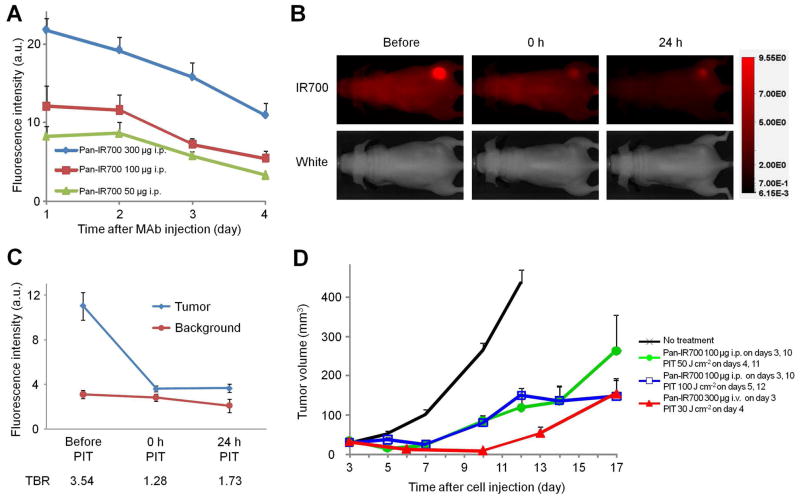
Figure 1. Effectiveness of fractionated Pan-IR700 with multiple NIR light exposures as detected by IR700 fluoresence
Pan-IR700 was administered to A431 tumor-bearing mice which were then exposed to NIR light and imaged with a fluorescent camera. (a) IR700 fluorescence of A431 tumors over time (n = 3 mice in each group). (b) Images of A431 tumor bearing mice before (left), immediately after (center) and 24 h after (right) PIT with 50 J cm-2 NIR light irradiation. IR700 fluorescence signal in the tumor decreased to background level immediately after PIT (center). Signal within the tumor increased 24 h after PIT indicating reaccumulation of Pan-IR700 due to circulating Pan-IR700 (right). (c) IR700 fluorescence of A431 tumor before and after NIR light irradiation. Data are mean ± s.e.m. (n = 4 mice). (d) Tumor volume reduction in response to Pan-IR700 PIT in A431 xenograft tumor (n≥3 10 mice in each treatment group).
Figure 2
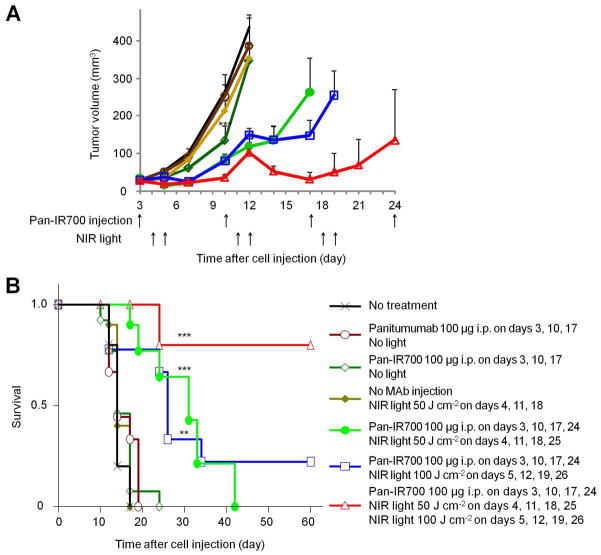
Figure 2. An optimized regimen of PIT resulted in complete pathologic response in mice with A431 xenograft tumors
(a) Repeated Pan-IR700 mediated PIT lead to more effective tumor volume reduction (n = 10 mice in each treatment group; *** P < 0.001 vs. non treatment control mice). Note that data were analyzed and shown only when each group of tumors were not exceeded 500 mm3. (b) Repeated Pan-IR700 mediated PIT led to prolonged survival. (n = 10 mice in each treatment group; *** P < 0.001, ** P < 0.01 vs. non treatment control mice).
Figure 3
Figure 3. Monitoring accumulation of Pan-IR700 into tumors using NIR fluorescence imaging
Monitoring PIT with Pan-IR700 fluorescence. Images were obtained 1 day after Pan-IR700 injection just before NIR light irradiation. Tumor growth or regression in response to Pan-IR700 mediated PIT was observable with IR700 fluorescence.
Figure 4
Figure 4. Serial histology pictures and micro-distribution of IR700 fluorescence in the tumor 1 h and 1 d after first PIT are shown together with a schema for explaining effectiveness of repeated PIT. Few fluorescent cells in diffuse necrotic cells with micro-hemorrhage are shown 1 h after PIT (Right upper images). Scattered fluorescent micro-clusters of survived tumor cells are shown 1 d after PIT (Left lower images). All cancer cells in clusters (black arrows) are fluoresced (white arrows) that indicate Pan-IR700 homogeneously distributed in survived and proliferated cancer cells

References

    1. Weiner LM, Surana R, Wang S. Monoclonal antibodies: versatile platforms for cancer immunotherapy. Nat Rev Immunol. 2010;10:317–327. - PMC - PubMed
    1. Waldmann TA. Immunotherapy: past, present and future. Nat Med. 2003;9:269–277. - PubMed
    1. Reichert JM, Rosensweig CJ, Faden LB, Dewitz MC. Monoclonal antibody successes in the clinic. Nat Biotechnol. 2005;23:1073–1078. - PubMed
    1. Clynes RA, Towers TL, Presta LG, Ravetch JV. Inhibitory Fc receptors modulate in vivo cytotoxicity against tumor targets. Nat Med. 2000;6:443–446. - PubMed
    1. Reff ME, Carner K, Chambers KS, Chinn PC, Leonard JE, Raab R, Newman RA, Hanna N, Anderson DR. Depletion of B cells in vivo by a chimeric mouse human monoclonal antibody to CD20. Blood. 1994;83:435–445. - PubMed

Publication types

Substances