


Targeting the von Hippel-Lindau E3 ubiquitin ligase using small molecules to disrupt the VHL/HIF-1α interaction
- PMID: 22369643
- PMCID: PMC3448299
- DOI: 10.1021/ja209924v
Targeting the von Hippel-Lindau E3 ubiquitin ligase using small molecules to disrupt the VHL/HIF-1α interaction
Abstract
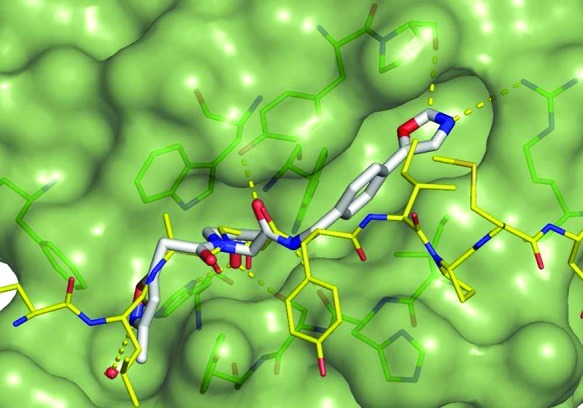
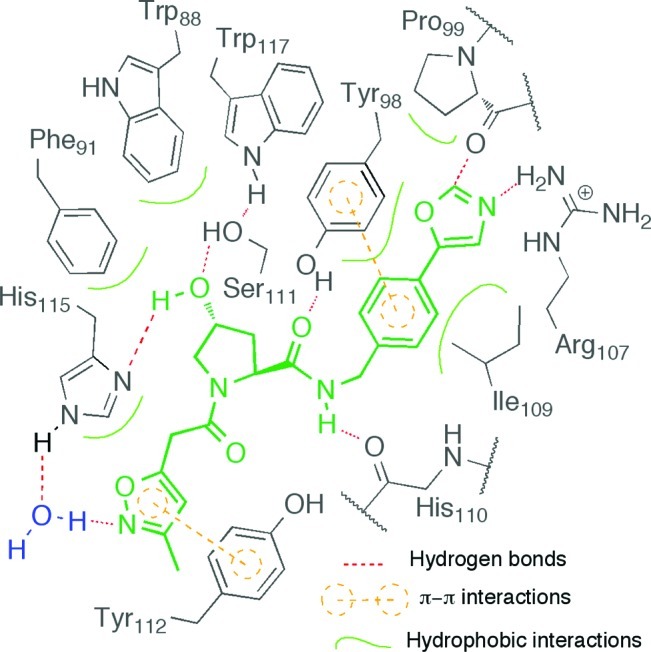
E3 ubiquitin ligases, which bind protein targets, leading to their ubiquitination and subsequent degradation, are attractive drug targets due to their exquisite substrate specificity. However, the development of small-molecule inhibitors has proven extraordinarily challenging as modulation of E3 ligase activities requires the targeting of protein-protein interactions. Using rational design, we have generated the first small molecule targeting the von Hippel-Lindau protein (VHL), the substrate recognition subunit of an E3 ligase, and an important target in cancer, chronic anemia, and ischemia. We have also obtained the crystal structure of VHL bound to our most potent inhibitor, confirming that the compound mimics the binding mode of the transcription factor HIF-1α, a substrate of VHL. These results have the potential to guide future development of improved lead compounds as therapeutics for the treatment of chronic anemia and ischemia.
Figures
References
-
- Cohen P.; Tcherpakov M. Cell 2010, 143, 686. - PubMed
-
- Adams J.; Behnke M.; Chen S.; Cruickshank A. A.; Dick L. R.; Grenier L.; Klunder J. M.; Ma Y.-T.; Plamondon L.; Stein R. L. Bioorg. Med. Chem. Lett. 1998, 8, 333. - PubMed
-
- Elofsson M.; Splittgerber U.; Myung J.; Mohan R.; Crews C. M. Chem. Biol. 1999, 6, 811. - PubMed
-
- Garber K. J. Natl. Cancer Inst. 2005, 97, 166. - PubMed
-
- Wells J. A.; McClendon C. L. Nature 2007, 450, 1001. - PubMed
Publication types
MeSH terms
Substances
Grants and funding
LinkOut - more resources
Full Text Sources
Other Literature Sources
