Safety evaluation of vitamin A in growing dogs
- PMID: 22370147
- PMCID: PMC3513714
- DOI: 10.1017/S0007114512000128
Safety evaluation of vitamin A in growing dogs
Abstract
The safe upper limit for inclusion of vitamin A in complete diets for growing dogs is uncertain, with the result that current recommendations range from 5.24 to 104.80 μmol retinol (5000 to 100 000 IU vitamin A)/4184 kJ (1000 kcal) metabolisable energy (ME). The aim of the present study was to determine the effect of feeding four concentrations of vitamin A to puppies from weaning until 1 year of age. A total of forty-nine puppies, of two breeds, Labrador Retriever and Miniature Schnauzer, were randomly assigned to one of four treatment groups. Following weaning at 8 weeks of age, puppies were fed a complete food supplemented with retinyl acetate diluted in vegetable oil and fed at 1 ml oil/100 g diet to achieve an intake of 5·24, 13·10, 78·60 and 104·80 μmol retinol (5000, 12 500, 75 000 and 100 000 IU vitamin A)/4184 kJ (1000 kcal) ME. Fasted blood and urine samples were collected at 8, 10, 12, 14, 16, 20, 26, 36 and 52 weeks of age and analysed for markers of vitamin A metabolism and markers of safety including haematological and biochemical variables, bone-specific alkaline phosphatase, cross-linked carboxyterminal telopeptides of type I collagen and dual-energy X-ray absorptiometry. Clinical examinations were conducted every 4 weeks. Data were analysed by means of a mixed model analysis with Bonferroni corrections for multiple endpoints. There was no effect of vitamin A concentration on any of the parameters, with the exception of total serum retinyl esters, and no effect of dose on the number, type and duration of adverse events. We therefore propose that 104·80 μmol retinol (100 000 IU vitamin A)/4184 kJ (1000 kcal) is a suitable safe upper limit for use in the formulation of diets designed for puppy growth.
Figures
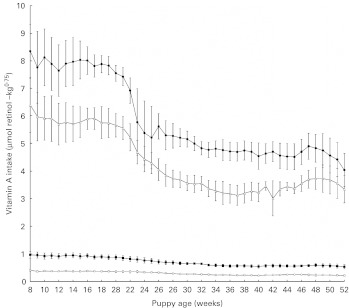
 ), 5·24 μmol retinol (5000 IU vitamin A)/4184 kJ (1000 kcal) metabolisable energy (ME); group B (
 ), 13·10 μmol retinol (12 500 IU vitamin A)/4184 kJ (1000 kcal) ME; group C (
 ), 78·60 μmol retinol (75 000 IU vitamin A)/4184 kJ (1000 kcal) ME; group D (
 ), 104·80 μmol retinol (100 000 IU vitamin A)/4184 kJ (1000 kcal) ME.
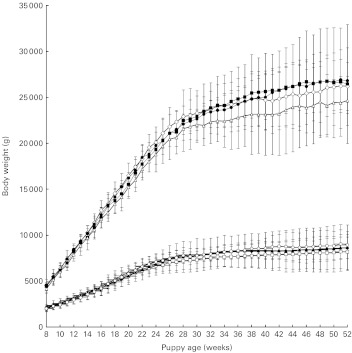 , Labrador Retriever (LR) group A; , LR group B; , LR group C; , LR group D;
  , Miniature Schnauzer (MS) group A;
  , MS group B;
  , MS group C;
  , MS group D.
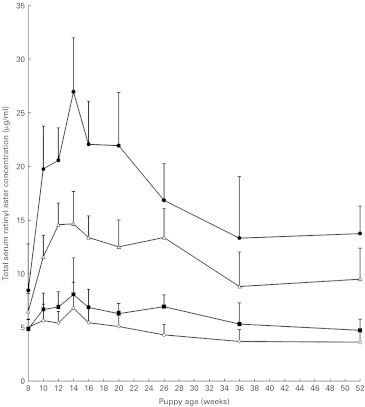 ), 5.24 μmol retinol (5000 IU vitamin A)/4184 kJ (1000 kcal) metabolisable energy (ME); group B (), 13.10 μmol retinol (12 500 IU vitamin A)/4184 kJ (1000 kcal) ME; group C (), 78.60 μmol retinol (75 000 IU vitamin A)/4184 kJ (1000 kcal) ME; group D (), 104.80 μmol retinol (100 000 IU vitamin A)/4184 kJ (1000 kcal) ME.
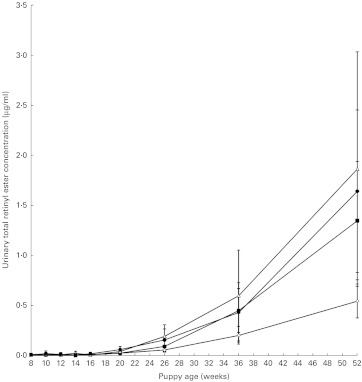 ), 5.24 μmol retinol (5000 IU vitamin A)/4184 kJ (1000 kcal) metabolisable energy (ME); group B (), 13.10 μmol retinol (12 500 IU vitamin A)/4184 kJ (1000 kcal) ME; group C (), 78.60 μmol retinol (75 000 IU vitamin A)/4184 kJ (1000 kcal) ME; group D (), 104.80 μmol retinol (100 000 IU vitamin A)/4184 kJ (1000 kcal) ME.
References
-
- Goldy GG, Burr JR, Langardener CN, et al. (1996) Effects of measured doses of vitamin A fed to healthy beagle dogs for 26 weeks. Vet Clin Nutr 3, 42–49.
-
- Wilson DE, Hejazi J, Elstad NL, et al. (1987) Novel aspects of vitamin A metabolism in the dog: distribution of lipoprotein retinyl esters in vitamin A-deprived and cholesterol-fed animals. Biochim Biophys Acta 922, 247–258. - PubMed
-
- Schweigert FJ & Bok V (2000) Vitamin A in blood plasma and urine of dogs is affected by the dietary level of vitamin A. Int J Vitam Nutr Res 70, 84–91. - PubMed
-
- Raila J, Buchholz I, Aupperle H, et al. (2000) The distribution of vitamin A and retinol-binding protein in the blood plasma, urine, liver and kidneys of carnivores. Vet Res 31, 541–551. - PubMed
Publication types
MeSH terms
Substances
LinkOut - more resources
Full Text Sources
Medical