


Predicting acute kidney injury among burn patients in the 21st century: a classification and regression tree analysis
- PMID: 22370901
- PMCID: PMC3310938
- DOI: 10.1097/BCR.0b013e318239cc24
Predicting acute kidney injury among burn patients in the 21st century: a classification and regression tree analysis
Abstract
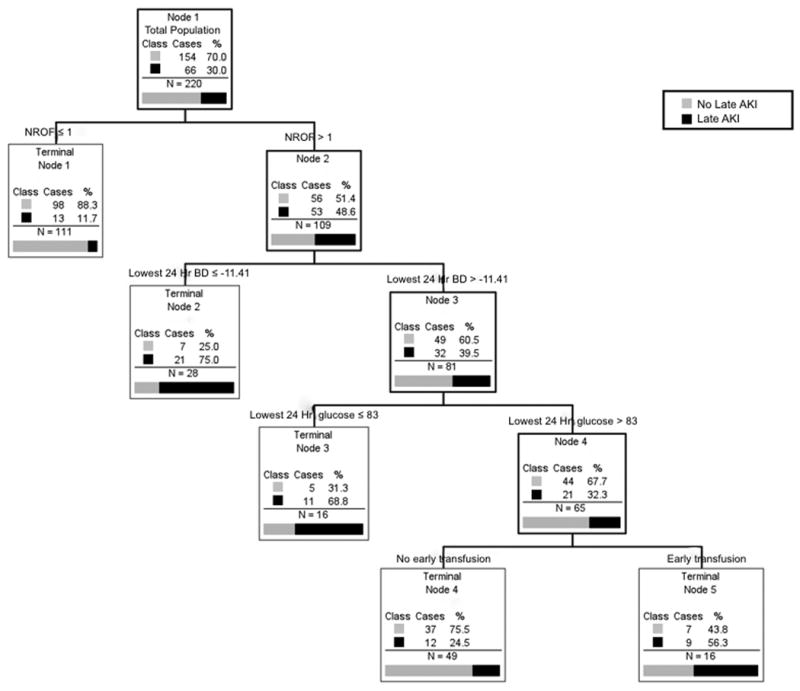
Historically, acute kidney injury (AKI) carried a deadly prognosis in the burn population. The aim of this study is to provide a modern description of AKI in the burn population and to develop a prediction tool for identifying patients at risk for late AKI. A large multi-institutional database, the Glue Grant's Trauma-Related Database, was used to characterize AKI in a cohort of critically ill burn patients. The authors defined AKI according to the RIFLE criteria and categorized AKI as early, late, or progressive. They then used Classification and Regression Tree (CART) analysis to create a decision tree with data obtained from the first 48 hours of admission to predict which subset of patients would develop late AKI. The accuracy of this decision tree was tested in a separate, single-institution cohort of burn patients who met the same criteria for entry into the Glue Grant study. Of the 220 total patients analyzed from the Glue Grant cohort, 49 (22.2%) developed early AKI, 39 (17.7%) developed late AKI, and 16 (7.2%) developed progressive AKI. The group with progressive AKI was statistically older, with more comorbidities and with the worst survival when compared with those with early or late AKI. Using CART analysis, a decision tree was developed with an overall accuracy of 80% for the development of late AKI for the Glue Grant dataset. The authors then tested this decision tree on a smaller dataset from our own institution to validate this tool and found it to be 73% accurate. AKI is common in severe burns with notable differences between early, late, and progressive AKI. In addition, CART analysis provided a predictive model for early identification of patients at highest risk for developing late AKI with proven clinical accuracy.
Figures
References
-
- Holm C, Horbrand F, von Donnersmarck GH, et al. Acute renal failure in severely burned patients. Burns. 1999;25:171–8. - PubMed
-
- Chrysopoulo MT, Jeschke MG, Dziewulski P, et al. Acute renal dysfunction in severely burned adults. J Trauma. 1999;46:141–4. - PubMed
-
- Vertel RM, Knochel JP. Nonoliguric acute renal failure. JAMA. 1967;200:598–602. - PubMed
-
- Davies DM, Pusey CD, Rainford DJ, et al. Acute renal failure in burns. J Plast Reconstr Surg. 1979;13:189–92. - PubMed
-
- Davies MP, Evans J, McGonigle RJS. The dialysis debate: acute renal failure in burns patients. Burns. 1994;20:71–3. - PubMed
Publication types
MeSH terms
Grants and funding
LinkOut - more resources
Full Text Sources
Medical
Miscellaneous
