


Impact of an active video game on healthy children's physical activity
- PMID: 22371457
- PMCID: PMC3289528
- DOI: 10.1542/peds.2011-2050
Impact of an active video game on healthy children's physical activity
Abstract
Objective: This naturalistic study tests whether children receiving a new (to them) active video game spontaneously engage in more physical activity than those receiving an inactive video game, and whether the effect would be greater among children in unsafe neighborhoods, who might not be allowed to play outside.
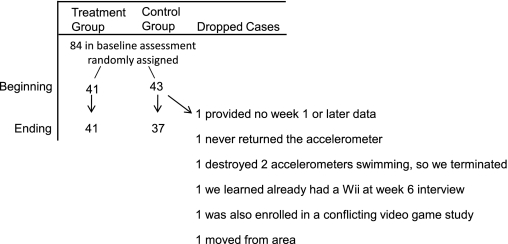
Methods: Participants were children 9 to 12 years of age, with a BMI >50th percentile, but <99th percentile; none of these children a medical condition that would preclude physical activity or playing video games. A randomized clinical trial assigned children to receiving 2 active or 2 inactive video games, the peripherals necessary to run the games, and a Wii console. Physical activity was monitored by using accelerometers for 5 weeks over the course of a 13-week experiment. Neighborhood safety was assessed with a 12 item validated questionnaire.
Results: There was no evidence that children receiving the active video games were more active in general, or at anytime, than children receiving the inactive video games. The outcomes were not moderated by parent perceived neighborhood safety, child BMI z score, or other demographic characteristics.
Conclusions: These results provide no reason to believe that simply acquiring an active video game under naturalistic circumstances provides a public health benefit to children.
Trial registration: ClinicalTrials.gov NCT01024153.
Figures
References
-
- Sallis JF. Age-related decline in physical activity: a synthesis of human and animal studies. Med Sci Sports Exerc. 2000;32(9):1598–1600 - PubMed
-
- Troiano RP, Berrigan D, Dodd KW, Mâsse LC, Tilert T, McDowell M. Physical activity in the United States measured by accelerometer. Med Sci Sports Exerc. 2008;40(1):181–188 - PubMed
-
- Molnar BE, Gortmaker SL, Bull FC, Buka SL. Unsafe to play? Neighborhood disorder and lack of safety predict reduced physical activity among urban children and adolescents. Am J Health Promot. 2004;18(5):378–386 - PubMed
-
- Baranowski T, Thompson WO, DuRant RH, Baranowski J, Puhl J. Observations on physical activity in physical locations: age, gender, ethnicity, and month effects. Res Q Exerc Sport. 1993;64(2):127–133 - PubMed
-
- Whitaker RC, Wright JA, Pepe MS, Seidel KD, Dietz WH. Predicting obesity in young adulthood from childhood and parental obesity. N Engl J Med. 1997;337(13):869–873 - PubMed
Publication types
MeSH terms
Associated data
Grants and funding
LinkOut - more resources
Full Text Sources
Other Literature Sources
Medical
