. 2012 Mar 13;109(11):4257-62.
doi: 10.1073/pnas.1119803109. Epub 2012 Feb 27.

Noonan syndrome-causing SHP2 mutants inhibit insulin-like growth factor 1 release via growth hormone-induced ERK hyperactivation, which contributes to short stature

Affiliations

Noonan syndrome-causing SHP2 mutants inhibit insulin-like growth factor 1 release via growth hormone-induced ERK hyperactivation, which contributes to short stature

Audrey De Rocca Serra-Nédélec et al. Proc Natl Acad Sci U S A. .

Abstract

Noonan syndrome (NS), a genetic disease caused in half of cases by activating mutations of the tyrosine phosphatase SHP2 (PTPN11), is characterized by congenital cardiopathies, facial dysmorphic features, and short stature. How mutated SHP2 induces growth retardation remains poorly understood. We report here that early postnatal growth delay is associated with low levels of insulin-like growth factor 1 (IGF-1) in a mouse model of NS expressing the D61G mutant of SHP2. Conversely, inhibition of SHP2 expression in growth hormone (GH)-responsive cell lines results in increased IGF-1 release upon GH stimulation. SHP2-deficient cells display decreased ERK1/2 phosphorylation and rat sarcoma (RAS) activation in response to GH, whereas expression of NS-associated SHP2 mutants results in ERK1/2 hyperactivation in vitro and in vivo. RAS/ERK1/2 inhibition in SHP2-deficient cells correlates with impaired dephosphorylation of the adaptor Grb2-associated binder-1 (GAB1) on its RAS GTPase-activating protein (RASGAP) binding sites and is rescued by interfering with RASGAP recruitment or function. We demonstrate that inhibition of ERK1/2 activation results in an increase of IGF-1 levels in vitro and in vivo, which is associated with significant growth improvement in NS mice. In conclusion, NS-causing SHP2 mutants inhibit GH-induced IGF-1 release through RAS/ERK1/2 hyperactivation, a mechanism that could contribute to growth retardation. This finding suggests that, in addition to its previously shown beneficial effect on NS-linked cardiac and craniofacial defects, RAS/ERK1/2 modulation could also alleviate the short stature phenotype in NS caused by PTPN11 mutations.


Conflict of interest statement

The authors declare no conflict of interest.

Figures

Fig. 1.
Fig. 1.
Growth retardation in NS mice correlates with lower IGF-1 level. (A and B) NS and WT mice were measured (A) and weighted (B) at indicated ages. (C) Blood IGF-1 levels of NS and WT mice were determined by ELISA at the indicated ages. Individual values and mean ± SEM are shown. Statistical significance was assessed by the ANOVA plus Bonferroni posttest. (D) Sera from 3-wk-old NS and WT mice were analyzed for IGF-1, IGF-BP3, insulin, and cortisol levels by ELISA. No. of animals (WT/NS): week 1: 18/10; week 2: 13/10; week 3: 23/14; week 4: 21/15; week 5: 15/13; week 6: 17/10.
Fig. 2.
Fig. 2.
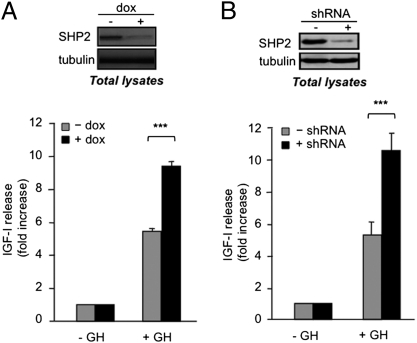
SHP2 negatively regulates GH-induced IGF-1 expression. (A) Confluent, insulin-primed, 3T3F442A ΔSHP2ind cells were treated with doxycycline (+dox) or left untreated (−dox), serum deprived, and stimulated with GH for 24 h. (Upper) Aliquots of cells were processed for Western blot analysis as indicated. (Lower) IGF-1 concentrations in the media were measured by ELISA. (B) Same experiment as in A using doxycycline-treated 3T3F442A ΔSHP2ind cells (+shRNA) and 3T3F442A GFPind (−shRNA).
Fig. 3.
Fig. 3.
SHP2 promotes GH-evoked ERK1/2 activation, but does not influence the JAK2/STAT5 or PI3K/Akt pathways. (A and B) 3T3F442A ΔSHP2ind cells were treated with doxycycline (+dox) or left untreated (−dox), serum-starved, and then stimulated with GH during the indicated times, lysed and processed for Western blot analysis. (C and D) HEKGHR-GFP or HEKGHR-shRNA cells were processed as in A. (E and F) 3T3F442A cells were infected with adenoviruses encoding GFP, His-tagged SHP2-WT or SHP2-C459G, and then processed as in A. (B, D, and F) Quantifications of P-ERK1/2 Western blots from experiments described in A, C, and E.
Fig. 4.
Fig. 4.
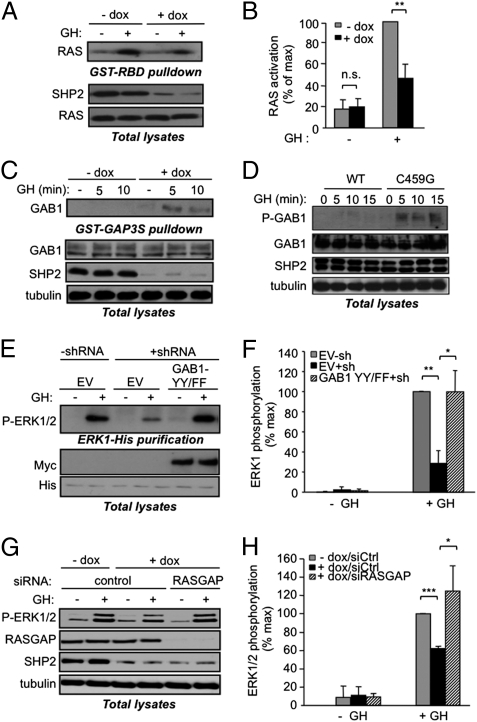
SHP2 controls GH-induced RAS activation by inhibiting RASGAP recruitment. (A and B) 3T3F442A ΔSHP2ind cells were processed as in Fig. 3A and GH stimulated for 10 min. Activated RAS was isolated from cleared lysates using a GST-RBD fusion protein. An anti-RAS Western blot was performed on the GST-RBD pull-downs and on lysates. (C) Cells were treated as in A, except that a GST-RASGAP fusion protein was used and an anti-GAB1 Western blot was performed. (D) 3T3F442A cells were infected with adenoviruses encoding SHP2-WT or SHP2-C459G, stimulated for the indicated times, lysed, and processed for indicated Western blotting (P-GAB1: phospho Y307). (E and F) HEKGHR (−shRNA) and HEKGHR-sh (+shRNA) cells were transfected with ERK1-His and empty vector (EV) as a control or a Myc-tagged GAB1 Y307F/Y317F mutant (GAB1-YYFF), serum starved, and stimulated with GH for 10 min; indicated Western blots were performed on purified ERK1-His (E Upper) and on lysate aliquots (E Lower). (G and H) 3T3F442A ΔSHP2ind were treated with doxycycline (+dox) or left untreated (−dox), transfected with control or anti-RASGAP siRNA, serum starved, then GH stimulated for 10 min and processed for Western blot analysis. (B, F, and H) Quantification of immunoblots described in A, E, and G.
Fig. 5.
Fig. 5.
NS-associated SHP2 mutants enhance GH-induced ERK1/2 activation. (A and B) HEKGHR cells were cotransfected with ERK1-His and His-tagged SHP2 WT, D61del, or N308D variants, or the empty vector (−), and then processed as in Fig. 4E. (C and D) 3T3F442A cells were infected with adenoviruses encoding GFP, SHP2-N308D, or SHP2-D61del, serum starved, then GH stimulated for 10 min and processed for indicated Western blot analysis. (E and F) Untreated (−dox) or 0.005 μg/mL doxycycline-treated (+dox) 3T3F442A ΔSHP2/N308D and 3T3F442A ΔSHP2/D61del cells were GH stimulated for 10 min, lysed, and processed for indicated Western blot analysis. (G and H) Fasted WT and NS mice were injected i.p. with 8 μg/g GH (+) or PBS (−) for 10 min, and then euthanized. Equal amounts of protein from liver extracts were processed for Western blot analysis. (B, D, F, and H) Quantification of immunoblots described in A, C, E, and G. Only significant differences vs. control are indicated.
Fig. 6.
Fig. 6.
MEK inhibition partially restores IGF-1 level in vitro and in vivo and increases growth of NS mice. (A) 3T3F442A cells were serum starved overnight, then treated with the indicated doses of U0126, stimulated with GH for 10 min, lysed, and processed for indicated Western blot analysis. (B) Confluent, insulin-primed 3T3F442A cells were treated with the indicated doses of U0126, stimulated with GH for 24 h, and then IGF-1 concentrations were measured by ELISA. (C–E) At 5 d after delivery, nursing females were injected i.p. daily for 20 d with U0126 or vehicle, and then blood IGF-1 levels in the pups were determined by ELISA (C), as was their body length (D) and weight (E). Four litters were used, with equivalent animal numbers and body weights at birth (no. of animals: WT/PBS: 5; WT/U0126: 5; NS/PBS: 9; NS/U0126: 8).

References

    1. Romano AA, et al. Noonan syndrome: Clinical features, diagnosis, and management guidelines. Pediatrics. 2010;126:746–759. - PubMed
    1. Tartaglia M, Gelb BD, Zenker M. Noonan syndrome and clinically related disorders. Best Pract Res Clin Endocrinol Metab. 2011;25:161–179. - PMC - PubMed
    1. Tidyman WE, Rauen KA. The RASopathies: Developmental syndromes of Ras/MAPK pathway dysregulation. Curr Opin Genet Dev. 2009;19:230–236. - PMC - PubMed
    1. Tartaglia M, et al. Mutations in PTPN11, encoding the protein tyrosine phosphatase SHP-2, cause Noonan syndrome. Nat Genet. 2001;29:465–468. - PubMed
    1. Edouard T, et al. How do Shp2 mutations that oppositely influence its biochemical activity result in syndromes with overlapping symptoms? Cell Mol Life Sci. 2007;64:1585–1590. - PMC - PubMed

Publication types

MeSH terms

Substances