


Routine blood tests to predict liver fibrosis in chronic hepatitis C
- PMID: 22371634
- PMCID: PMC3286137
- DOI: 10.3748/wjg.v18.i8.746
Routine blood tests to predict liver fibrosis in chronic hepatitis C
Abstract
Aim: To verify the usefulness of FibroQ for predicting fibrosis in patients with chronic hepatitis C, compared with other noninvasive tests.
Methods: This retrospective cohort study included 237 consecutive patients with chronic hepatitis C who had undergone percutaneous liver biopsy before treatment. FibroQ, aspartate aminotransferase (AST)/alanine aminotransferase ratio (AAR), AST to platelet ratio index, cirrhosis discriminant score, age-platelet index (API), Pohl score, FIB-4 index, and Lok's model were calculated and compared.
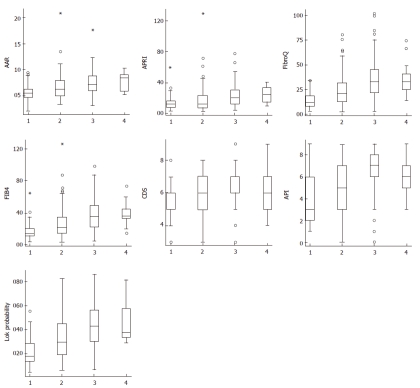
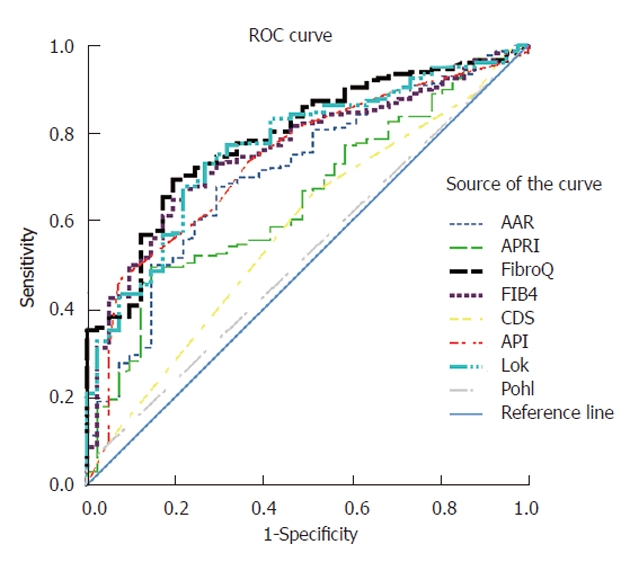
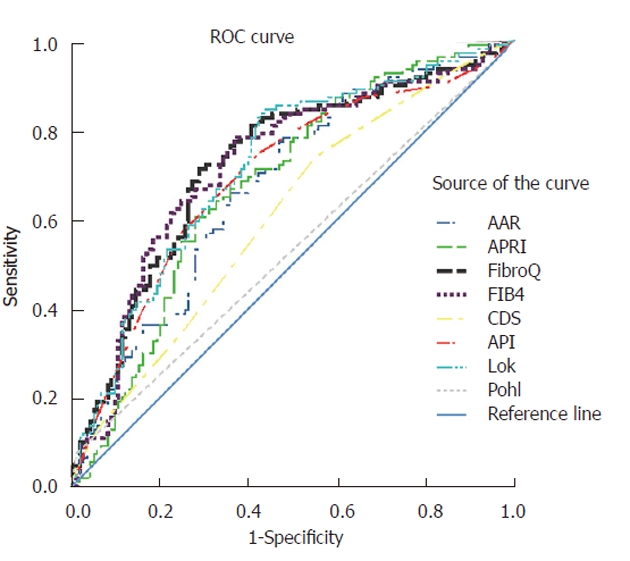
Results: FibroQ, FIB-4, AAR, API and Lok's model results increased significantly as fibrosis advanced (analysis of variance test: P < 0.001). FibroQ trended to be superior in predicting significant fibrosis score in chronic hepatitis C compared with other noninvasive tests.
Conclusion: FibroQ is a simple and useful test for predicting significant fibrosis in patients with chronic hepatitis C.
Keywords: Alanine aminotransferase; Aspartate aminotransferase; Aspartate aminotransferase to platelet ratio index; Cirrhosis discriminant score; FIB-4 index; FibroQ; Liver fibrosis; Lok’s model; Noninvasive test; Pohl score.
Figures
References
-
- Hepatitis C--global prevalence (update) Wkly Epidemiol Rec. 2000;75:18–19. - PubMed
-
- Seeff LB. Natural history of hepatitis C. Am J Med. 1999;107:10S–15S. - PubMed
-
- EASL International Consensus Conference on hepatitis C. Paris, 26-27 February 1999. Consensus statement. J Hepatol. 1999;31 Suppl 1:3–8. - PubMed
-
- National Institutes of Health Consensus Development Conference Statement: Management of hepatitis C: 2002--June 10-12, 2002. Hepatology. 2002;36:S3–20. - PubMed
-
- Bonino F, Oliveri F, Colombatto P, Coco B, Mura D, Realdi G, Brunetto MR. Treatment of patients with chronic hepatitis C and cirrhosis. J Hepatol. 1999;31 Suppl 1:197–200. - PubMed
Publication types
MeSH terms
LinkOut - more resources
Full Text Sources
Medical
