. 2012 Jul;20(7):1384-92.
doi: 10.1038/mt.2012.34. Epub 2012 Feb 28.

Protein-anchoring strategy for delivering acetylcholinesterase to the neuromuscular junction

Affiliations

Protein-anchoring strategy for delivering acetylcholinesterase to the neuromuscular junction

Mikako Ito et al. Mol Ther. 2012 Jul.

Abstract

Acetylcholinesterase (AChE) at the neuromuscular junction (NMJ) is anchored to the synaptic basal lamina via a triple helical collagen Q (ColQ). Congenital defects of ColQ cause endplate AChE deficiency and myasthenic syndrome. A single intravenous administration of adeno-associated virus serotype 8 (AAV8)-COLQ to Colq(-/-) mice recovered motor functions, synaptic transmission, as well as the morphology of the NMJ. ColQ-tailed AChE was specifically anchored to NMJ and its amount was restored to 89% of the wild type. We next characterized the molecular basis of this efficient recovery. We first confirmed that ColQ-tailed AChE can be specifically targeted to NMJ by an in vitro overlay assay in Colq(-/-) mice muscle sections. We then injected AAV1-COLQ-IRES-EGFP into the left tibialis anterior and detected AChE in noninjected limbs. Furthermore, the in vivo injection of recombinant ColQ-tailed AChE protein complex into the gluteus maximus muscle of Colq(-/-) mice led to accumulation of AChE in noninjected forelimbs. We demonstrated for the first time in vivo that the ColQ protein contains a tissue-targeting signal that is sufficient for anchoring itself to the NMJ. We propose that the protein-anchoring strategy is potentially applicable to a broad spectrum of diseases affecting extracellular matrix molecules.


Figures
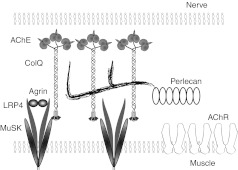
Figure 1
Figure 1
Schematic of anchoring of collagen Q (ColQ) to neuromuscular junction (NMJ). Twelve catalytic subunits of acetylcholinesterase (AChE) are attached to ColQ to form ColQ-tailed AChE. Two heparan sulfate proteoglycan-binding domains of ColQ are bound to perlecan. C-terminal domain of ColQ is bound to muscle-specific kinase (MuSK). Nerve-derived agrin binds to an LRP4–MuSK complex and induces rapsyn-mediated clustering of acetylcholine receptors (AChR) by phosphorylating AChR.
Figure 2
Figure 2
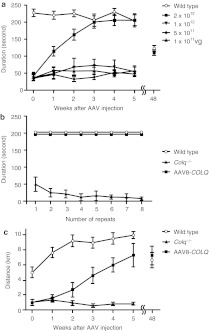
Exploration of motor function after intravenous injection of AAV8-ColQ to the tail vein of Colq−/− mice. (a) Motor function on the rotarod. The rotation was linearly accelerated from 0 to 40 r.p.m. in 240 seconds. Five groups of six mice were studied. Each group consisted of 4-week old mice and was either injected or not (control group) with increasing numbers of viral particles. Three weeks after their AAV8-COLQ injection, only the group of mice treated with 2 × 10¹² vg remained on the rod as long as the wild-type littermates. Importantly, there was a progressive motor function recovery during the first 3 weeks after injection of Colq−/− mice. Symbols indicate mean and SE of six mice for each experiment. Mean and SE of the durations on the rotarod of two treated mice at 48 weeks after treatment is indicated along with that of the four age-matched wild-type mice. (b) Fatigue test using the rotarod was performed on three groups of a total of 18 mice. The rotation speed was fixed at 10 r.p.m. and the mice were immediately placed back on the rod each time they fell. Mice injected with 2 × 10¹² vg exhibited no fatigue at 6 weeks after injection, whereas untreated Colq−/− mice fell increasingly more rapidly off the rod. (c) Voluntary movements were quantified by a counter-equipped running wheel. Plots show mean and SE of the number of rotations over 24 hours in each group of six mice (wild type, Colq−/−, and AAV8-COLQ). Only the group of mice treated with 2 × 10¹² vg increased the number of rotations every week but they did not reach the level of wild-type mice at 5 weeks after injection. Mean and SE of the number of rotations of two treated mice at 48 weeks after treatment is indicated along with that of the four age-matched wild-type mice. AAV8, adeno-associated virus serotype 8; ColQ, collagen Q.
Figure 3
Figure 3
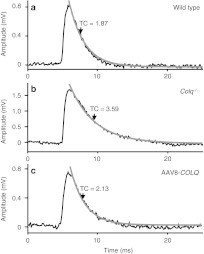
Representative miniature endplate potential (MEPP) recordings of diaphragm muscles of (a) wild type, (b) Colq−/−, and (c) AAV8-COLQ-treated mice. (b) Colq−/− mice have higher MEPP amplitude and a longer decay time constant (TC) than (a) wild-type mice. AAV8-COLQ treatment shortened the decay TC and lowered the MEPP amplitude. Gray lines represent fitted exponential decay curves. AAV8, adeno-associated virus serotype 8; ColQ, collagen Q.
Figure 4
Figure 4
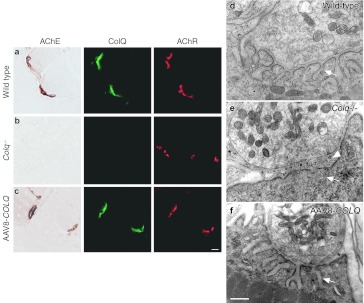
Histologies and ultrastructures of the neuromuscular junctions (NMJs). Localization of acetylcholinesterase (AChE) activity, collagen Q (ColQ), and acetylcholine receptors (AChR) in quadriceps muscles of (a) wild type, (b) Colq−/−, and (c) AAV8-COLQ mice. Mice treated with 2 × 10¹² vg of intravenous AAV8-COLQ express ColQ-tailed AChE at NMJ. AChE is stained for its activity. ColQ and AChR are detected by the polyclonal anti-ColQ antibody and α-bungarotoxin, respectively. Bar = 10 µm (ac). Representative stainings of six mice in each group are indicated. Ultrastructures of soleus muscle NMJ (d–f). (e) Colq−/− mice show simplified synaptic clefts (arrow) and widening of the synaptic space (arrow head), whereas the NMJ ultrastructure of AAV8-COLQ mice (f) is indistinguishable from that of wild type (d). AAV8-COLQ mice still have small nerve terminals and invaginated Schwann cells (*). Bar = 1 µm (d–f). Representative ultrastructures of 27–41 electron micrograph (EM) pictures (see Supplementary Table S1) are indicated. AAV8, adeno-associated virus serotype 8.
Figure 5
Figure 5
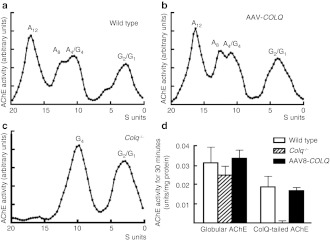
Quantification and biochemical analysis of acetylcholinesterase (AChE) recovery in muscles. Intravenous injection of 2 × 10¹² vg of AAV8-COLQ into (b) Colq−/− mice gives rise to a sedimentation profile that is identical to that of (a) wild type, whereas (c) Colq−/− mice carry no collagen Q (ColQ)-tailed AChE. A4, A8, and A12 species carry 4, 8, and 12 AChE catalytic subunits attached to a triple helical ColQ. G1, G2, and G4 species carry 1, 2, and 4 AChE catalytic subunits but without ColQ. A representative profile of three experiments is indicated. (d) Quantification of globular and ColQ-tailed AChE species (mean and SD, n = 4). The activity of ColQ-tailed AChE in the skeletal muscle of AAV8-COLQ mice is restored to 89 ± 10% of that of wild type. AAV8, adeno-associated virus serotype 8.
Figure 6
Figure 6
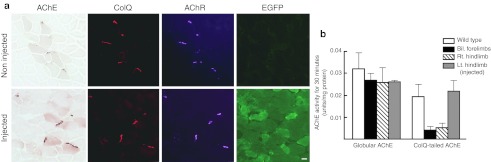
Intramuscular injection of 2 × 10¹¹ vg of AAV1-COLQ-IRES-EGFP into the left anterior tibial muscle of Colq−/− mice. (a) Acetylcholinesterase (AChE) activity and collagen Q (ColQ) are colocalized to the acetylcholine receptors (AChR) in the injected muscle, as well as in the noninjected triceps muscle, although the signal intensities are not as high as those of the injected muscle. In contrast to ColQ, an intracellular molecule, enhanced green fluorescent protein (EGFP), is expressed only in the injected muscle, but not in the noninjected muscle. Bar = 10 µm. (b) Quantification of globular and ColQ-tailed AChE species of skeletal muscles (mean and SD, n = 4). In the injected left hindlimb, the activity of ColQ-tailed AChE is similar to that of wild type. In the noninjected both forelimbs and right hindlimb, the activities are 21.5 and 28.4% of wild type, respectively. AAV1, adeno-associated virus serotype 1.
Figure 7
Figure 7
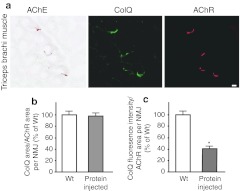
Injection of purified recombinant human collagen Q (ColQ)- tailed acetylcholinesterase (AChE). (a) Daily injection of 0.2 µg human recombinant ColQ-tailed AChE into the gluteus maximus muscles of Colq−/− mice rescues AChE activity and ColQ in the noninjected triceps where they are colocalized to acetylcholine receptors (AChR). Bar = 10 µm. (b) The size of ColQ-positive area is normalized for the size of AChR-positive area at the neuromuscular junctions (NMJs) of noninjected triceps. (c) Signal intensities of ColQ at the NMJs of noninjected triceps. Mean and SE are indicated. WT, wild-type mice, number of NMJs = 43; Protein injected, mice injected with ColQ-tailed AChE, number of NMJs = 42. *P < 0.001. Signal intensities are normalized to that of Colq−/− mice. Quantitative analyses were performed with the BZ-9000 microscope and the Dynamic Cell Count software BZ-H1C (Keyence).

References

    1. Krejci E, Thomine S, Boschetti N, Legay C, Sketelj J., and, Massoulié J. The mammalian gene of acetylcholinesterase-associated collagen. J Biol Chem. 1997;272:22840–22847. - PubMed
    1. Rotundo RL. Asymmetric acetylcholinesterase is assembled in the Golgi apparatus. Proc Natl Acad Sci USA. 1984;81:479–483. - PMC - PubMed
    1. Ruiz CA., and, Rotundo RL. Limiting role of protein disulfide isomerase in the expression of collagen-tailed acetylcholinesterase forms in muscle. J Biol Chem. 2009;284:31753–31763. - PMC - PubMed
    1. Deprez P, Inestrosa NC., and, Krejci E. Two different heparin-binding domains in the triple-helical domain of ColQ, the collagen tail subunit of synaptic acetylcholinesterase. J Biol Chem. 2003;278:23233–23242. - PubMed
    1. Peng HB, Xie H, Rossi SG., and, Rotundo RL. Acetylcholinesterase clustering at the neuromuscular junction involves perlecan and dystroglycan. J Cell Biol. 1999;145:911–921. - PMC - PubMed

Publication types

MeSH terms

LinkOut - more resources