


Hypnotics' association with mortality or cancer: a matched cohort study
- PMID: 22371848
- PMCID: PMC3293137
- DOI: 10.1136/bmjopen-2012-000850
Hypnotics' association with mortality or cancer: a matched cohort study
Abstract
Objectives: An estimated 6%-10% of US adults took a hypnotic drug for poor sleep in 2010. This study extends previous reports associating hypnotics with excess mortality.
Setting: A large integrated health system in the USA.
Design: Longitudinal electronic medical records were extracted for a one-to-two matched cohort survival analysis.
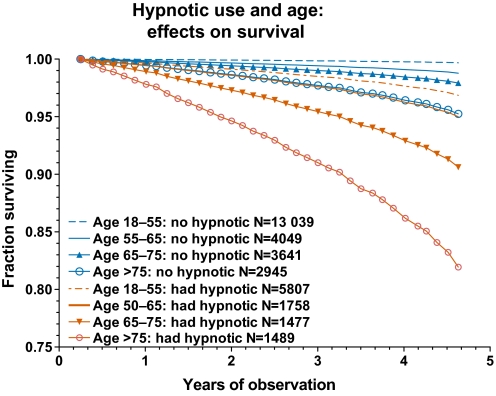
Subjects: Subjects (mean age 54 years) were 10 529 patients who received hypnotic prescriptions and 23 676 matched controls with no hypnotic prescriptions, followed for an average of 2.5 years between January 2002 and January 2007.
Main outcome measures: Data were adjusted for age, gender, smoking, body mass index, ethnicity, marital status, alcohol use and prior cancer. Hazard ratios (HRs) for death were computed from Cox proportional hazards models controlled for risk factors and using up to 116 strata, which exactly matched cases and controls by 12 classes of comorbidity.
Results: As predicted, patients prescribed any hypnotic had substantially elevated hazards of dying compared to those prescribed no hypnotics. For groups prescribed 0.4-18, 18-132 and >132 doses/year, HRs (95% CIs) were 3.60 (2.92 to 4.44), 4.43 (3.67 to 5.36) and 5.32 (4.50 to 6.30), respectively, demonstrating a dose-response association. HRs were elevated in separate analyses for several common hypnotics, including zolpidem, temazepam, eszopiclone, zaleplon, other benzodiazepines, barbiturates and sedative antihistamines. Hypnotic use in the upper third was associated with a significant elevation of incident cancer; HR=1.35 (95% CI 1.18 to 1.55). Results were robust within groups suffering each comorbidity, indicating that the death and cancer hazards associated with hypnotic drugs were not attributable to pre-existing disease.
Conclusions: Receiving hypnotic prescriptions was associated with greater than threefold increased hazards of death even when prescribed <18 pills/year. This association held in separate analyses for several commonly used hypnotics and for newer shorter-acting drugs. Control of selective prescription of hypnotics for patients in poor health did not explain the observed excess mortality.
Conflict of interest statement
Figures
Comment in
-
ACP Journal Club. Hypnotic drugs were associated with increased risk for mortality.Ann Intern Med. 2012 Jun 19;156(12):JC6-13. doi: 10.7326/0003-4819-156-12-201206190-02013. Ann Intern Med. 2012. PMID: 22711114 No abstract available.
-
Hypnotics and mortality risk.J Clin Sleep Med. 2012 Aug 15;8(4):351-2. doi: 10.5664/jcsm.2016. J Clin Sleep Med. 2012. PMID: 22893762 Free PMC article. No abstract available.
-
Climacteric commentaries. Better sleep but higher mortality risk.Climacteric. 2012 Aug;15(4):401. Climacteric. 2012. PMID: 22950121 No abstract available.
References
-
- International Narcotics Control Board Psychotropic Substances: Statistics for 2008; Assessments of Annual Medical and Scientific Requirements for Substances in Schedules II, III and IV of the Convention on Psychotropic Substances of 1971. New York: United Nations, 2010
-
- Petersen A. Dawn of a new sleep drug? Wall St J 2011:D1–4
-
- Hammond EC. Smoking in relation to the death rates of one million men and women. Natl Cancer Inst Monogr 1966;19:127–204 - PubMed
-
- Kripke DF, Simons RN, Garfinkel L, et al. Short and long sleep and sleeping pills: is increased mortality associated? Arch Gen Psychiatry 1979;36:103–16 - PubMed
-
- Merlo J, Hedblad B, Ogren M, et al. Increased risk of ischaemic heart disease mortality in elderly men using anxiolytics-hypnotics and analgesics. Eur J Clin Pharmacol 1996;49:261–5 - PubMed
LinkOut - more resources
Full Text Sources
Medical
Research Materials
