


The relationship of peripheral arterial disease and metabolic syndrome prevalence in asymptomatic US adults 40 years and older: results from the National Health and Nutrition Examination Survey (1999-2004)
- PMID: 22372773
- PMCID: PMC8108912
- DOI: 10.1111/j.1751-7176.2011.00580.x
The relationship of peripheral arterial disease and metabolic syndrome prevalence in asymptomatic US adults 40 years and older: results from the National Health and Nutrition Examination Survey (1999-2004)
Abstract
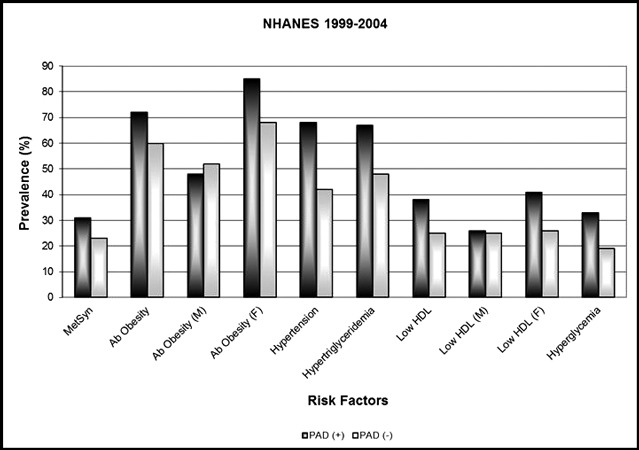
Peripheral arterial disease (PAD) is a subclinical marker of coronary artery disease and identifies asymptomatic individuals at high risk for cardiovascular disease (CVD) events. The metabolic syndrome (MetS) is a constellation of clinical factors that increases the risk of developing diabetes and CVD. The authors' objectives were to estimate the prevalence of MetS in patients with PAD and to determine the prevalence of PAD in the population of asymptomatic US adults 40 years and older with MetS. The authors analyzed data from 3 National Health and Nutrition Examination Surveys (NHANES, 1999-2004). Prevalence of MetS as defined by the Third Report of the Adult Treatment Panel criteria and prevalence of associated cardiac risk factors were determined in 5376 asymptomatic participants 40 years and older. Presence of PAD was defined as ankle-brachial index <0.9. Estimates were weighted with the sample weights accounting for the unequal selection probability of complex NHANES sampling and over sampling of selected population subgroups. Prevalence of PAD in asymptomatic US adults 40 years and older was 4.2%. PAD prevalence in persons with MetS was 7.0% compared with 3.3% in persons without MetS. A total of 38% of the population with PAD also had MetS. High rates of abdominal obesity, hypertension, hyperglycemia, and low high-density lipoprotein cholesterol are significant contributors to both MetS and PAD. Persons with MetS have twice the risk of having PAD. Of persons with PAD, almost 40% have MetS. The presence of either PAD or MetS should warrant screening for both conditions so that risk stratification and management of risk factors may be performed.
© 2012 Wiley Periodicals, Inc.
Figures
References
-
- Wild SH, Byrne CD, Smith FB, et al. Low ankle‐brachial pressure index predicts increased risk of cardiovascular disease independent of the metabolic syndrome and conventional cardiovascular risk factors in the Edinburgh Artery Study. Diabetes Care. 2006;29:637–642. - PubMed
-
- Feringa HH, Karagiannis SE, Schouten O, et al. Prognostic significance of declining ankle‐brachial index values in patients with suspected or known peripheral arterial disease. Eur J Vas Endovasc Surg. 2007;34:206–213. - PubMed
-
- Sutton‐Tyrrell K, Venkitachalam L, Kanaya AM, et al. The Health, Aging, and Body Composition Study. Stroke. 2008;39:863–869. - PubMed
-
- Makowsky MJ, McAlister FA, Galbraith PD, et al. Lower extremity peripheral arterial disease in individuals with coronary artery disease: prognostic importance care gaps, and impact of therapy. Am Heart J. 2008;155:348–355. - PubMed
MeSH terms
LinkOut - more resources
Full Text Sources
Medical
