. 2012 Mar;87(3):279-84.
doi: 10.1097/ACM.0b013e318244838a.

A roadmap for academic health centers to establish good laboratory practice-compliant infrastructure

Affiliations

A roadmap for academic health centers to establish good laboratory practice-compliant infrastructure

Joan E Adamo et al. Acad Med. 2012 Mar.

Abstract

Prior to human clinical trials, nonclinical safety and toxicology studies are required to demonstrate that a new product appears safe for human testing; these nonclinical studies are governed by good laboratory practice (GLP) regulations. As academic health centers (AHCs) embrace the charge to increase the translation of basic science research into clinical discoveries, researchers at these institutions increasingly will be conducting GLP-regulated nonclinical studies. Because the consequences for noncompliance are severe and many AHC researchers are unfamiliar with Food and Drug Administration regulations, the authors describe the regulatory requirements for conducting GLP research, including the strict documentation requirements, the necessary personnel training, the importance of study monitoring, and the critical role that compliance oversight plays in the process. They then explain the process that AHCs interested in conducting GLP studies should take before the start of their research program, including conducting a needs assessment and a gap analysis and selecting a model for GLP compliance. Finally, the authors identify and analyze several critical barriers to developing and implementing a GLP-compliant infrastructure at an AHC. Despite these challenges, the capacity to perform such research will help AHCs to build and maintain competitive research programs and to facilitate the successful translation of faculty-initiated research from nonclinical studies to first-in-human clinical trials.


Figures
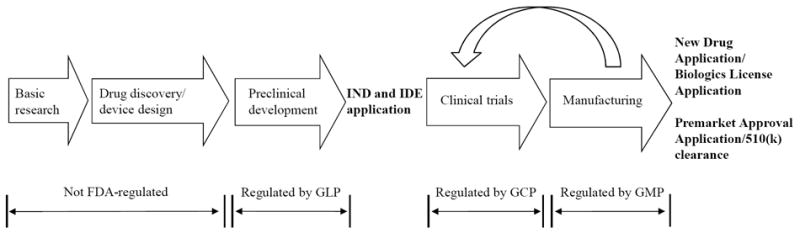
Figure 1
Figure 1
Flow of Food and Drug Administration (FDA)-regulated processes from basic science research to clinical studies and product marketing. FDA regulations are indicated for each stage of the process, starting with preclinical development, which is covered under good laboratory practice (GLP) regulations, followed by clinical studies, which require submission of an Investigational New Drug (IND) or Investigational Device Exemption (IDE) application and are governed by good clinical practice (GCP) regulations. The manufacture of products for marketing under a New Drug Application, Biologics License Application, Premarket Approval Application, or 510(k) clearance for devices and later-stage clinical studies, is governed by good manufacturing practice (GMP) regulations.
Figure 2
Figure 2
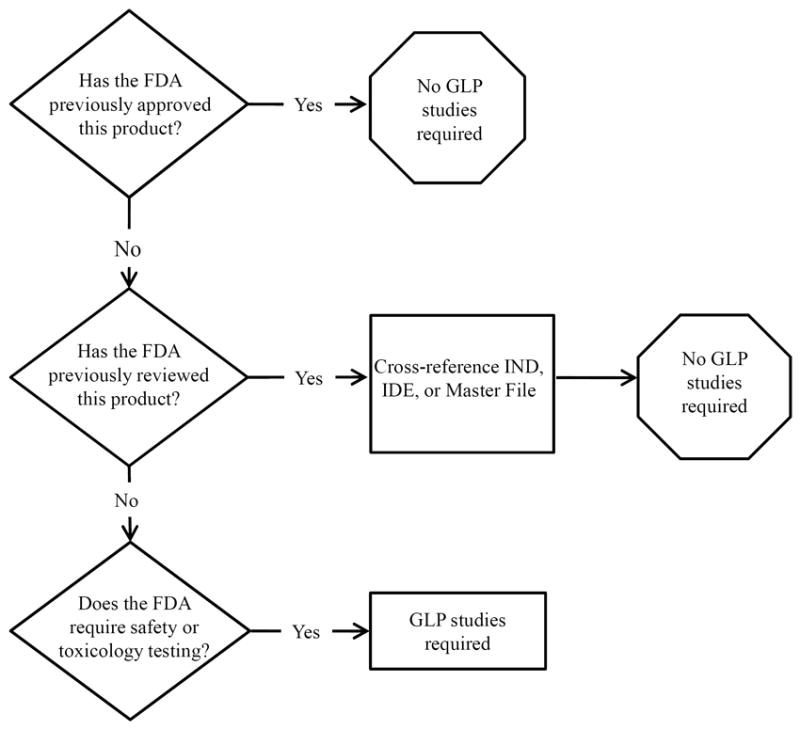
Flowchart for determining whether studies generating nonclinical data intended to support an Investigational New Drug (IND) or Investigational Device Exemption (IDE) submission likely require compliance with Food and Drug Administration (FDA) good laboratory practice (GLP) regulations. This simplified flowchart provides context for GLP studies and is not an exhaustive guide for all GLP requirements.
Figure 3
Figure 3
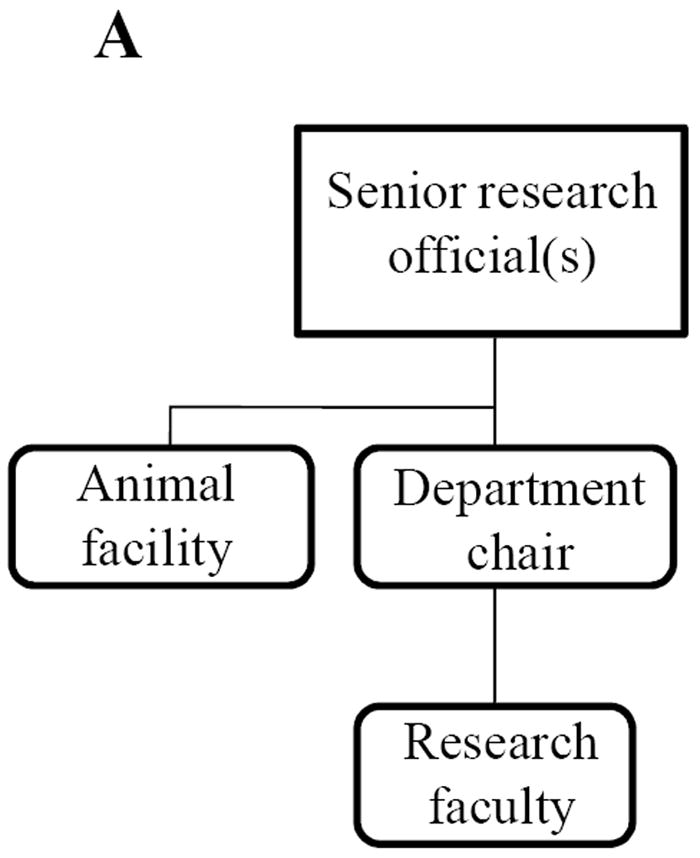
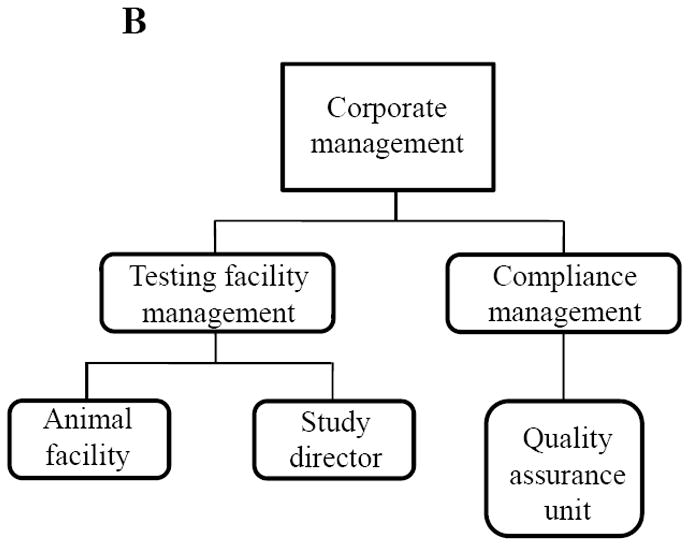
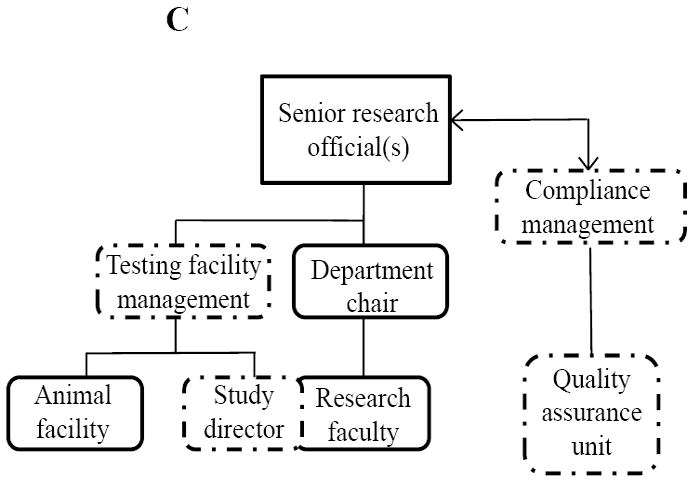
Comparison of the structure of the research organizations at a typical academic health center (AHC) (panel A) and a typical commercial laboratory (panel B). Panel C depicts a potential combination of the two for AHCs conducting research that meets the FDA’s good laboratory practice (GLP) regulations by adding management and oversight functions that are not usually part of the AHC research structure. Dotted lines indicate roles that must be added to comply with GLP regulations. Overlapping dotted and solid lines indicate potential co-located roles. Arrows indicate coordinated responsibilities.
Figure 3
Figure 3
Comparison of the structure of the research organizations at a typical academic health center (AHC) (panel A) and a typical commercial laboratory (panel B). Panel C depicts a potential combination of the two for AHCs conducting research that meets the FDA’s good laboratory practice (GLP) regulations by adding management and oversight functions that are not usually part of the AHC research structure. Dotted lines indicate roles that must be added to comply with GLP regulations. Overlapping dotted and solid lines indicate potential co-located roles. Arrows indicate coordinated responsibilities.
Figure 3
Figure 3
Comparison of the structure of the research organizations at a typical academic health center (AHC) (panel A) and a typical commercial laboratory (panel B). Panel C depicts a potential combination of the two for AHCs conducting research that meets the FDA’s good laboratory practice (GLP) regulations by adding management and oversight functions that are not usually part of the AHC research structure. Dotted lines indicate roles that must be added to comply with GLP regulations. Overlapping dotted and solid lines indicate potential co-located roles. Arrows indicate coordinated responsibilities.

References

    1. Collins FS. Reengineering translational science: the time is right. Sci Transl Med. 2011;3:90cm17. - PMC - PubMed
    1. Berro M. Support for investigator-initiated clinical research involving investigational drugs or devices: the Clinical and Translational Science Award experience. Acad Med. 2011;86:217–223. - PubMed
    1. Hancock S. Meeting the challenges of implementing good laboratory practices compliance in a university setting. Qual Assur J. 2002;6:15–21.
    1. Schneider K. Faking it—the case against industrial bio-test laboratories. The Amicus Journal. 1983 Spring;:14–26.
    1. Baldeshwiler AM. History of FDA good laboratory practices. Qual Assur J. 2003;7:157–161.

Publication types

MeSH terms