


Brain slices from glutaminase-deficient mice metabolize less glutamine: a cellular metabolomic study with carbon 13 NMR
- PMID: 22373647
- PMCID: PMC3345920
- DOI: 10.1038/jcbfm.2012.22
Brain slices from glutaminase-deficient mice metabolize less glutamine: a cellular metabolomic study with carbon 13 NMR
Abstract
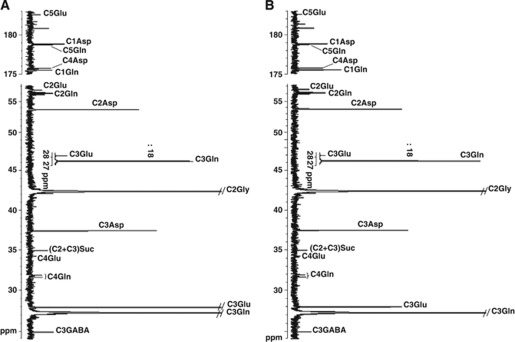
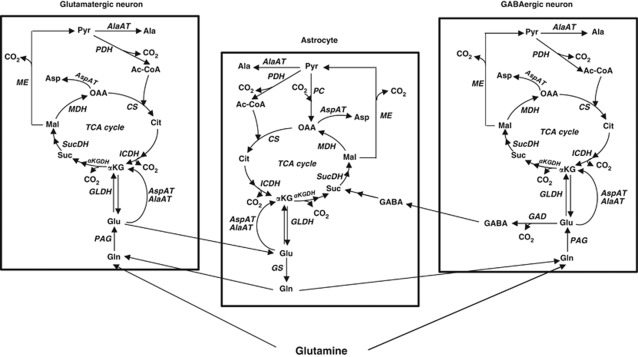
In the brain, glutaminase is considered to have a key role in the provision of glutamate, a major excitatory neurotransmitter. Brain slices obtained from wild-type (control) and glutaminase-deficient (GLS1+/-) mice were incubated without glucose and with 5 or 1 mmol/L [3-(13)C]glutamine as substrate. At the end of the incubation, substrate removal and product formation were measured by both enzymatic and carbon 13 nuclear magnetic resonance ((13)C-NMR) techniques. Slices from GLS1+/- mice consumed less [3-(13)C]glutamine and accumulated less [3-(13)C]glutamate. They also produced less (13)CO(2) but accumulated amounts of (13)C-aspartate and (13)C-gamma-aminobutyric acid (GABA) that were similar to those found with brain slices from control mice. The newly formed glutamine observed in slices from control mice remained unchanged in slices from GLS1+/- mice. As expected, flux through glutaminase in slices from GLS1+/- mice was found diminished. Fluxes through all enzymes of the tricarboxylic acid cycle were also reduced in brain slices from GLS1+/- mice except through malate dehydrogenase with 5 mmol/L [3-(13)C]glutamine. The latter diminutions are consistent with the decreases in the production of (13)CO(2) also observed in the slices from these mice. It is concluded that the genetic approach used in this study confirms the key role of glutaminase for the provision of glutamate.
Figures
References
-
- Aledo JC, Gomez-Fabre PM, Olalla L, Marquez J. Identification of two human glutaminase loci and tissue-specific expression of the two related genes. Mamm Genome. 2000;11:1107–1110. - PubMed
-
- Antal S, Fonagy A, Fulop Z, Hidvegi EJ, Vogel HH., Jr Decreased weight, DNA, RNA and protein content of the brain after neutron irradiation of the 18-day mouse embryo. Int J Radiat Biol Relat Stud Phys Chem Med. 1984;46:425–433. - PubMed
-
- Bak LK, Zieminska E, Waagepetersen HS, Schousboe A, Albrecht J. Metabolism of [U-13C]glutamine and [U-13C]glutamate in isolated rat brain mitochondria suggests functional phosphate-activated glutaminase activity in matrix. Neurochem Res. 2008;33:273–278. - PubMed
-
- Berl S, Clarke D.1983The metabolic compartmentation concept Glutamine, glutamate and GABA in the central nervous system(Hertz LKE, McGeer EG, Schousboe A, eds),New York: Alan R. Liss, Inc; 205–217.
-
- Chauvin MF, Megnin-Chanet F, Martin G, Lhoste JM, Baverel G. The rabbit kidney tubule utilizes glucose for glutamine synthesis. A 13C NMR study. J Biol Chem. 1994;269:26025–26033. - PubMed
MeSH terms
Substances
LinkOut - more resources
Full Text Sources
Molecular Biology Databases
Research Materials
Miscellaneous
