


The association between IGF-I and insulin resistance: a general population study in Danish adults
- PMID: 22374641
- PMCID: PMC3308317
- DOI: 10.2337/dc11-1833
The association between IGF-I and insulin resistance: a general population study in Danish adults
Abstract
Objective: IGF-I has an almost 50% amino acid sequence homology with insulin and elicits nearly the same hypoglycemic response. Studies showed that low and high IGF-I levels are related to impaired glucose tolerance and to a higher risk of type 2 diabetes. The aim of the current study was to evaluate the association between IGF-I level and insulin resistance in a Danish general population.
Research design and methods: Included were 3,354 adults, aged 19-72 years, from the cross-sectional Health2006 study. The homeostasis model assessment of insulin resistance (HOMA-IR) was used as the index to estimate insulin resistance. Serum IGF-I levels were determined by an immunoassay and grouped into quintiles (Q1-Q5). Linear or multinomial logistic regression analyses were performed.
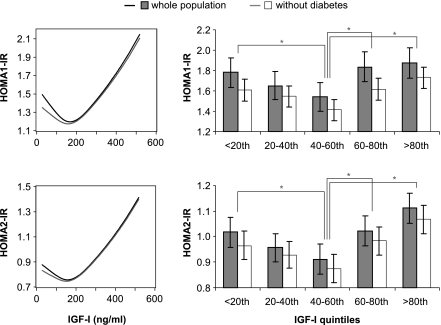
Results: In the study population, 520 subjects (15.5%) had increased HOMA-IR values above 2.5. After adjustment for age, sex, physical activity, and waist-to-height ratio, a U-shaped association between IGF-I and HOMA-IR was found. Low IGF-I (Q1: odds ratio [OR] 1.65 [95% CI 1.16-2.34], P < 0.01) as well as high IGF-I (Q5: 1.96 [1.38-2.79], P < 0.01) levels were related to a higher odds of increased HOMA-IR values compared with subjects with intermediate (Q3) IGF-I levels. These associations remained statistically significant after the exclusion of subjects with type 2 diabetes and by using the updated computer HOMA2-IR model.
Conclusions: Low- and high-normal IGF-I levels are both related to insulin resistance. The biological mechanism of this complex phenomenon has to be elucidated in more detail for future risk stratification.
Figures
References
-
- Jones JI, Clemmons DR. Insulin-like growth factors and their binding proteins: biological actions. Endocr Rev 1995;16:3–34 - PubMed
-
- Sandhu MS, Heald AH, Gibson JM, Cruickshank JK, Dunger DB, Wareham NJ. Circulating concentrations of insulin-like growth factor-I and development of glucose intolerance: a prospective observational study. Lancet 2002;359:1740–1745 - PubMed
-
- Sierra-Johnson J, Romero-Corral A, Somers VK, et al. IGF-I/IGFBP-3 ratio: a mechanistic insight into the metabolic syndrome. Clin Sci (Lond) 2009;116:507–512 - PubMed
-
- Schneider HJ, Friedrich N, Klotsche J, et al. Prediction of incident diabetes mellitus by baseline IGF1 levels. Eur J Endocrinol 2011;164:223–229 - PubMed
Publication types
MeSH terms
Substances
LinkOut - more resources
Full Text Sources
Medical
