. 2012 Jan 18;12 Suppl 1(Suppl 1):S11.
doi: 10.1186/1471-2180-12-S1-S11.

Wolbachia surface protein induces innate immune responses in mosquito cells

Wolbachia surface protein induces innate immune responses in mosquito cells

Sofia B Pinto et al. BMC Microbiol. .

Abstract

Background: Wolbachia endosymbiotic bacteria are capable of inducing chronic upregulation of insect immune genes in some situations and this phenotype may influence the transmission of important insect-borne pathogens. However the molecules involved in these interactions have not been characterized.

Results: Here we show that recombinant Wolbachia Surface Protein (WSP) stimulates increased transcription of immune genes in mosquito cells derived from the mosquito Anopheles gambiae, which is naturally uninfected with Wolbachia; at least two of the upregulated genes, TEP1 and APL1, are known to be important in Plasmodium killing in this species. When cells from Aedes albopictus, which is naturally Wolbachia-infected, were challenged with WSP lower levels of upregulation were observed than for the An. gambiae cells.

Conclusions: We have found that WSP is a strong immune elicitor in a naturally Wolbachia-uninfected mosquito species (Anopheles gambiae) while a milder elicitor in a naturally-infected species (Aedes albopictus). Since the WSP of a mosquito non-native (nematode) Wolbachia strain was used, these data suggest that there is a generalized tolerance to WSP in Ae. albopictus.


Figures
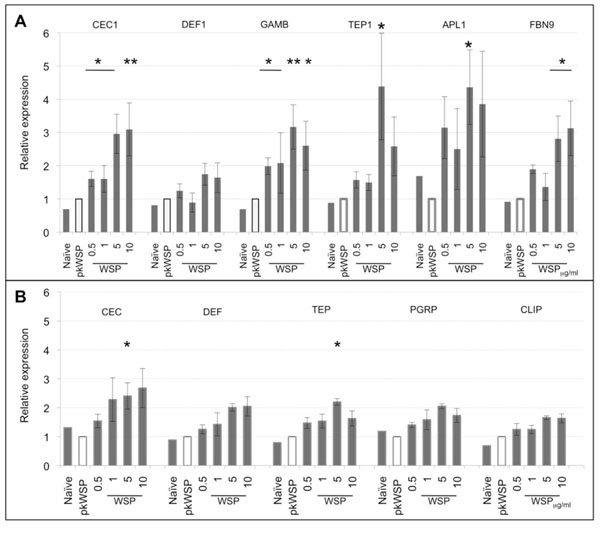
Figure 1
Figure 1
WSP challenge in mosquito cells. qRT-PCR analysis of AMPs and innate immune genes at 3h post-WSP challenge in 4a3A (A) and Aa23T (B). Increased expression dependent on WSP quantities up to 5μg/ml was detected in all genes tested. Relative expressions were calculated to pkWSP (WSP protein treated with proteinase K) challenged cells and represent the average of 4 biological repeats +/- SE. Statistical analysis where performed using a Wilcoxon rank sum test (*p<0.05, **p<0.01).
Figure 2
Figure 2
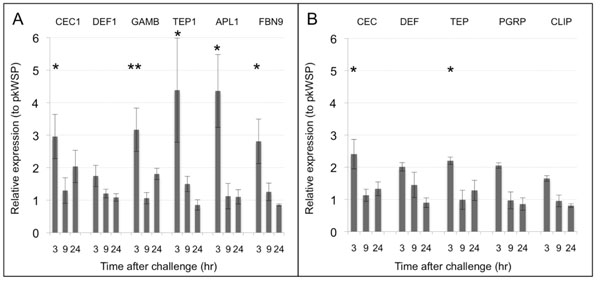
Dynamics of WSP challenge in mosquito cells. qRT-PCR analyses in 4a3A (A) and Aa23T (B) cell lines at 3, 9 and 24h after WSP challenge detect significant upregulation for all tested genes at 3h post-challenge. With the exception of CEC1 and GAMB, mRNA levels return back to control levels at 24h. Relative expressions were calculated to pkWSP-challenged cells and represent the average of 4 biological repeats +/- SE. Statistical analysis where performed using Wilcoxon Rank Sum Test (*p<0.05, **p<0.01).
Figure 3
Figure 3
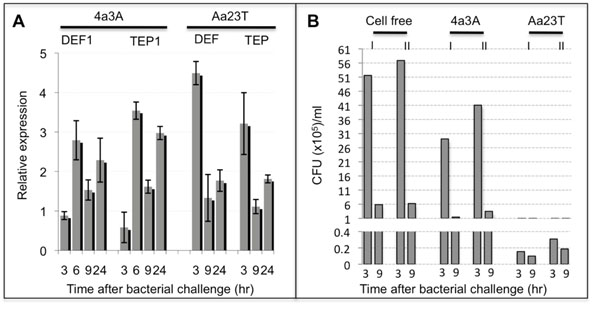
4a3A and Aa23T immune response to bacterial challenges. (A) qRT-PCR analysis at 3, 6, 9 and 24h after cell challenge with a mixture of heat-killed E. coli and E. faecalis show both early and late phase induction of DEF and TEP in both mosquito species. The time of early phase induction varies between species. Upregulation levels for each gene are similar between the two cell lines. Relative expressions were calculated to PBS-challenged cells and represent the average of 3 biological repeats +/- SE (B) 99% of E. coli is rapidly cleared by Aa23T cell line at 3h post-infection while for 4a3A only about 14% have been killed when compared to the same amount of bacteria incubated in cell-free (CF) medium. The starting amount used in each case was 25µl per well of culture with an OD600 reading of 0.05, which represents approximately 15-18M CFU/ml. I -Set I; II -Set II.

References

    1. Bian G, Xu Y, Lu P, Xie Y, Xi Z. The endosymbiotic bacterium Wolbachia induces resistance to dengue virus in Aedes aegypti. PLoS Path. 2010;6:e1000833. doi: 10.1371/journal.ppat.1000833. - DOI - PMC - PubMed
    1. Hedges LM, Brownlie JC, O'Neill SL, Johnson KN. Wolbachia and virus protection in insects. Science. 2008;322:702. doi: 10.1126/science.1162418. - DOI - PubMed
    1. Moreira LA. et al.A Wolbachia symbiont in Aedes aegypti limits infection with dengue, chikungunya, and Plasmodium. Cell. 2009;139:1268–1278. doi: 10.1016/j.cell.2009.11.042. - DOI - PubMed
    1. Osborne SE, Leong YS, O'Neill SL, Johnson KN. Variation in antiviral protection mediated by different Wolbachia strains in Drosophila simulans. PLoS Path. 2009;5:e1000656. doi: 10.1371/journal.ppat.1000656. - DOI - PMC - PubMed
    1. Teixeira L, Ferreira A, Ashburner M. The bacterial symbiont Wolbachia induces resistance to RNA viral infections in Drosophila melanogaster. PLoS Biol. 2008;6:e2. - PMC - PubMed

Publication types

Substances