


Self-reported impulsivity, but not behavioral choice or response impulsivity, partially mediates the effect of stress on drinking behavior
- PMID: 22376044
- PMCID: PMC3673559
- DOI: 10.3109/10253890.2012.671397
Self-reported impulsivity, but not behavioral choice or response impulsivity, partially mediates the effect of stress on drinking behavior
Abstract
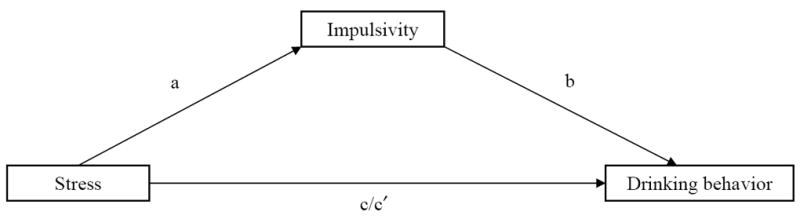
Stress and impulsivity contribute to alcohol use, and stress may also act via impulsivity to increase drinking behavior. Impulsivity represents a multi-faceted construct and self-report and behavioral assessments may effectively capture distinct clinically relevant factors. The present research investigated whether aspects of impulsivity mediate the effect of stress on alcohol use. A community-based sample of 192 men and women was assessed on measures of cumulative stress, alcohol use, self-reported impulsivity, and behavioral choice and response impulsivity. Data were analyzed using regression and bootstrapping techniques to estimate indirect effects of stress on drinking via impulsivity. Cumulative adversity exhibited both direct effects and indirect effects (via self-reported impulsivity) on drinking behavior. Additional models examining specific types of stress indicated direct and indirect effects of trauma and recent life events, and indirect effects of major life events and chronic stressors on drinking behavior. Overall, cumulative stress was associated with increased drinking behavior, and this effect was partially mediated by self-reported impulsivity. Self-reported impulsivity also mediated the effects of different types of stress on drinking behavior. These findings highlight the value of mediation models to examine the pathways through which different types of stress increase drinking behavior. Treatment and prevention strategies should focus on enhancing stress management and self-control.
Conflict of interest statement
Figures
References
-
- Allen J, Litten R, Fertig J, Babor T. A review of research on the alcohol use disorders identification test (AUDIT) Alcohol Clin Exp Res. 1997;21:613–619. - PubMed
-
- Andrews MM, Meda SA, Thomas AD, Potenza MN, Krystal JH, Worhunsky P, Stevens MC, O’Malley S, Book GA, Reynolds B, Pearlson GD. Individuals family history positive for alcoholism show functional magnetic resonance imaging differences in reward sensitivity that are related to impulsivity factors. Biol Psychiatry. 2011;69(7):675–683. - PMC - PubMed
-
- Arnsten AF. Toward a new understanding of attention-deficit hyperactivity disorder pathophysiology: An important role for prefrontal cortex dysfunction. CNS Drugs. 2009;23(Supplement 1):33–41. - PubMed
-
- Arnsten AF, Goldman-Rakic PS. Noise stress impairs prefrontal cortical cognitive function in monkeys: Evidence for a hyperdopaminergic mechanism. Arch Gen Psychiatry. 1998;55(4):362–368. - PubMed
-
- Babor T, Higgins-Biddle J, Saunders J, Monteiro M. AUDIT. The alcohol use disorders identification test. Guidelines for use in primary care. 2. World Health Organization: Department of Mental Health and Substance Dependence; 2001.
Publication types
MeSH terms
Grants and funding
- P20 DA027844/DA/NIDA NIH HHS/United States
- RL1 AA017539/AA/NIAAA NIH HHS/United States
- P20-DA027844/DA/NIDA NIH HHS/United States
- K08 DA029641/DA/NIDA NIH HHS/United States
- UL1 DE019586/DE/NIDCR NIH HHS/United States
- UL1-DE019586/DE/NIDCR NIH HHS/United States
- T32 DA007238-21/DA/NIDA NIH HHS/United States
- PL1-DA024859/DA/NIDA NIH HHS/United States
- PL1 DA024859/DA/NIDA NIH HHS/United States
- T32 DA007238/DA/NIDA NIH HHS/United States
- K08DA029641/DA/NIDA NIH HHS/United States
- RL1-AA017539/AA/NIAAA NIH HHS/United States
LinkOut - more resources
Full Text Sources
Medical
