


Condom use within non-commercial partnerships of female sex workers in southern India
- PMID: 22376171
- PMCID: PMC3287549
- DOI: 10.1186/1471-2458-11-S6-S11
Condom use within non-commercial partnerships of female sex workers in southern India
Abstract
Background: Although female sex workers (FSWs) report high levels of condom use with commercial sex clients, particularly after targeted HIV preventive interventions have been implemented, condom use is often low with non-commercial partners. There is limited understanding regarding the factors that influence condom use with FSWs' non-commercial partners, and of how programs can be designed to increase condom use with these partners. The main objectives of this study were therefore to describe FSWs' self-reported non-commercial partners, along with interpersonal factors characterizing their non-commercial partnerships, and to examine the factors associated with consistent condom use (CCU) within non-commercial partnerships.
Methods: This study used data collected from cross-sectional questionnaires administered to 988 FSWs in four districts in Karnataka state in 2006-07. We used bivariate and multivariable logistic regression analysis to examine the relationship between CCU (i.e., 'always' compared to 'never', 'sometimes' or 'frequently') with non-commercial partners of FSWs (including the respondents' husband or main cohabiting partner [if not married] and their most recent non-paying partner [who is neither a husband nor the main cohabiting partner, and with whom the FSW had sex within the previous year]) and interpersonal factors describing these partnerships, as well as social and environmental factors. Weighting and survey methods were used to account for the cluster sampling design.
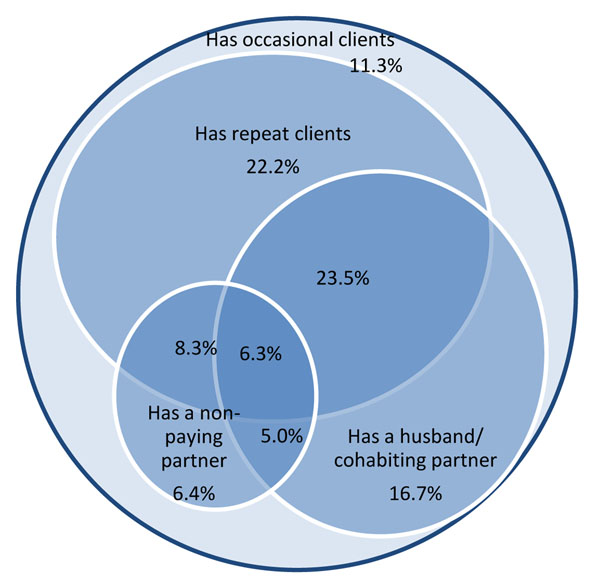
Results: Overall, 511 (51.8%) FSWs reported having a husband or cohabiting partner and 247 (23.7%) reported having a non-paying partner. CCU with these partners was low (22.6% and 40.3% respectively). In multivariable analysis, the odds of CCU with FSWs' husband or cohabiting partner were 1.8-fold higher for FSWs whose partner knew she was a sex worker (adjusted odds ratio [AOR]: 1.84, 95% confidence intervals[CI]: 1.02-3.32) and almost 6-fold higher if the FSW was unmarried (AOR: 5.73, 95%CI: 2.79-11.76]. CCU with FSWs' non-paying partner decreased by 18% for each one-year increase in the duration of the relationship (AOR: 0.82, 95%CI: 0.68-0.97).
Conclusions: This study revealed important patterns and interpersonal determinants of condom use within non-commercial partnerships of FSWs. Integrated structural and community-driven HIV/STI prevention programs that focus on gender and reduce sex work stigma should be investigated to increase condom use in non-commercial partnerships.
Figures
References
-
- Voeten HACM, Egesah OB, Varkevisser CM, Habberma JDF. Female sex workers and unsafe sex in urban and rural Nyanza, Kenya: regular partners may contribute more to HIV transmission than clients. Tropical Medicine and International Health. 2007;12:174–182. - PubMed
-
- Stoebenau K, Hindin MJ, Nathanson CA, Rakotoarison PG, Razafintsalama V. "... But Then He Became My Sipa": The Implications of Relationship Fluidity for Condom Use Among Women Sex Workers in Antananarivo, Madagascar. Am J Public Health. 2009;99:811–819. doi: 10.2105/AJPH.2007.118422. - DOI - PMC - PubMed
-
- Reza-Paul S, Beattie T, Syed HUR, Venukumar KT, Venugopal MS, Fathima MP, Raghavendra H, Akram P, Manjula R, Lakshmi M. et al. Declines in risk behaviour and sexually transmitted infection prevalence following a community-led HIV preventive intervention among female sex workers in Mysore, India. AIDS. 2008;22:S91–S100. doi: 10.1097/01.aids.0000343767.08197.18. - DOI - PubMed
-
- Alary M, Mukenge-Tshibaka L, Bernier F, Geraldo N, Lowndes C, Meda H, Gnintoungbe C, Anagonou S, Joly J. Decline in the prevalence of HIV and sexually transmitted diseases among female sex workers in Cotonou, Benin, 1993-1999. AIDS. 2002;16:463–470. doi: 10.1097/00002030-200202150-00019. - DOI - PubMed
