. 2012 Mar;18(3):431-8.
doi: 10.3201/eid1803.111367.

Seroprevalence of antibodies against Taenia solium cysticerci among refugees resettled in United States

Affiliations

Seroprevalence of antibodies against Taenia solium cysticerci among refugees resettled in United States

Seth E O'Neal et al. Emerg Infect Dis. 2012 Mar.

Abstract

Neurocysticercosis (NCC) is a disease caused by central nervous system infection by the larval stage of the pork tapeworm, Taenia solium. In developing countries, NCC is a leading cause of adult-onset epilepsy. Case reports of NCC are increasing among refugees resettled to the United States and other nations, but the underlying prevalence among refugee groups is unknown. We tested stored serum samples from the Centers for Disease Control and Prevention Migrant Serum Bank for antibodies against T. solium cysts by using the enzyme-linked immunoelectrotransfer blot. Seroprevalence was high among all 4 populations tested: refugees from Burma (23.2%), Lao People's Democratic Republic (18.3%), Bhutan (22.8%), and Burundi (25.8%). Clinicians caring for refugee populations should suspect NCC in patients with seizure, chronic headache, or unexplained neurologic manifestations. Improved understanding of the prevalence of epilepsy and other associated diseases among refugees could guide recommendations for their evaluation and treatment before, during, and after resettlement.


Figures
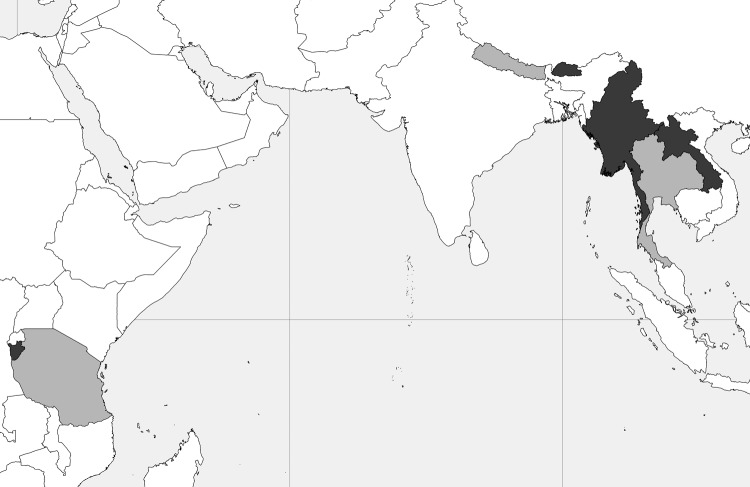
Figure 1
Figure 1
Geographic location and background of refugee populations sampled for antibodies against Taenia solium cysticerci by using the classic enzyme-linked immunoelectrotransfer blot for lentil-lectin purified glycoprotein. Countries of origin are shaded dark grey (Burundi, Bhutan, Burma [Myanmar], Laos). Host countries are shaded light grey (Tanzania, Nepal, Thailand). Burundi: ≈14,000 Burundian refugees who lived in camps in Tanzania since 1972 were resettled during 2006–2008. Resettled refugees were primarily ethnic Hutu. Bhutan: ethnic Lhotshampa Bhutanese refugees arrived in Nepal ≈1990. Resettlement began in 2008 and is ongoing, with ≈40,000 resettled thus far. Burma: there has been intermittent influx of refugees into Thailand from Burma since 1984. Resettlement began in 2004 and is ongoing, with ≈90,000 resettled thus far. Resettled refugees in this group are primarily ethnic Karen and Karenni. Laos: refugees from Laos arrived in Thailand as early as 1975, and many resettled soon thereafter. The most recent round of resettlement from the Wat Tham Krabok camp occurred during 2004–2006 with resettlement of ≈16,000 ethnic Hmong refugees.
Figure 2
Figure 2
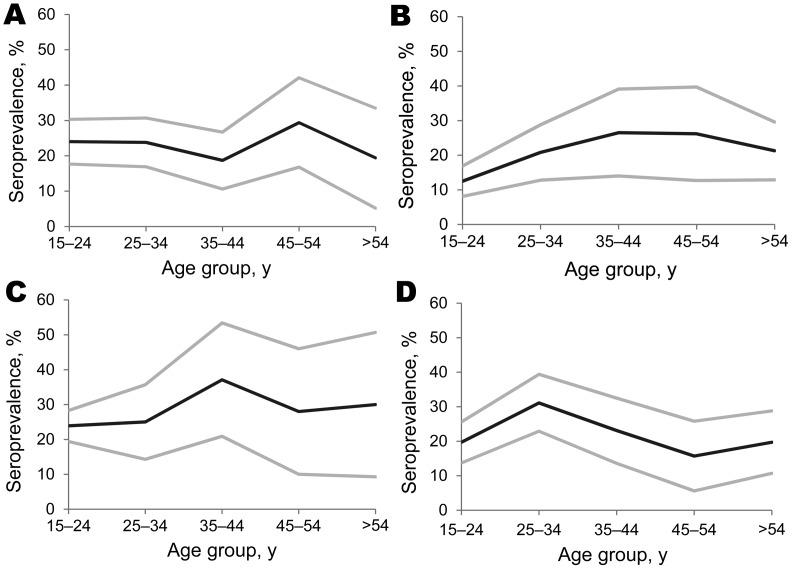
Distribution of positive results from the classic enzyme-linked immunoelectrotransfer blot for lentil-lectin purified glycoprotein for antibodies against Taenia solium cysticerci by age category among US-bound refugees from A) Burma (Myanmar), p = 0.65; B) Laos (Hmong), p = 0.04; C) Burundi, p = 0.56; and D) Bhutan, p = 0.12. Black lines represent seroprevalence estimates across age categories; gray lines represent upper and lower bounds of the corresponding 95% CI. Two-sided p values were determined by using likelihood ratio χ2.
Figure 3
Figure 3
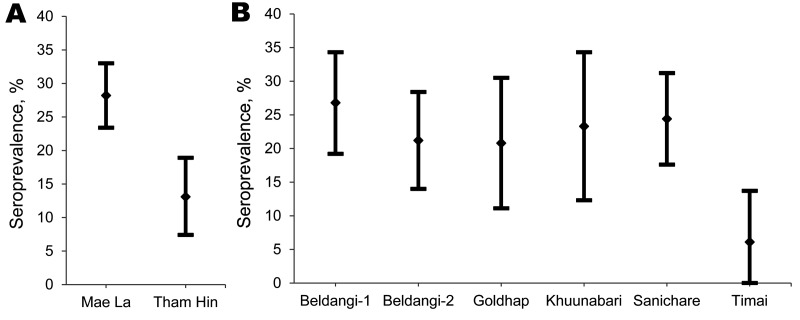
Age- and sex-adjusted seroprevalence of antibodies against Taenia solium cysticerci, by refugee camp among US-bound refugees from A) Burma (Myanmar) and B) Bhutan. Adjustment is by direct standardization within each refugee group. Point estimates and corresponding 95% CIs are shown.

References

    1. Scharf D. Neurocysticercosis. Two hundred thirty-eight cases from a California hospital. Arch Neurol. 1988;45:777–80. 10.1001/archneur.1988.00520310087022 - DOI - PubMed
    1. Shandera WX, White AC, Chen JC, Diaz P, Armstrong R. Neurocysticercosis in Houston, Texas. A report of 112 cases. Medicine. 1994;73:37–52. 10.1097/00005792-199401000-00004 - DOI - PubMed
    1. Ndimubanzi PC, Carabin H, Budke CM, Nguyen H, Qian Y-J, Rainwater E, et al. A systematic review of the frequency of neurocyticercosis with a focus on people with epilepsy. PLoS Negl Trop Dis. 2010;4:e870. 10.1371/journal.pntd.0000870 - DOI - PMC - PubMed
    1. Del Brutto OH, Santibáñez R, Idrovo L, Rodrìguez S, Díaz-Calderón E, Navas C, et al. Epilepsy and neurocysticercosis in Atahualpa: a door-to-door survey in rural coastal Ecuador. Epilepsia. 2005;46:583–7. 10.1111/j.0013-9580.2005.36504.x - DOI - PubMed
    1. Montano SM, Villaran MV, Ylquimiche L, Figueroa JJ, Rodriguez S, Bautista CT, et al. Neurocysticercosis: association between seizures, serology, and brain CT in rural Peru. Neurology. 2005;65:229–33. 10.1212/01.wnl.0000168828.83461.09 - DOI - PubMed

Publication types

MeSH terms

LinkOut - more resources