. 2012 May;191(1):107-18.
doi: 10.1534/genetics.111.136549. Epub 2012 Feb 29.

Ribosome deficiency protects against ER stress in Saccharomyces cerevisiae

Affiliations

Ribosome deficiency protects against ER stress in Saccharomyces cerevisiae

Kristan K Steffen et al. Genetics. 2012 May.

Abstract

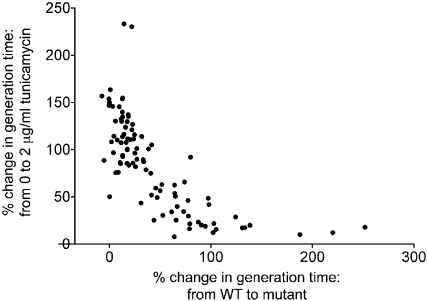
In Saccharomyces cerevisiae, 59 of the 78 ribosomal proteins are encoded by duplicated genes that, in most cases, encode identical or very similar protein products. However, different sets of ribosomal protein genes have been identified in screens for various phenotypes, including life span, budding pattern, and drug sensitivities. Due to potential suppressors of growth rate defects among this set of strains in the ORF deletion collection, we regenerated the entire set of haploid ribosomal protein gene deletion strains in a clean genetic background. The new strains were used to create double deletions lacking both paralogs, allowing us to define a set of 14 nonessential ribosomal proteins. Replicative life-span analysis of new strains corresponding to ORF deletion collection strains that likely carried suppressors of growth defects identified 11 new yeast replicative aging genes. Treatment of the collection of ribosomal protein gene deletion strains with tunicamycin revealed a significant correlation between slow growth and resistance to ER stress that was recapitulated by reducing translation of wild-type yeast with cycloheximide. Interestingly, enhanced tunicamycin resistance in ribosomal protein gene deletion mutants was independent of the unfolded protein response transcription factor Hac1. These data support a model in which reduced translation is protective against ER stress by a mechanism distinct from the canonical ER stress response pathway and further add to the diverse yet specific phenotypes associated with ribosomal protein gene deletions.


Figures
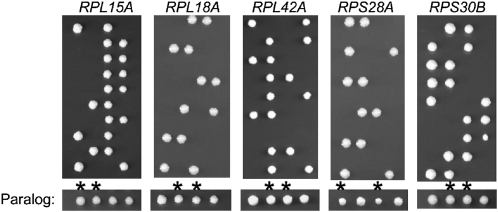
Figure 1
Figure 1
Essential ribosomal protein genes with paralogs. Sporulation of heterozygous diploids lacking the specific gene (text above panel), followed by ascus digestion, dissection, and analysis, yielded 2:2 segregation of viable to inviable spores, thus indentifying essential RPGs. A representative tetrad from the corresponding paralog heterozygous diploid is shown below with asterisks designating colonies lacking the corresponding paralog.
Figure 2
Figure 2
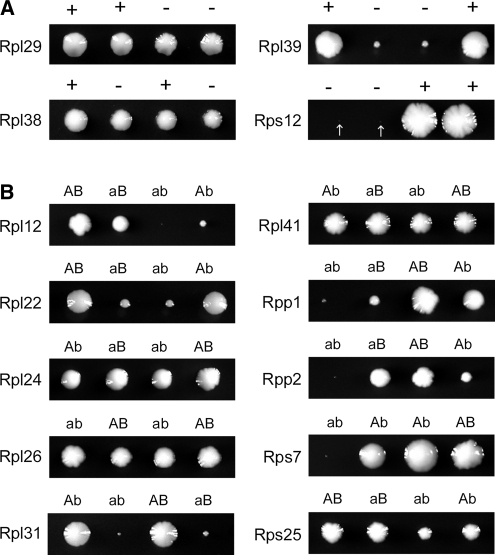
Nonessential ribosomal proteins. (A) Representative tetrads dissected from sporulated heterozygous diploids lacking the specified gene are shown, with “+” indicating presence and “−” indicating absence of the specific gene. Arrows denote especially small (rps12Δ) colonies. (B) Representative tetrads dissected from sporulated doubly heterozygous diploids lacking one copy of each of the paralogous RPGs are shown, with uppercase “A” or “B” indicating that paralog A or B is present; lowercase “a” or “b” indicate that paralog A or B is absent. Genotypes were confirmed by PCR.
Figure 3
Figure 3
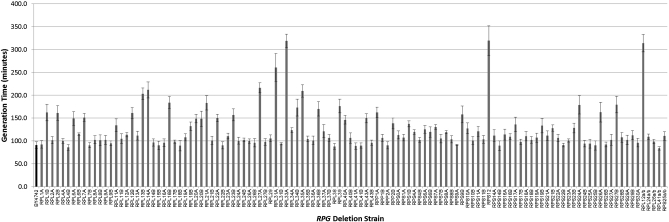
Average generation time of all remade RPG deletion strains in YPD, ±SD. Solid bar is BY4742 wild-type control. See also Table S2.
Figure 4
Figure 4
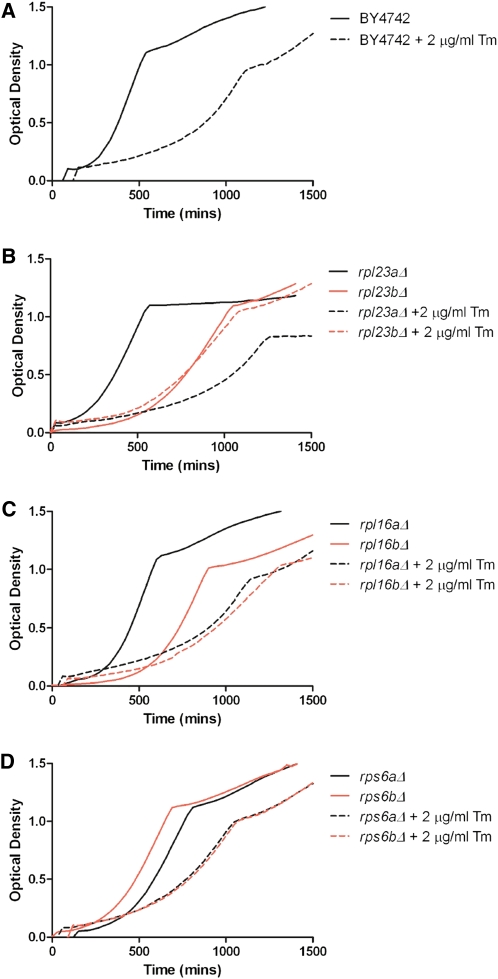
Growth in YPD vs. YPD + 2 μg/ml tunicamycin. (A) Generation time of BY4742 in tunicamycin is ∼2.5-fold greater than in YPD. (B) Cells lacking RPL23A are more severely affected by tunicamycin treatment than cells lacking RPL23B. (C) Cells lacking RPL16A are more severely affected by tunicamycin treatment than cells lacking RPL16B. (D) Cells lacking RPS6A or RPS6B respond similarly to tunicamycin treatment. See also Table S2.
Figure 5
Figure 5
Percentage of change in generation time from wild-type to rpΔ vs. percentage of change in growth from 0 to 2 μg/ml tunicamycin.
Figure 6
Figure 6
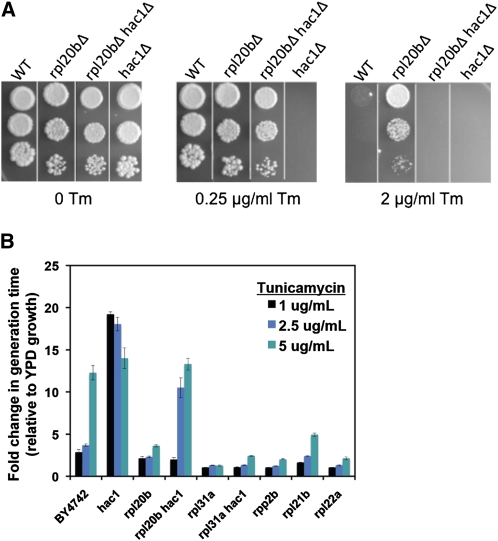
Cells lacking RPL20B are resistant to tunicamycin (Tm) in a manner at least partially independent of HAC1. (A) Tenfold serial dilutions of saturated yeast cultures were spotted on YPD plates containing 0, 0.25, or 2 μg/ml tunicamycin. (B) Fold change in generation time in liquid medium containing 1, 2.5, or 5 μg/ml Tm relative to YPD alone.

References

    1. Abovich N., Rosbash M., 1984. Two genes for ribosomal protein 51 of Saccharomyces cerevisiae complement and contribute to the ribosomes. Mol. Cell. Biol. 4: 1871–1879. - PMC - PubMed
    1. Badis G., Saveanu C., Fromont-Racine M., Jacquier A., 2004. Targeted mRNA degradation by deadenylation-independent decapping. Mol. Cell 15: 5–15. - PubMed
    1. Ban N., Nissen P., Hansen J., Moore P. B., Steitz T. A., 2000. The complete atomic structure of the large ribosomal subunit at 2.4 A resolution. Science 289: 905–920. - PubMed
    1. Baronas-Lowell D. M., Warner J. R., 1990. Ribosomal protein L30 is dispensable in the yeast Saccharomyces cerevisiae. Mol. Cell. Biol. 10: 5235–5243. - PMC - PubMed
    1. Boria I., Garelli E., Gazda H. T., Aspesi A., Quarello P., et al. , 2010. The ribosomal basis of Diamond-Blackfan Anemia: mutation and database update. Hum. Mutat. 31: 1269–1279. - PMC - PubMed

Publication types

MeSH terms