


How the type of anthropogenic change alters the consequences of ecological traps
- PMID: 22378802
- PMCID: PMC3350704
- DOI: 10.1098/rspb.2012.0139
How the type of anthropogenic change alters the consequences of ecological traps
Abstract
Understanding altered ecological and evolutionary dynamics in novel environments is vital for predicting species responses to rapid environmental change. One fundamental concept relevant to such dynamics is the ecological trap, which arises from rapid anthropogenic change and can facilitate extinction. Ecological traps occur when formerly adaptive habitat preferences become maladaptive because the cues individuals preferentially use in selecting habitats lead to lower fitness than other alternatives. While it has been emphasized that traps can arise from different types of anthropogenic change, the resulting consequences of these different types of traps remain unknown. Using a novel model framework that builds upon the Price equation from evolutionary genetics, we provide the first analysis that contrasts the ecological and evolutionary consequences of ecological traps arising from two general types of perturbations known to trigger traps. Our model suggests that traps arising from degradation of existing habitats are more likely to facilitate extinction than those arising from the addition of novel trap habitat. Importantly, our framework reveals the mechanisms of these outcomes and the substantial scope for persistence via rapid evolution that may buffer many populations from extinction, helping to resolve the paradox of continued persistence of many species in dramatically altered landscapes.
Figures
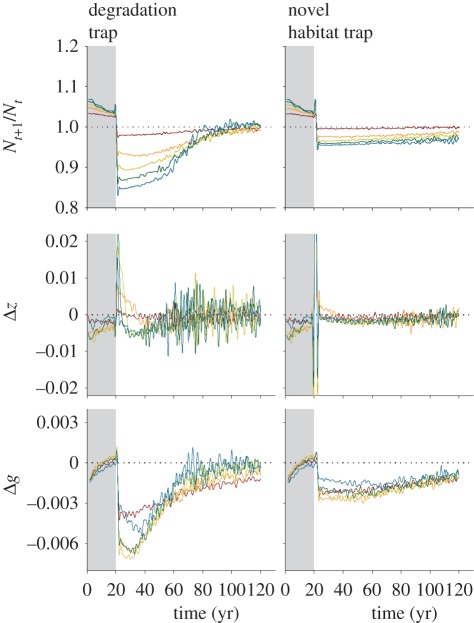
 ) and habitat preference (
 ) over time for two types of ecological traps under different amounts of trap habitat created (ha). Grey shading denotes initial dynamics that occur prior to trap formation. Marginal means from 37 500 simulations are shown for each type of trap. Brown line, 100; orange line, 300; green line, 500; dark green line, 700; blue line, 900.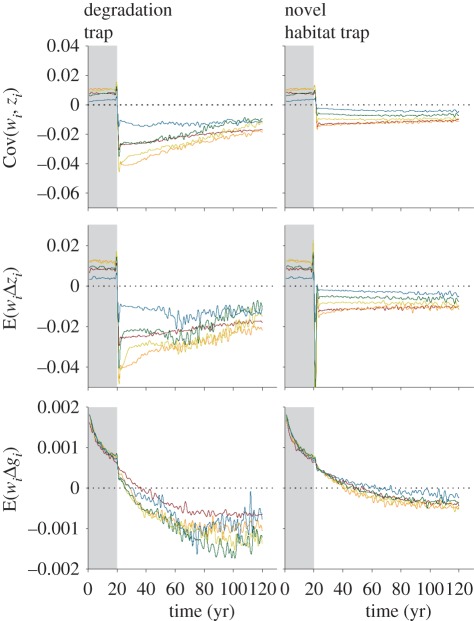
References
-
- Cheptou P. O., Carrue O., Rouifed S., Cantarel A. 2008. Rapid evolution of seed dispersal in an urban environment in the weed Crepis sancta. Proc. Natl Acad. Sci. USA 105, 3796–3799 10.1073/pnas.0708446105 (doi:10.1073/pnas.0708446105) - DOI - PMC - PubMed
-
- Stockwell C. A., Hendry A. P., Kinnison M. T. 2003. Contemporary evolution meets conservation biology. Trends Ecol. Evol. 18, 94–101 10.1016/S0169-5347(02)00044-7 (doi:10.1016/S0169-5347(02)00044-7) - DOI
-
- Reeve H. K., Sherman P. W. 1993. Adaptation and the goals of evolutionary research. Quart. Rev. Biol. 68, 1–32 10.1111/j.1469-185X.1993.tb00731.x (doi:10.1111/j.1469-185X.1993.tb00731.x) - DOI
-
- Crespi B. J. 2000. The evolution of maladaptation. Heredity 84, 623–629 10.1046/j.1365-2540.2000.00746.x (doi:10.1046/j.1365-2540.2000.00746.x) - DOI - PubMed
-
- Schlaepfer M. A., Runge M. C., Sherman P. W. 2002. Ecological and evolutionary traps. Trends Ecol. Evol. 17, 474–480 10.1016/S0169-5347(02)02580-6 (doi:10.1016/S0169-5347(02)02580-6) - DOI
Publication types
MeSH terms
LinkOut - more resources
Full Text Sources
