Anti-mullerian hormone as a predictor of time to menopause in late reproductive age women
- PMID: 22378815
- PMCID: PMC3339896
- DOI: 10.1210/jc.2011-3032
Anti-mullerian hormone as a predictor of time to menopause in late reproductive age women
Abstract
Context: Anti-mullerian hormone (AMH) has emerged as a marker of ovarian reserve and a possible surrogate measure of reproductive aging.
Objective: The aim of the study was to evaluate the predictive value of AMH levels in determining the median time to menopause for late reproductive age women and the predictive ability of AMH compared to FSH and inhibin b.
Design and setting: A 14-yr follow-up in the Penn Ovarian Aging Study, 1996-2010, was conducted for a randomly identified population-based cohort.
Subjects: A total of 401 late reproductive age women participated in the study.
Main outcome measure: Observed time to menopause was measured.
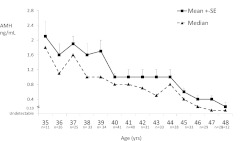
Results: All participants were premenopausal, with a mean (SD) age of 41.47 (3.52) yr and a median AMH level of 0.68 ng/ml at baseline. AMH strongly predicted time to menopause; age further improved predictions. Among women with a baseline AMH level below 0.20 ng/ml, the median time to menopause was 5.99 yr [95% confidence interval (CI), 4.20-6.33] in the 45- to 48-yr age group and 9.94 yr (95% CI, 3.31-12.73) in the 35- to 39-yr age group. With higher baseline AMH levels above 1.50 ng/ml, the median time to menopause was 6.23 yr in the oldest age group and more than 13.01 yr in the youngest age group. Smoking significantly reduced the time to menopause (hazard ratio, 1.61; 95% CI, 1.19-2.19; P = 0.002). AMH was a stronger predictor of time to menopause than FSH or inhibin b.
Conclusions: AMH is a strong predictor of median time to menopause in late reproductive age women. Age and smoking are significant and independent contributors to the predictions of AMH.
Figures
References
-
- de Vet A, Laven JS, de Jong FH, Themmen AP, Fauser BC. 2002. Antimüllerian hormone serum levels: a putative marker for ovarian aging. Fertil Steril 77:357–362 - PubMed
-
- Gruijters MJ, Visser JA, Durlinger AL, Themmen AP. 2003. Anti-Müllerian hormone and its role in ovarian function. Mol Cell Endocrinol 211:85–90 - PubMed
-
- Feyereisen E, Méndez Lozano DH, Taieb J, Hesters L, Frydman R, Fanchin R. 2006. Anti-Müllerian hormone: clinical insights into a promising biomarker of ovarian follicular status. Reprod Biomed Online 12:695–703 - PubMed
-
- Scheffer GJ, Broekmans FJ, Looman CW, Blankenstein M, Fauser BC, teJong FH, teVelde ER. 2003. The number of antral follicles in normal women with proven fertility is the best reflection of reproductive age. Hum Reprod 18:700–706 - PubMed
-
- van Rooij IA, Broekmans FJ, te Velde ER, Fauser BC, Bancsi LF, de Jong FH, Themmen AP. 2002. Serum anti-Müllerian hormone levels: a novel measure of ovarian reserve. Hum Reprod 17:3065–3071 - PubMed
Publication types
MeSH terms
Substances
Grants and funding
LinkOut - more resources
Full Text Sources
Other Literature Sources
Medical