


Haldane's rule in marsupials: what happens when both sexes are functionally hemizygous?
- PMID: 22378959
- PMCID: PMC3331990
- DOI: 10.1093/jhered/esr154
Haldane's rule in marsupials: what happens when both sexes are functionally hemizygous?
Abstract
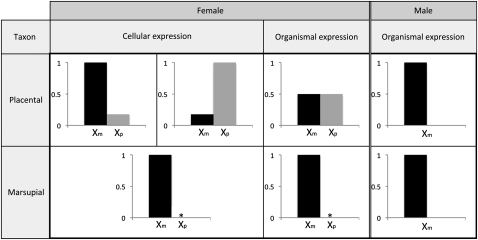
During the process of speciation, diverging taxa often hybridize and produce offspring wherein the heterogametic sex (i.e., XY or ZW) is unfit (Haldane's rule). Dominance theory seeks to explain Haldane's rule in terms of the difference in X-linked dominance regimes experienced by the sexes. However, X inactivation in female mammals extends the effects of hemizygosity to both sexes. Here, we highlight where the assumptions of dominance theory are particularly problematic in marsupials, where X inactivation uniformly results in silencing the paternal X. We then present evidence of Haldane's rule for sterility but not for viability in marsupials, as well as the first violations of Haldane's rule for these traits among all mammals. Marsupials represent a large taxonomic group possessing heteromorphic sex chromosomes, where the dominance theory cannot explain Haldane's rule. In this light, we evaluate alternative explanations for the preponderance of male sterility in interspecific hybrids, including faster male evolution, X-Y interactions, and genomic conflict hypotheses.
Figures
References
-
- Brothers AN, Delph LF. Haldane's rule is extended to plants with sex chromosomes. Evolution. 2010;64:3643–3648. - PubMed
-
- Burgoyne PS, Mahadevaiah SK, Sutcliffe MJ, Palmer SJ. Fertility in mice requires X–Y pairing and a Y-chromosomal “spermiogenesis” gene mapping to the long arm. Cell. 1992;71(3):391–398. - PubMed
-
- Close R, Lowry P. Hybrids in marsupial research. Aust J Zool. 1990;37(2–4):259–267.
