. 2012 May;86(9):5230-43.
doi: 10.1128/JVI.06728-11. Epub 2012 Feb 29.

Widespread impact of HLA restriction on immune control and escape pathways of HIV-1

Affiliations

Widespread impact of HLA restriction on immune control and escape pathways of HIV-1

Jonathan M Carlson et al. J Virol. 2012 May.

Abstract

The promiscuous presentation of epitopes by similar HLA class I alleles holds promise for a universal T-cell-based HIV-1 vaccine. However, in some instances, cytotoxic T lymphocytes (CTL) restricted by HLA alleles with similar or identical binding motifs are known to target epitopes at different frequencies, with different functional avidities and with different apparent clinical outcomes. Such differences may be illuminated by the association of similar HLA alleles with distinctive escape pathways. Using a novel computational method featuring phylogenetically corrected odds ratios, we systematically analyzed differential patterns of immune escape across all optimally defined epitopes in Gag, Pol, and Nef in 2,126 HIV-1 clade C-infected adults. Overall, we identified 301 polymorphisms in 90 epitopes associated with HLA alleles belonging to shared supertypes. We detected differential escape in 37 of 38 epitopes restricted by more than one allele, which included 278 instances of differential escape at the polymorphism level. The majority (66 to 97%) of these resulted from the selection of unique HLA-specific polymorphisms rather than differential epitope targeting rates, as confirmed by gamma interferon (IFN-γ) enzyme-linked immunosorbent spot assay (ELISPOT) data. Discordant associations between HLA alleles and viral load were frequently observed between allele pairs that selected for differential escape. Furthermore, the total number of associated polymorphisms strongly correlated with average viral load. These studies confirm that differential escape is a widespread phenomenon and may be the norm when two alleles present the same epitope. Given the clinical correlates of immune escape, such heterogeneity suggests that certain epitopes will lead to discordant outcomes if applied universally in a vaccine.


Figures
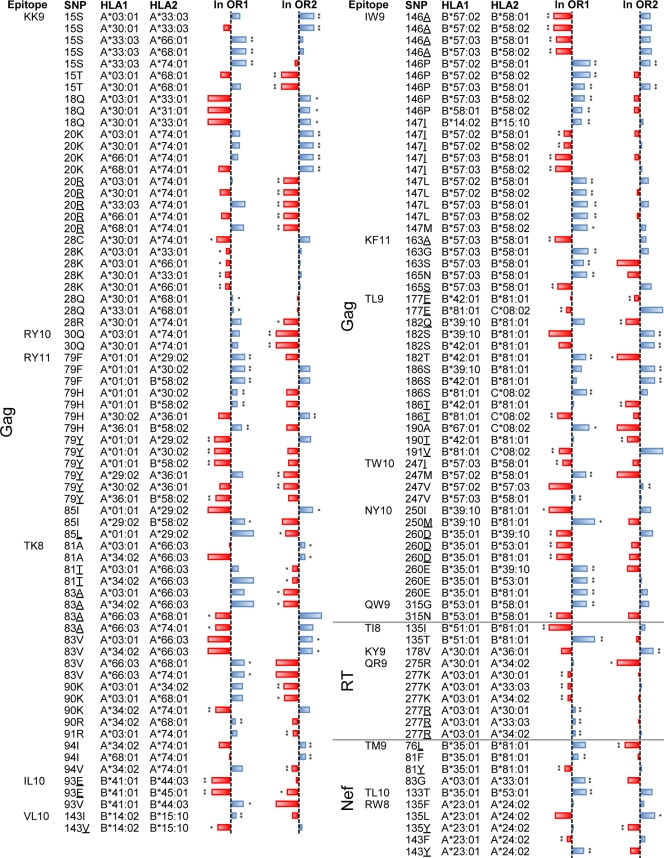
Fig 1
Fig 1
Per-site differential escape between HLA alleles that restrict the same epitope. Bars represent the natural logarithm of the phylogenetically corrected odds ratio. Values between −20 (red, extending to the left) and +20 (blue, extending to the right) are shown; infinite log-odds ratios are set to values of ±20. Associations that are individually significant are labeled with single asterisks (q < 0.2) or double asterisks (q < 0.05). Polymorphisms are given in the SNP (single-nucleotide polymorphism) column; underlined amino acids signify cohort consensus. A phylogenetically corrected logistic model was used to derive a P value that tests the null hypothesis that both alleles select for escape with the same odds ratio. Comparisons with a P value of <0.005 (q < 0.006) are reported. The complete list of all comparisons with P values of <0.05 is available in Table S4 in the supplemental material.
Fig 2
Fig 2
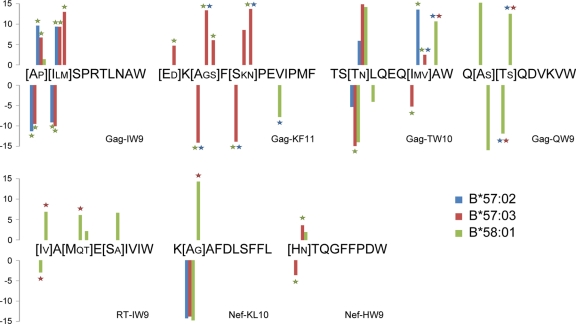
Differential escape among protective B58-supertype alleles. The phylogenetically corrected log-odds ratio of each B*57:02-, B*57:03-, or B*58:01-associated polymorphism from Table 1 was tested for differential selection against the other two alleles. Bars represent the log-odds of observing the indicated polymorphism. Stars indicate that the magnitude of the odds ratio is significantly (P < 0.05, q < 0.06) greater than that for the allele indicated by the color of the star. Large amino acid letters indicate cohort consensus; small letters indicate alternative polymorphisms associated with at least one allele.
Fig 3
Fig 3
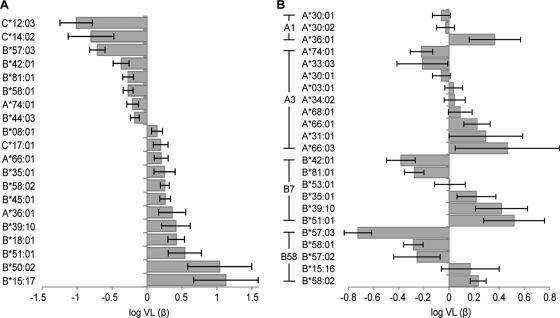
Relative contributions (β parameters) of HLA alleles to log VL. (A) All HLA alleles identified at a P value of <0.05 (q < 0.13) in a forward selection procedure; (B) HLA-A and HLA-B alleles, grouped by supertype, that were discordantly association with VL compared to an allele that was associated with differential escape in the same epitope, conditioned on the alleles from panel A. Relative bar heights depict the maximum likelihood β estimates from a joint linear model (estimated corrected average VL among individuals expressing that allele), conditioned on cohort labels. Error bars represent standard error estimates for β.
Fig 4
Fig 4
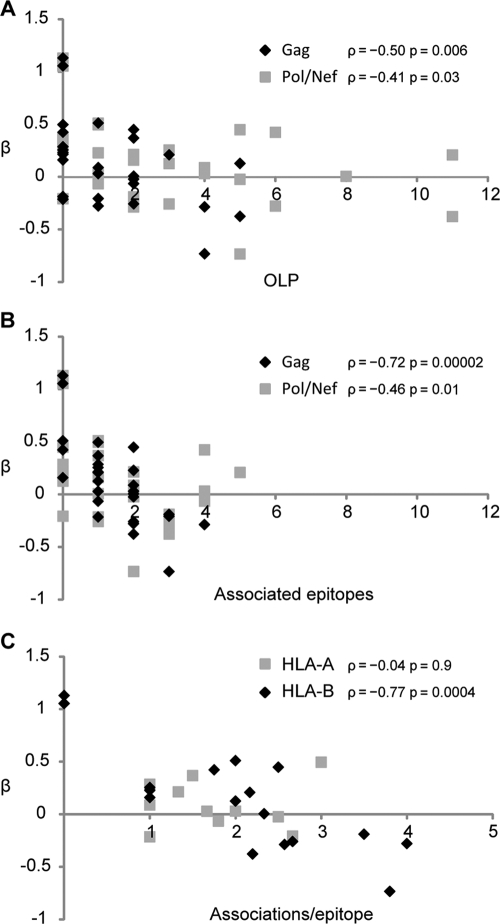
HLA alleles that select for escape are associated with reduced viral load. Log viral load was modeled as a linear function of the HLA-A and -B alleles from Fig. 3, and the resulting β estimates were correlated against the number of OLP responses that associated with that allele (A), the number of optimal epitopes that were targeted by that allele as determined by the presence of associated escape polymorphisms (B), and the total number of escape polymorphisms per targeted optimal epitope (C). Spearman rank correlation coefficients (ρ) are reported for each plotted data set.

References

    1. Allen TM, et al. 2005. Selective escape from CD8+ T-cell responses represents a major driving force of human immunodeficiency virus type 1 (HIV-1) sequence diversity and reveals constraints on HIV-1 evolution. J. Virol. 79:13239–13249 - PMC - PubMed
    1. Altfeld M, et al. 2003. Influence of HLA-B57 on clinical presentation and viral control during acute HIV-1 infection. AIDS 17:2581–2591 - PubMed
    1. Altfeld M, et al. 2000. Identification of dominant optimal HLA-B60- and HLA-B61-restricted cytotoxic T-lymphocyte (CTL) epitopes: rapid characterization of CTL responses by enzyme-linked immunospot assay. J. Virol. 74:8541–8549 - PMC - PubMed
    1. Avila-Rios S, et al. 2009. Unique features of HLA-mediated HIV evolution in a Mexican cohort: a comparative study. Retrovirology 6:72. - PMC - PubMed
    1. Bansal A, et al. 2010. CD8 T cell response and evolutionary pressure to HIV-1 cryptic epitopes derived from antisense transcription. J. Exp. Med. 207:51–59 - PMC - PubMed

Publication types