Review
. 2012 Jun;22(3):256-63.
doi: 10.1016/j.gde.2012.02.002. Epub 2012 Feb 28.

New perspectives on the biology of fragile X syndrome

Affiliations
Review

New perspectives on the biology of fragile X syndrome

Tao Wang et al. Curr Opin Genet Dev. 2012 Jun.

Abstract

Fragile X syndrome (FXS) is a trinucleotide repeat disorder caused by a CGG repeat expansion in FMR1, and loss of its protein product FMRP. Recent studies have provided increased support for the role of FMRP in translational repression via ribosomal stalling and the microRNA pathway. In neurons, particular focus has been placed on identifying the signaling pathways such as PI3K and mTOR downstream of group 1 metabotropic glutamate receptors (mGluR1/5) that regulate FMRP. New evidence also suggests that loss of FMRP causes presynaptic dysfunction and abnormal adult neurogenesis. In addition, studies on FXS stem cells especially induced pluripotent stem (iPS) cells and new sequencing efforts hold out promise for deeper understanding of the silencing process and mutation spectrum of FMR1.


Figures

Figure 1
Figure 1
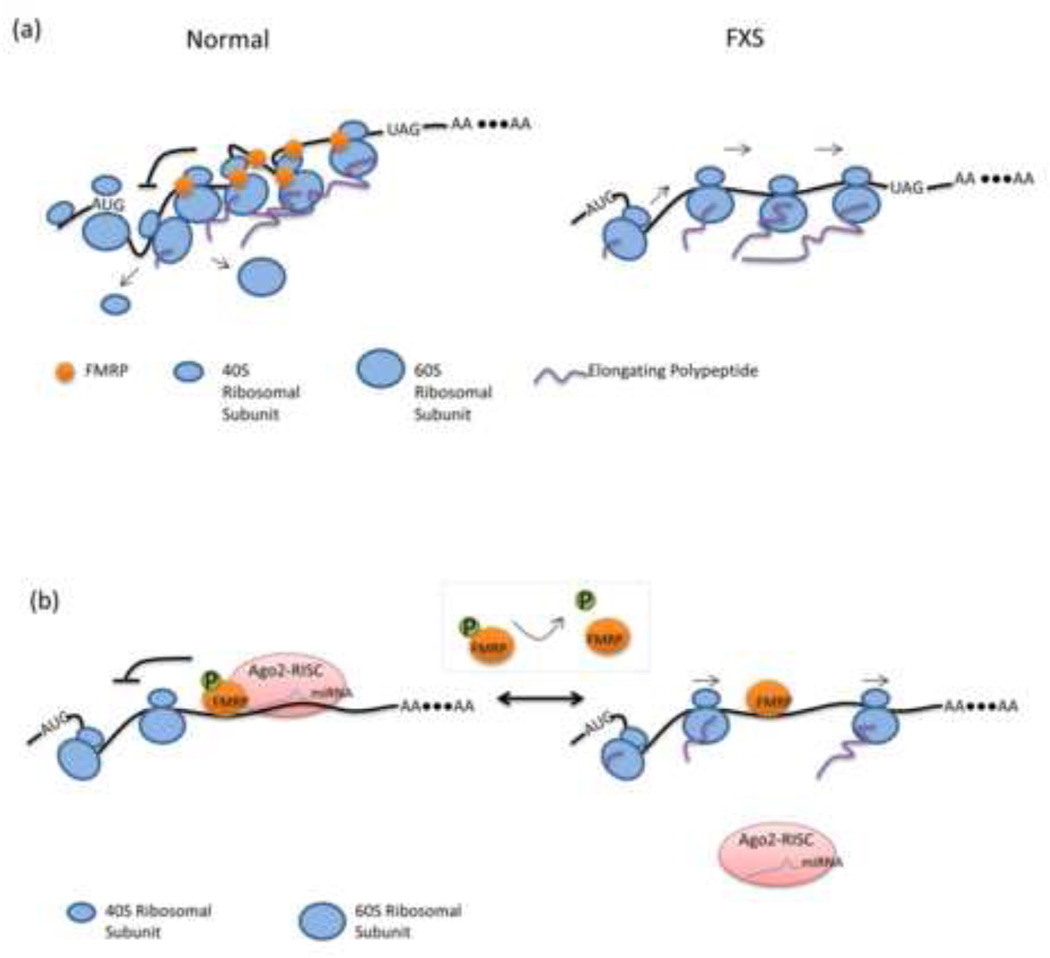
Mechanisms of FMRP mediated translational regulation. (a) FMRP inhibits translation of target mRNAs by ribosome stalling. In normal cells, increased number of ribosomes are stalled on FMRP-target transcripts, which results in reduced translation. Darnell et al.[8] shows that a predominance of tags among FMRP target transcripts are distributed within the coding sequence by HITS-CLIP experiment. The stalling event occurs not only on target mRNAs bearing known secondary structures such as kissing complex and G-quadruplexes, but also on some mRNAs without these structures. In FXS cells, translational repression by FMRP via ribosome stalling is absent. (b) MiRNA-mediated translational repression by FMRP. FMRP is found to interact with miRNAs and members of the RISC complex. MiRNAs such as miR-125a, miR-125b and miR-132 are selectively associated with the FMRP-RISC RNP complex. These miRNAs in turn facilitate the selection and repression of target mRNAs by FMRP. Phosphorylation of FMRP acts as a switch for this mechanism. Dephosphorylation of serine 499 causes the dissociation of the RISC complex from target mRNAs and relieves the translational repression. However, dephosphorylated FMRP remains associated with target mRNAs.
Figure 2
Figure 2
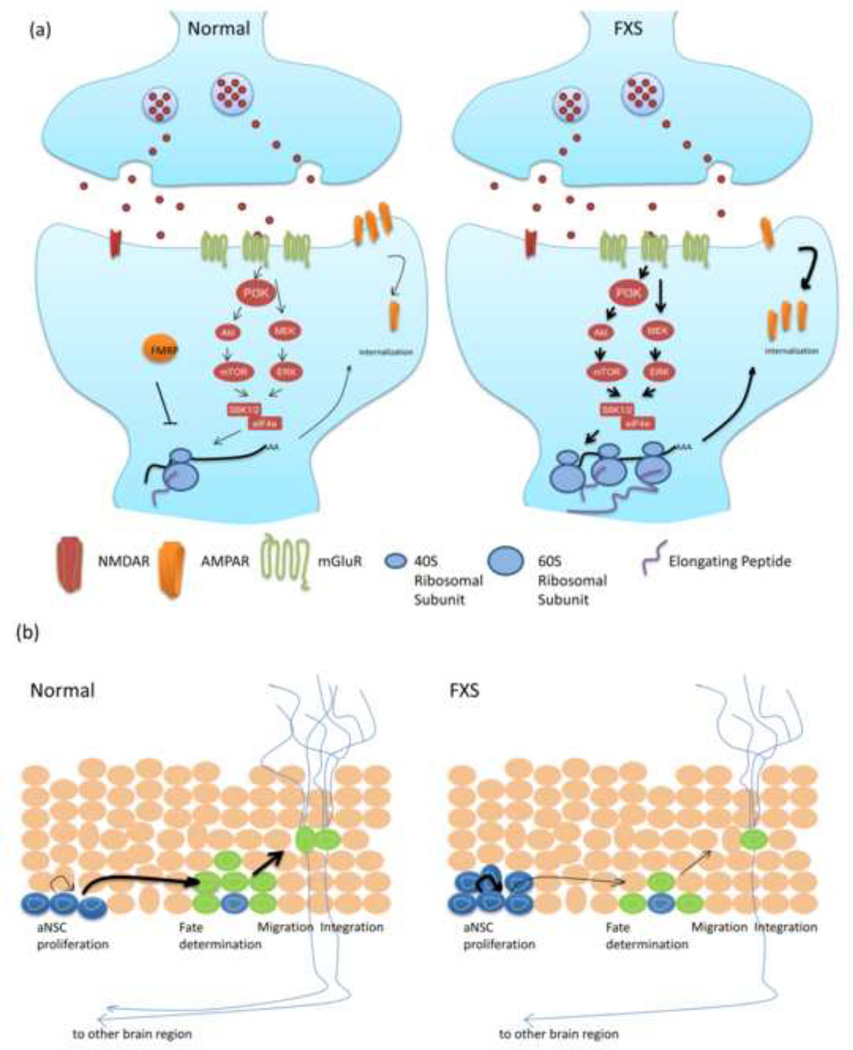
(a) FMRP is a negative regulator in Group I mGluR-dependent protein synthesis. In wild-type synpase, activation of Group I mGluR receptors increases protein synthesis via the mTOR and ERK signaling pathways. Both pathways converge to increase eIF4E activity and initiate the assembly of eIF4F, the first step in the initiation of mRNA cap-dependent translation. This group I mGluR-dependent protein synthesis induces long-term depression (LTD), a molecular basis of learning and memory, which is impaired in FXS. In FXS, stimulation of Group I mGluR receptors causes excessive protein synthesis via increased mTOR and ERK signaling pathways, which leads to abnormal synaptic plasticity such as increased AMPAR internalization. (b) The role of FMRP in adult neurogenesis. The panel shows the cells from subgranular zone of the dentate gyrus in hippocampus in mice. Compared with wild-type cells, Fmrp-deficient aNSCs display increased proliferation, decreased neuronal differentiation, and increased glial differentiation, which in turn alter the fate specification of aNSCs. Subsequently, the abnormal adult neurogenesis leads to impaired hippocampus-dependent learning.
Figure 3
Figure 3
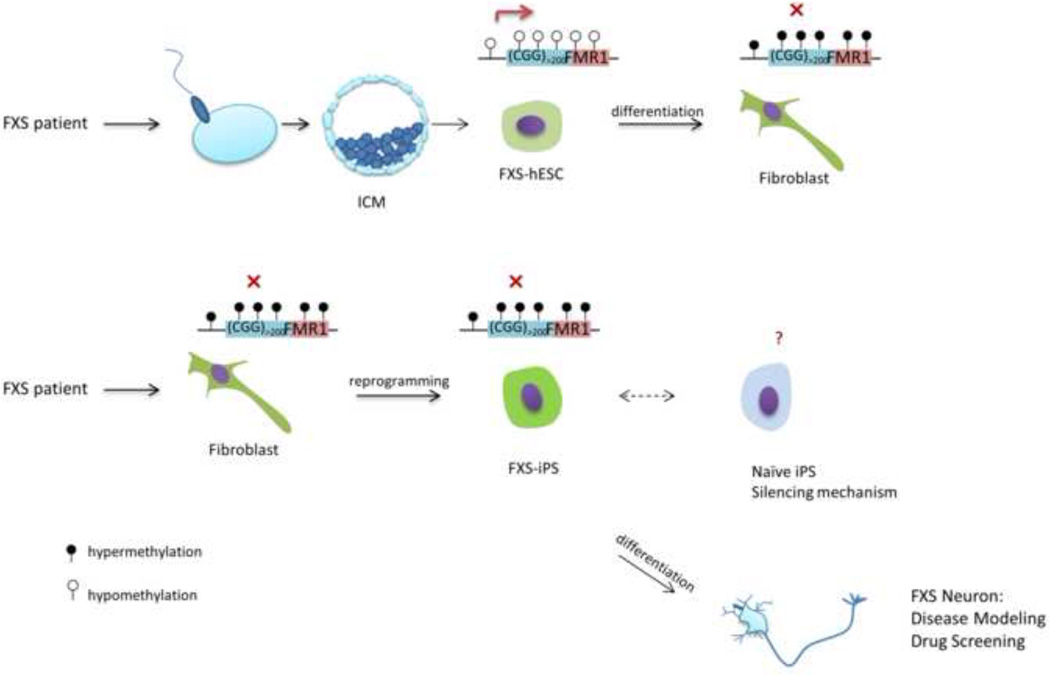
The paradox of FMR1 full mutation epigenetic status between FX-iPSC and FX-hESC. In FXS, during early embryonic development, the FMR1 full mutation allele remains unsilenced. Analysis from one FXS-hESC line shows that the full mutation allele is still active, while during in vitro differentiation, FMR1 undergoes epigenetic silencing. In contrast, the full mutation allele remains methylated in iPS cells reprogrammed from FXS patients’ fibroblasts. The successful generation of naïve/ground state FXS-iPS cells will allow new investigations into the epigenetic status of the full mutation. These pluripotent stem cells derived from FXS patients provide invaluable model systems for studying FMR1 epigenetic regulation, drug screening and in vitro neuronal modeling.

References

    1. Boyle L, Kaufmann WE. The behavioral phenotype of FMR1 mutations. Am J Med Genet C Semin Med Genet. 2010;154C:469–476. - PubMed
    1. Krueger DD, Bear MF. Toward fulfilling the promise of molecular medicine in fragile X syndrome. Annu Rev Med. 2011;62:411–429. - PMC - PubMed
    1. Penagarikano O, Mulle JG, Warren ST. The pathophysiology of fragile x syndrome. Annu Rev Genomics Hum Genet. 2007;8:109–129. - PubMed
    1. Bassell GJ, Warren ST. Fragile X syndrome: loss of local mRNA regulation alters synaptic development and function. Neuron. 2008;60:201–214. - PMC - PubMed
    1. Ceman S, O'Donnell WT, Reed M, Patton S, Pohl J, Warren ST. Phosphorylation influences the translation state of FMRP-associated polyribosomes. Hum Mol Genet. 2003;12:3295–3305. - PubMed

Publication types

MeSH terms

Substances