


Bidirectional interactions between circadian entrainment and cognitive performance
- PMID: 22383380
- PMCID: PMC3293516
- DOI: 10.1101/lm.023499.111
Bidirectional interactions between circadian entrainment and cognitive performance
Abstract
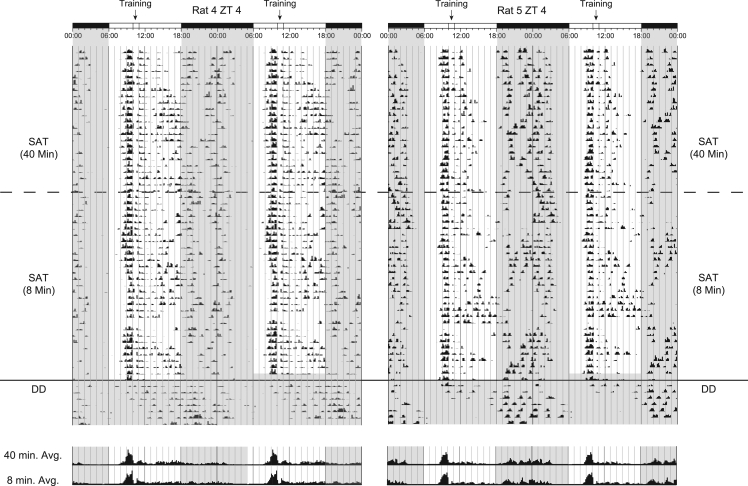
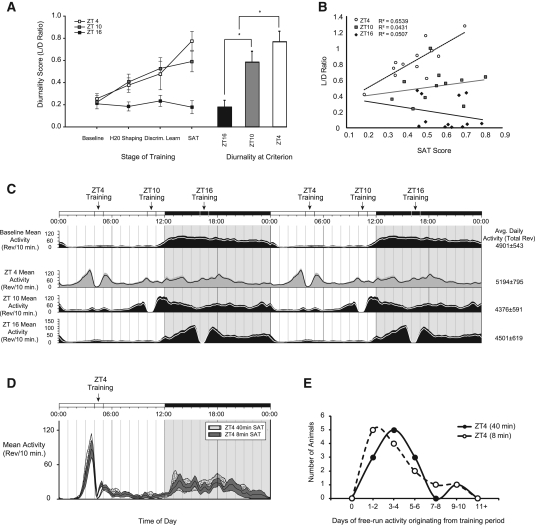
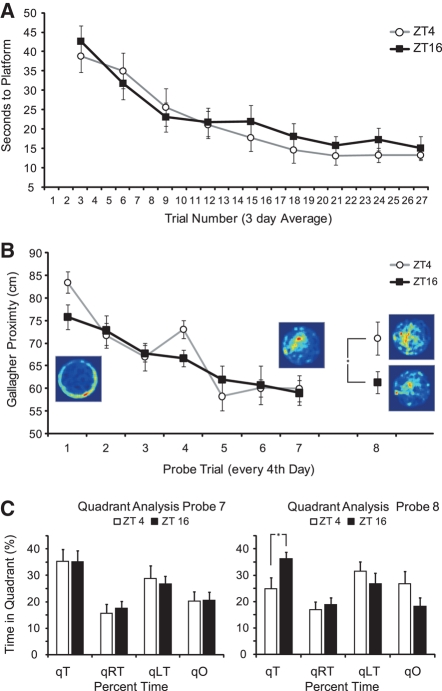
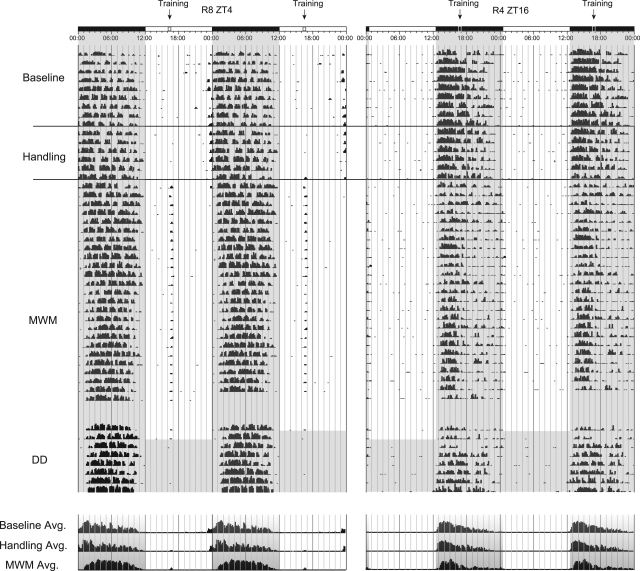
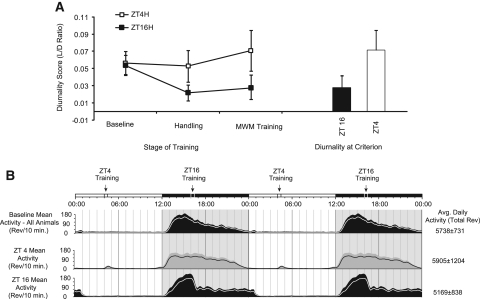
Circadian rhythms influence a variety of physiological and behavioral processes; however, little is known about how circadian rhythms interact with the organisms' ability to acquire and retain information about their environment. These experiments tested whether rats trained outside their endogenous active period demonstrate the same rate of acquisition, daily performance, and remote memory ability as their nocturnally trained counterparts in tasks of sustained attention and spatial memory. Furthermore, we explored how daily task training influenced circadian patterns of activity. We found that rats demonstrate better acquisition and performance on an operant task requiring attentional effort when trained during the dark-phase. Time of day did not affect acquisition or performance on the Morris water maze; however, when animals were retested 2 wk after their last day of training, they showed better remote memory if training originally occurred during the dark-phase. Finally, attentional, but not spatial, task performance during the light-phase promotes a shift toward diurnality and the synchronization of activity to the time of daily training; this shift was most robust when the demands on the cognitive control of attention were highest. Our findings support a theory of bidirectional interactions between cognitive performance and circadian processes and are consistent with the view that the circadian abnormalities associated with shift-work, aging, and neuropsychiatric illnesses may contribute to the deleterious effects on cognition often present in these populations. Furthermore, these findings suggest that time of day should be an important consideration for a variety of cognitive tasks principally used in psychological and neuroscience research.
Figures
References
-
- Aguilar-Valles A, Sanchez E, de Gortari P, Balderas I, Ramirez-Amaya V, Bermudez-Rattoni F, Joseph-Bravo P 2005. Analysis of the stress response in rats trained in the water-maze: Differential expression of corticotropin-releasing hormone, CRH-R1, glucocorticoid receptors, and brain-derived neurotrophic factor in limbic regions. Neuroendocrinology 82: 306–319 - PubMed
-
- Allen PA, Grabbe J, McCarthy A, Bush AH, Wallace B 2008. The early bird does not get the worm: Time-of-day effects on college students' basic cognitive processing. Am J Psychol 121: 551–564 - PubMed
-
- Amir S, Cain S, Sullivan J, Robinson B, Stewart J 1999. Olfactory stimulation enhances light-induced phase shifts in free-running activity rhythms and Fos expression in the suprachiasmatic nucleus. Neuroscience 92: 1165–1170 - PubMed
-
- Arnold HM, Burk JA, Hodgson EM, Sarter M, Bruno JP 2002. Differential cortical acetylcholine release in rats performing a sustained attention task versus behavioral control tasks that do not explicitly tax attention. Neuroscience 114: 451–460 - PubMed
-
- Barnes CA, McNaughton BL, Goddard GV, Douglas RM, Adamec R 1977. Circadian rhythm of synaptic excitability in rat and monkey central nervous system. Science 197: 91–92 - PubMed
Publication types
MeSH terms
Grants and funding
LinkOut - more resources
Full Text Sources
Medical