


Old and new perspectives on peritoneal dialysis in Italy emerging from the Peritoneal Dialysis Study Group Census
- PMID: 22383633
- PMCID: PMC3524866
- DOI: 10.3747/pdi.2011.00112
Old and new perspectives on peritoneal dialysis in Italy emerging from the Peritoneal Dialysis Study Group Census
Abstract
Background: To understand how peritoneal dialysis (PD) was being used in Italy in 2005 and 2008, a census of all centers was carried out.
Methods: In 2005 and 2008, data were collected from, respectively, 222 and 223 centers, with respect to 4432 and 4094 prevalent patients.
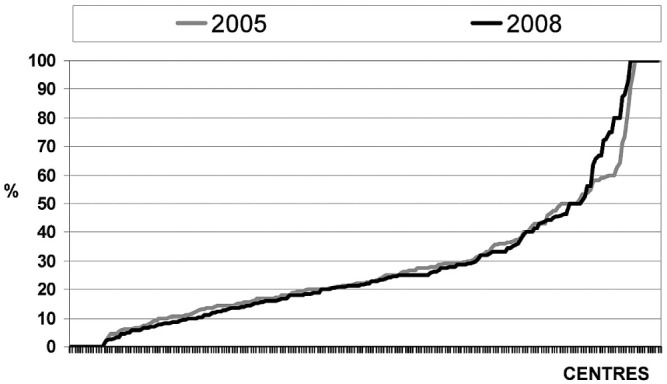
Results: In the two periods, the PD incidence remained stable (24.3% vs 22.9%), varying from center to center. Continuous ambulatory PD (CAPD) was the main initial method (55%), but APD was more widespread among prevalent patients (53%). Among patients returning to dialysis from transplantation (Tx), PD was used in 10%. The use of incremental CAPD increased significantly from 2005 to 2008, in terms both of the number of centers (27.0% vs 40.9%) and of patients (13.6% vs 25.7%). Late referrals remained stable at 28%, with less use of PD. The overall drop-out rate (episodes/100 patient-years) remained unchanged (31.0 vs 32.8), with 13.1 and 12.9 being the result of death, and 11.8 and 12.4 being the result of a switch to hemodialysis, mainly after peritonitis. A dialysis partner was required by 21.8% of the PD patients. The incidence of peritonitis was 1 episode in 36.5 and 41.1 patient-months, with negative cultures occurring in 17.1% of cases in both periods. The incidence of encapsulating peritoneal sclerosis (episodes/100 patient-years) was 0.70, representing 1.26% of patients treated. The catheter types used and the sites and methods of insertion varied widely from center to center.
Conclusions: These censuses confirm the good results of PD in Italy, and provide insight into little-known aspects such as the use of incremental PD, the presence of a dialysis partner, and the incidence of encapsulating peritoneal sclerosis.
Figures
References
-
- Viglino G, Neri L, Alloatti S, Cabiddu G, Cocchi R, Limido A, et al. Analysis of the factors conditioning the diffusion of peritoneal dialysis in Italy. Nephrol Dial Transplant 2007; 22:3601–5 - PubMed
-
- Società Italiana di Nefrologia (SIN). Registro Italiano di Dialisi e Trapianto. Italy: SIN; 2011. [data for 2009]: 14,19 [Available online at: http://www.sin-ridt.org/Italia/Report2009/REPORT%20RIDT%202009.pdf; accessed 11 January 2012]
-
- Società Italiana di Nefrologia (SIN), Gruppo di Studio di Dialisi Peritoneale. La Scelta della Terapia Dialitica [da dicembre 2006 a luglio 2007]. Italy: SIN; 2006. [Available online at: http://www.dialisiperitoneale.org/files/questionario/scelta_trattamento_...; accessed 11 January 2012]
-
- Cabiddu G, Viglino G, Neri L, Filippini A, Limido A, Luchi L, et al. La scelta del trattamento dialitico. Risultati di un questionario del Gruppo di Studio di Dialisi Peritoneale. G Ital Nefrol 2008; 25(Suppl 39):S40
-
- Viglino G, Neri L. Theory and reality in the selection of peritoneal dialysis. Perit Dial Int 2008; 28:480–3 - PubMed
MeSH terms
LinkOut - more resources
Full Text Sources
