


Simultaneous screening of multiple mutations by invader assay improves molecular diagnosis of hereditary hearing loss: a multicenter study
- PMID: 22384008
- PMCID: PMC3286470
- DOI: 10.1371/journal.pone.0031276
Simultaneous screening of multiple mutations by invader assay improves molecular diagnosis of hereditary hearing loss: a multicenter study
Abstract
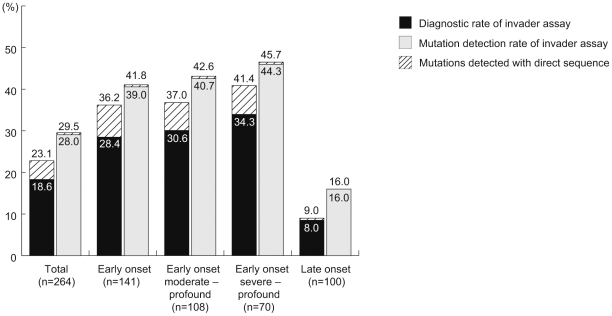
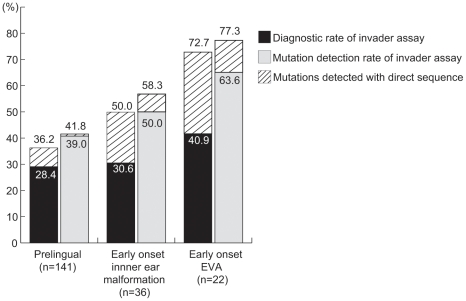
Although etiological studies have shown genetic disorders to be a common cause of congenital/early-onset sensorineural hearing loss, there have been no detailed multicenter studies based on genetic testing. In the present report, 264 Japanese patients with bilateral sensorineural hearing loss from 33 ENT departments nationwide participated. For these patients, we first applied the Invader assay for screening 47 known mutations of 13 known deafness genes, followed by direct sequencing as necessary. A total of 78 (29.5%) subjects had at least one deafness gene mutation. Mutations were more frequently found in the patients with congenital or early-onset hearing loss, i.e., in those with an awareness age of 0-6 years, mutations were significantly higher (41.8%) than in patients with an older age of awareness (16.0%). Among the 13 genes, mutations in GJB2 and SLC26A4 were mainly found in congenital or early-onset patients, in contrast with mitochondrial mutations (12S rRNA m.1555A>G, tRNA(Leu(UUR)) m.3243A>G), which were predominantly found in older-onset patients. The present method of simultaneous screening of multiple deafness mutations by Invader assay followed by direct sequencing will enable us to detect deafness mutations in an efficient and practical manner for clinical use.
Conflict of interest statement
Figures
References
-
- Morton CC, Nance WE. Newborn hearing screening: a silent revolution. N Engl J Med. 2006;354:2151–2164. - PubMed
-
- Abe S, Yamaguchi T, Usami S. Application of deafness diagnostic screening panel based on deafness mutation/gene database using Invader Assay. Genetic Testing. 2007;11(3):333–340. - PubMed
-
- Usami S, Abe S, Weston MD, Shinkawa H, Van Camp G, et al. Non-syndromic hearing loss associated with enlarged vestibular aqueduct is caused by PDS mutations. Hum Genet. 1999;104:188–192. - PubMed
-
- Ohtsuka A, Yuge I, Kimura S, Namba A, Abe S, et al. GJB2 deafness gene shows a specific spectrum of mutations in Japan, including a frequent founder mutation. Hum Genet. 2003;112:329–333. - PubMed
-
- Tsukada K, Nishio S, Usami S. A large cohort study of GJB2 mutations in Japanese hearing loss patients. Clin Genet. 2010;78:464–470. - PubMed
Publication types
MeSH terms
Substances
LinkOut - more resources
Full Text Sources
Research Materials
Miscellaneous
