


Exploiting magnetic resonance angiography imaging improves model estimation of BOLD signal
- PMID: 22384043
- PMCID: PMC3285158
- DOI: 10.1371/journal.pone.0031612
Exploiting magnetic resonance angiography imaging improves model estimation of BOLD signal
Abstract
The change of BOLD signal relies heavily upon the resting blood volume fraction ([Formula: see text]) associated with regional vasculature. However, existing hemodynamic data assimilation studies pretermit such concern. They simply assign the value in a physiologically plausible range to get over ill-conditioning of the assimilation problem and fail to explore actual [Formula: see text]. Such performance might lead to unreliable model estimation. In this work, we present the first exploration of the influence of [Formula: see text] on fMRI data assimilation, where actual [Formula: see text] within a given cortical area was calibrated by an MR angiography experiment and then was augmented into the assimilation scheme. We have investigated the impact of [Formula: see text] on single-region data assimilation and multi-region data assimilation (dynamic cause modeling, DCM) in a classical flashing checkerboard experiment. Results show that the employment of an assumed [Formula: see text] in fMRI data assimilation is only suitable for fMRI signal reconstruction and activation detection grounded on this signal, and not suitable for estimation of unobserved states and effective connectivity study. We thereby argue that introducing physically realistic [Formula: see text] in the assimilation process may provide more reliable estimation of physiological information, which contributes to a better understanding of the underlying hemodynamic processes. Such an effort is valuable and should be well appreciated.
Conflict of interest statement
Figures

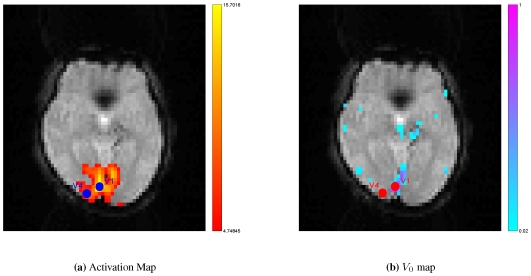
 : Primary visual cortex;
  : Visual area
  ).
).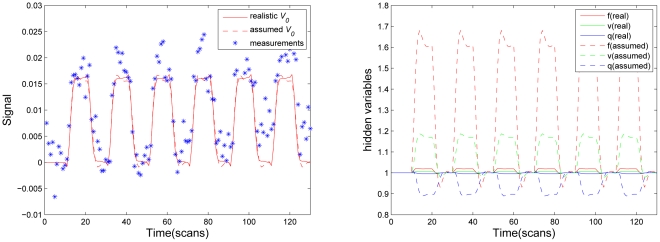
 . Real
  value is
  .
.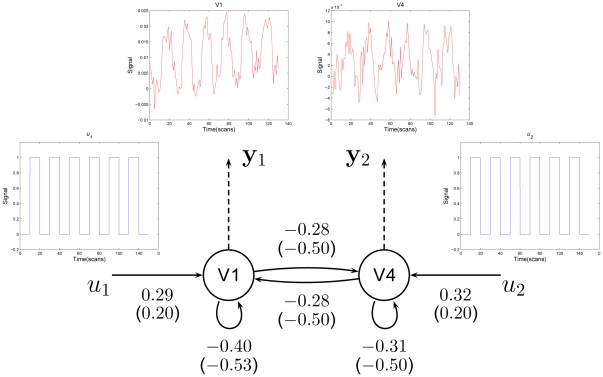
 are shown alongside the corresponding connections. The values in brackets are parameters estimated with assumed
  .
.  in visual area V
 ,
,  in V
in V and assumed
  in two areas.
  and
and  represent external inputs into the system;
  and
and  are the hemodynamic observations and arrows indicate connections.
References
-
- Buxton RB, Wong EC, Frank LR. Dynamics of Blood Flow and Oxygenation Changes During Brain Activation: The Balloon Model. Magnetic Resonance in Medicine. 1998;39:855–864. - PubMed
-
- Buxton RB, Frank LR. A model for the coupling between cerebral blood flow and oxygen metabolism during neural stimulation. Journal of Cerebral Blood & Flow Metabolism. 1997;17:64–72. - PubMed
-
- Friston KJ, Mechelli A, Turner R, Price CJ. Nonlinear Responses in fMRI: The Balloon Model, Volterra Kernels, and Other Hemodynamics. NeuroImage. 2000;12:466–477. - PubMed
-
- Riera JJ, Watanabe J, Kazuki I, Naoki M, Aubert E, et al. A State-space Model of the Hemodynamic Approach: Nonlinear Filtering of BOLD Signals. NeuroImage. 2004;21:547–567. - PubMed
-
- Johnston LA, Duff E, Egan GF. Particle Filtering for Nonlinear BOLD Signal Analysis. 2006. pp. 292–299. In: 9th International Conference on Medical Image Computing and Computer Assisted Intervention (MICCAI). Copenhagen, Denmark. - PubMed
Publication types
MeSH terms
Substances
LinkOut - more resources
Full Text Sources
Medical
