


No evolutionary shift in the mating system of north American Ambrosia artemisiifolia (Asteraceae) following its introduction to China
- PMID: 22384104
- PMCID: PMC3285193
- DOI: 10.1371/journal.pone.0031935
No evolutionary shift in the mating system of north American Ambrosia artemisiifolia (Asteraceae) following its introduction to China
Abstract
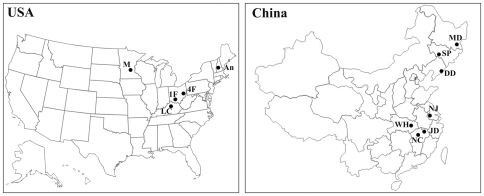
The mating system plays a key role during the process of plant invasion. Contemporary evolution of uniparental reproduction (selfing or asexuality) can relieve the challenges of mate limitation in colonizing populations by providing reproductive assurance. Here we examined aspects of the genetics of colonization in Ambrosia artemisiifolia, a North American native that is invasive in China. This species has been found to possess a strong self-incompatibility system and have high outcrossing rates in North America and we examined whether there has been an evolutionary shift towards the dependence on selfing in the introduced range. Specifically, we estimated outcrossing rates in one native and five invasive populations and compared levels of genetic diversity between North America and China. Based on six microsatellite loci we found that, like the native North American population, all five Chinese populations possessed a completely outcrossing mating system. The estimates of paternity correlations were low, ranging from 0.028-0.122, which suggests that populations possessed ~8-36 pollen donor parents contributing to each maternal plant in the invasive populations. High levels of genetic diversity for both native and invasive populations were found with the unbiased estimate of gene diversity ranging from 0.262-0.289 for both geographic ranges based on AFLP markers. Our results demonstrate that there has been no evolutionary shift from outcrossing to selfing during A. artemisiifolia's invasion of China. Furthermore, high levels of genetic variation in North America and China indicate that there has been no erosion of genetic variance due to a bottleneck during the introduction process. We suggest that the successful invasion of A. artemisiifolia into Asia was facilitated by repeated introductions from multiple source populations in the native range creating a diverse gene pool within Chinese populations.
Conflict of interest statement
Figures
References
-
- Barrett SCH, Husband BC. The genetics of plant migration and colonization. In: Brown AHD, Clegg MT, Kahler AL, Weir BS, editors. Plant population genetics, breeding, and genetic resources. Sunderland, Massachusetts: Sinauer & Associates; 1990. pp. 254–277.
-
- Brown AHD, Marshall DR. Evolutionary changes accompanying colonization in plants. In: Scudder GGE, Reveal JL, editors. Evolution today: Proceedings of the second international congress of systematic and evolutionary biology. Pittsburgh: Hunt Institute for Botanical Documentation, Carnegie-Mellon; 1981. pp. 351–363.
-
- Sakai AK, Allendorf FW, Holt JS, Lodge DM, Molofsky J, et al. The population biology of invasive species. Annual Review of Ecology and Systematics. 2001;32:305–332.
-
- Busch JW, Schoen DJ. The evolution of self-incompatibility when mates are limiting. Trends in Plant Science. 2008;13:128–136. - PubMed
Publication types
MeSH terms
LinkOut - more resources
Full Text Sources
