


Diagnosis of Parkinson's disease based on disease-specific autoantibody profiles in human sera
- PMID: 22384236
- PMCID: PMC3285212
- DOI: 10.1371/journal.pone.0032383
Diagnosis of Parkinson's disease based on disease-specific autoantibody profiles in human sera
Abstract
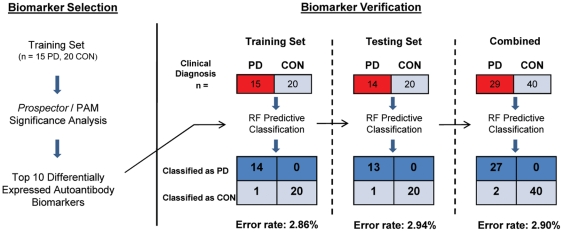
Parkinson's disease (PD), hallmarked by a variety of motor disorders and neurological decline, is the second most common neurodegenerative disease worldwide. Currently, no diagnostic test exists to identify sufferers, and physicians must rely on a combination of subjective physical and neurological assessments to make a diagnosis. The discovery of definitive blood-borne biomarkers would be a major step towards early and reliable diagnosis. Despite attention devoted to this search, such biomarkers have remained elusive. In the present study, we used human protein microarrays to reveal serum autoantibodies that are differentially expressed among PD and control subjects. The diagnostic significance of each of these autoantibodies was evaluated, resulting in the selection of 10 autoantibody biomarkers that can effectively differentiate PD sera from control sera with a sensitivity of 93.1% and specificity of 100%. PD sera were also distinguishable from sera obtained from Alzheimer's disease, breast cancer, and multiple sclerosis patients with accuracies of 86.0%, 96.6%, and 100%, respectively. Results demonstrate that serum autoantibodies can be used as highly specific and accurate biomarkers for PD diagnosis throughout the course of the disease.
Conflict of interest statement
Figures

References
-
- de Lau LML, Breteler MMB. Epidemiology of Parkinson's disease. Lancet Neurol. 2006;5:525–535. - PubMed
-
- Jankovic J. Parkinson's disease: clinical features and diagnosis. J Neurol Neurosurg Psychiatry. 2008;79:368–376. - PubMed
-
- Hornykiewicz O. The discovery of dopamine deficiency in the parkinsonian brain. J Neural Transm Suppl. 2006:9–15. - PubMed
-
- Birkmayer W, Hornykiewicz O. [The L-3,4-dioxyphenylalanine (DOPA)-effect in Parkinson-akinesia]. Wien Klin Wochenschr. 1961;73:787–788. - PubMed
-
- Gaig C, Tolosa E. When does Parkinson's disease begin? Mov Disord. 2009;24(Suppl 2):S656–664. - PubMed
Publication types
MeSH terms
Substances
LinkOut - more resources
Full Text Sources
Other Literature Sources
Medical
Molecular Biology Databases
