


Conditionally immortalized mouse embryonic fibroblasts retain proliferative activity without compromising multipotent differentiation potential
- PMID: 22384246
- PMCID: PMC3285668
- DOI: 10.1371/journal.pone.0032428
Conditionally immortalized mouse embryonic fibroblasts retain proliferative activity without compromising multipotent differentiation potential
Erratum in
- PLoS One. 2013;8(1). doi: 10.1371/annotation/2f1c6442-0ecb-4a33-9534-aae89b5fbbc1 doi: 10.1371/annotation/2f1c6442-0ecb-4a33-9534-aae89b5fbbc1
Abstract
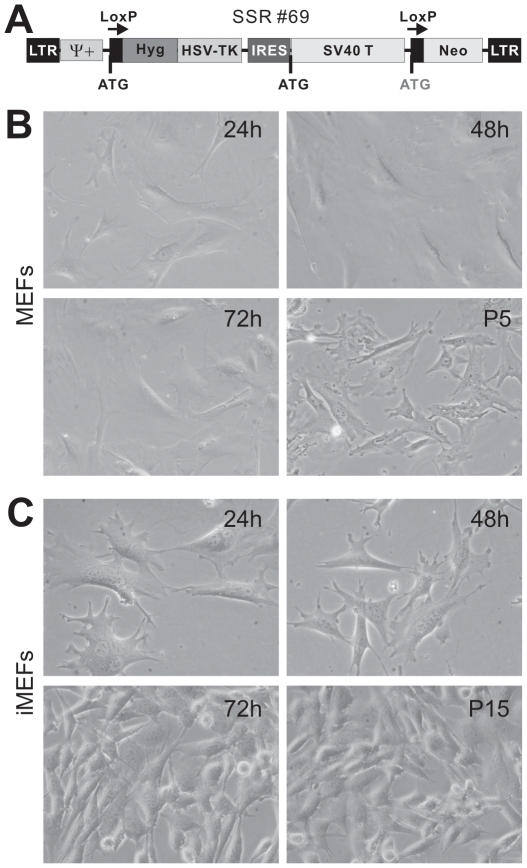
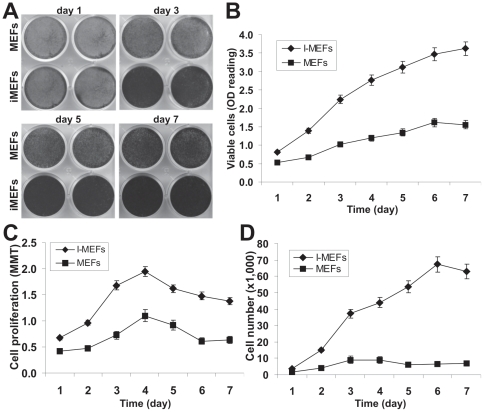
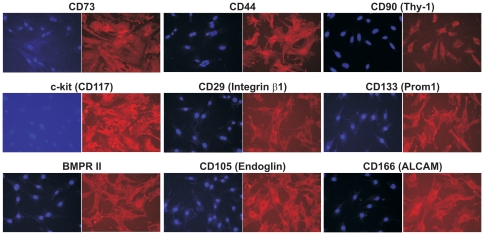
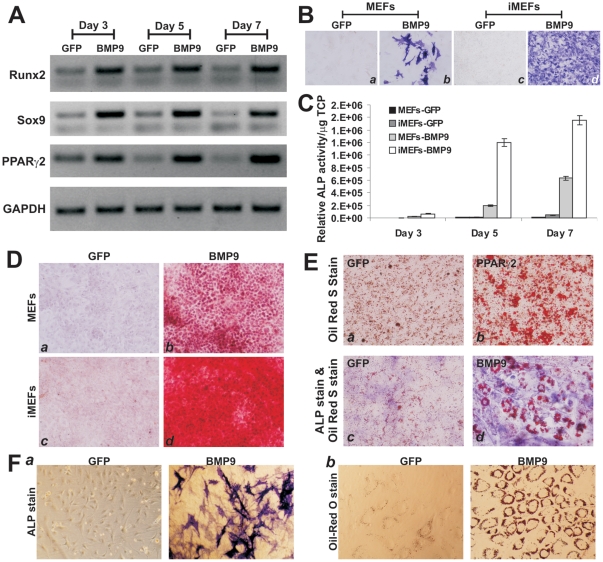
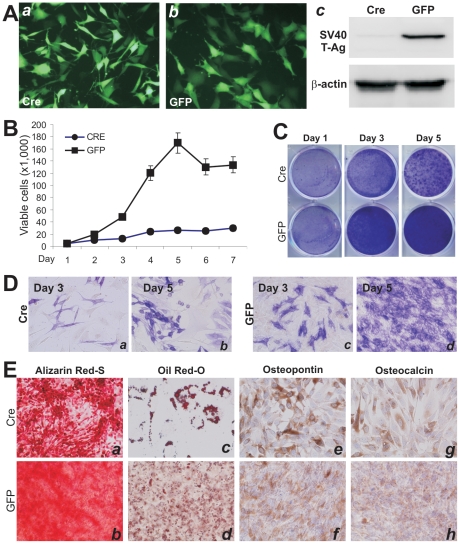
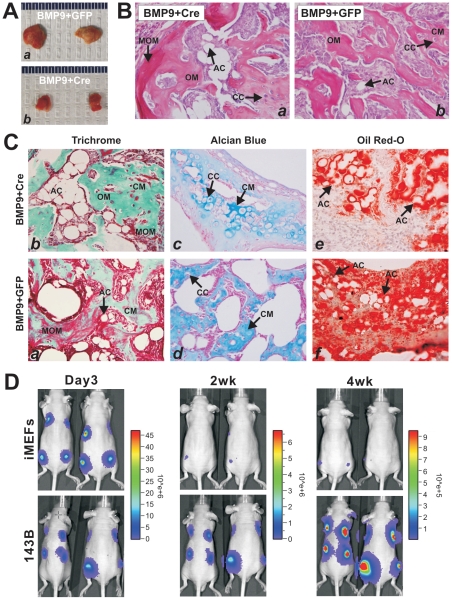
Mesenchymal stem cells (MSCs) are multipotent cells which reside in many tissues and can give rise to multiple lineages including bone, cartilage and adipose. Although MSCs have attracted significant attention for basic and translational research, primary MSCs have limited life span in culture which hampers MSCs' broader applications. Here, we investigate if mouse mesenchymal progenitors can be conditionally immortalized with SV40 large T antigen and maintain long-term cell proliferation without compromising their multipotency. Using the system which expresses SV40 large T antigen flanked with Cre/loxP sites, we demonstrate that mouse embryonic fibroblasts (MEFs) can be efficiently immortalized by SV40 large T antigen. The conditionally immortalized MEFs (iMEFs) exhibit an enhanced proliferative activity and maintain long-term cell proliferation, which can be reversed by Cre recombinase. The iMEFs express most MSC markers and retain multipotency as they can differentiate into osteogenic, chondrogenic and adipogenic lineages under appropriate differentiation conditions in vitro and in vivo. The removal of SV40 large T reduces the differentiation potential of iMEFs possibly due to the decreased progenitor expansion. Furthermore, the iMEFs are apparently not tumorigenic when they are subcutaneously injected into athymic nude mice. Thus, the conditionally immortalized iMEFs not only maintain long-term cell proliferation but also retain the ability to differentiate into multiple lineages. Our results suggest that the reversible immortalization strategy using SV40 large T antigen may be an efficient and safe approach to establishing long-term cell culture of primary mesenchymal progenitors for basic and translational research, as well as for potential clinical applications.
Conflict of interest statement
Figures
References
-
- Prockop DJ. Marrow stromal cells as stem cells for nonhematopoietic tissues. Science. 1997;276:71–74. - PubMed
-
- Pittenger MF, Mackay AM, Beck SC, Jaiswal RK, Douglas R, et al. Multilineage potential of adult human mesenchymal stem cells. Science. 1999;284:143–147. - PubMed
-
- Caplan AI, Bruder SP. Mesenchymal stem cells: building blocks for molecular medicine in the 21st century. Trends in Mol Med. 2001;7:259–264. - PubMed
Publication types
MeSH terms
Substances
LinkOut - more resources
Full Text Sources
Other Literature Sources
