


Immunology in the clinic review series; focus on type 1 diabetes and viruses: role of antibodies enhancing the infection with Coxsackievirus-B in the pathogenesis of type 1 diabetes
- PMID: 22385236
- PMCID: PMC3390492
- DOI: 10.1111/j.1365-2249.2011.04559.x
Immunology in the clinic review series; focus on type 1 diabetes and viruses: role of antibodies enhancing the infection with Coxsackievirus-B in the pathogenesis of type 1 diabetes
Abstract
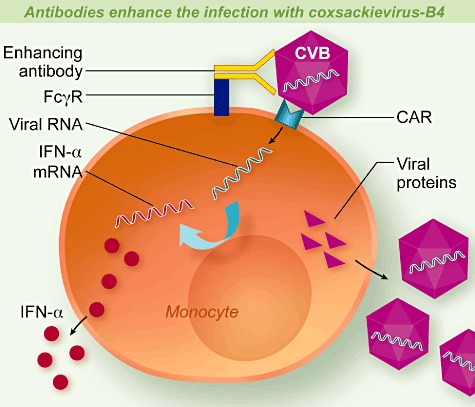
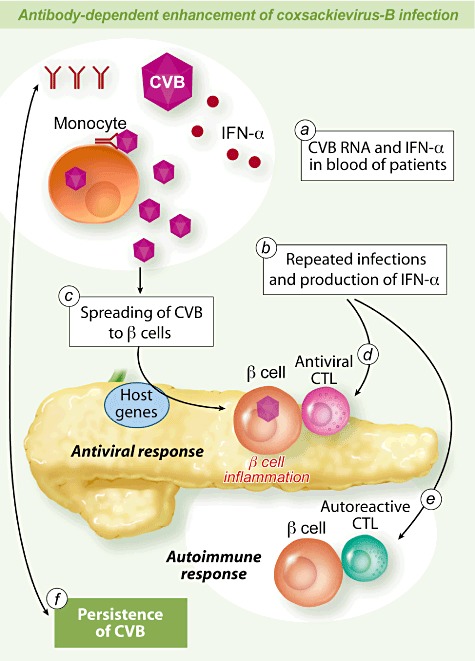
Type 1 diabetes results from an interaction between genetic and environmental factors. Coxsackieviruses B (CV-B) are major environmental candidates, as suggested by epidemiological and experimental studies. The mechanisms leading to the disease involve interactions between the virus, host target tissue (pancreas) and the immune system. The infection of target cells with viruses can be prevented by antibodies. Conversely, the infection can be enhanced by antibodies. The antibody-dependent enhancement (ADE) of infection has been described with various viruses, especially Picornaviruses. In mice infected with CV-B3 this phenomenon resulted in an extended inflammatory reaction and myocarditis. In the human system non-neutralizing antibodies can increase the infection of monocytes with CV-B4 and stimulate the production of interferon (IFN)-α by these cells in vitro. CV-B4/immunoglobulin (Ig)G immune complexes interacted with a specific viral receptor [Coxsackievirus and adenovirus receptor (CAR)] and with IgG Fc fraction receptors (FcγRII and FcγRIII) at the surface of monocytes. The virus-antibody complexes are internalized (CAR) and receptors for the Fc of IgG (FcγRII and FcγRIII). Such antibodies have been detected in patients with type 1 diabetes and they could be responsible for the presence of enteroviral RNA and IFN-α in peripheral blood mononuclear cells (PBMC) of these individuals. The target of enhancing antibodies has been identified as the VP4 protein, which allowed the detection of these antibodies by enzyme-linked immunosorbent assay (ELISA). It cannot be excluded that antibodies enhancing the infection with CV-B may play a role in the pathogenesis of type 1 diabetes, induced or aggravated by these viruses. They can cause a viral escape from the immune response and may participate in the spreading of viruses to β cells. Whether enhancing antibodies raised against VP4 can play a role in iterative homologous and/or heterologous CV-B infections and in the persistence of viruses within the host deserves further study.
© 2011 The Authors. Clinical and Experimental Immunology © 2011 British Society for Immunology.
Figures
References
-
- Vehik K, Dabelea D. The changing epidemiology of type 1 diabetes: why is it going through the roof? Diabetes Metab Res Rev. 2011;27:3–13. - PubMed
-
- Kondrashova A, Reunanen A, Romanov A, et al. A six-fold gradient in the incidence of type 1 diabetes at the eastern border of Finland. Ann Med. 2005;37:67–72. - PubMed
-
- Jaïdane H, Hober D. Role of coxsackievirus B4 in the pathogenesis of type 1 diabetes. Diabetes Metab. 2008;34:537–48. - PubMed
-
- Jaïdane H, Sane F, Gharbi J, Aouni M, Romond MB, Hober D. Coxsackievirus B4 and type 1 diabetes pathogenesis: contribution of animal models. Diabetes Metab Res Rev. 2009;25:591–603. - PubMed
-
- Jaïdane H, Sauter P, Sane F, Goffard A, Gharbi J, Hober D. Enteroviruses and type 1 diabetes: towards a better understanding of the relationship. Rev Med Virol. 2010;20:265–80. - PubMed
Publication types
MeSH terms
Substances
LinkOut - more resources
Full Text Sources
Medical
