. 2012 Apr;168(1):113-24.
doi: 10.1111/j.1365-2249.2011.04549.x.

Mechanical stress-activated immune response genes via Sirtuin 1 expression in human periodontal ligament cells

Affiliations

Mechanical stress-activated immune response genes via Sirtuin 1 expression in human periodontal ligament cells

S-I Lee et al. Clin Exp Immunol. 2012 Apr.

Abstract

Recently, Sirtuin 1 (SIRT1) has been implicated in the molecular control of ageing and immune response. Although the remodelling of periodontal ligament (PDL) in response to mechanical stress (MS) is mediated by several host factors, including cytokines and chemokines, the transmission of mechanical stimuli into specific cellular activity is still not understood fully. This study aimed to investigate the effects of MS, particularly cyclic strain, on immune response genes, as well as SIRT1 and its signal transduction pathways, in human PDL cells. MS up-regulated the expression of SIRT1 and immune response genes encoding cytokines [tumour necrosis factor (TNF)-α, interleukin (IL)-1β], chemokines [IL-8, monocyte cheoattractant protein (CCL)-20], defensins [human β-defensin (hBD)-2, hBD-3] and Toll-like receptors (TLR-2 and TLR-4) in a force- and time-dependent manner. The SIRT1 inducers resveratrol and isonicotinamide attenuated MS-induced cytokine and chemokine expression, but enhanced the expression of defensins and TLRs. Blockade of SIRT1 activity by the SIRT1 inhibitors sirtinol and nicotinamide and down-regulation of SIRT1 expression by SIRT1 siRNA reduced the stimulatory effects of MS on defensins and TLRs, but increased its effects on cytokines and chemokines. MS induced activation of protein kinase B (Akt), protein kinase C (PKC), nuclear factor (NF)-κB and p38 mitogen-activated protein kinase (MAPK), c-Jun N-terminal kinase (JNK) and extracellular signal-regulated kinase (ERK). Treatment with the anti-oxidants N-acetylcysteine and glutathione inhibited MS-induced reactive oxygen species production and expression of cytokines, chemokines, defensins and TLRs. These results suggest that MS activates human PDL cells to express immune/defence genes encoding cytokines, chemokines, defensins and TLRs via a SIRT1 pathway.


Figures

Fig. 1
Fig. 1
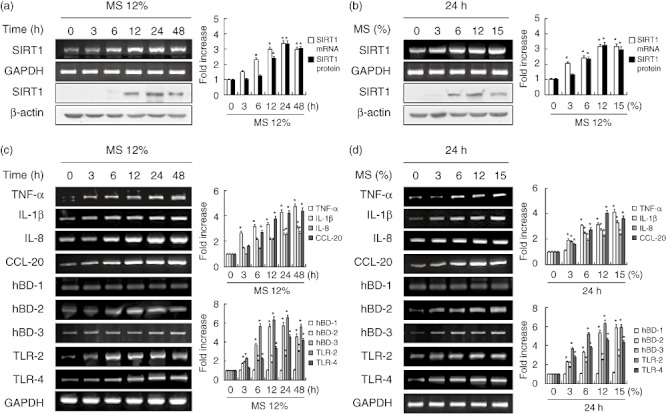
Effects of mechanical stress (MS) on the expression of Sirtuin 1 (SIRT1) and immune response genes in periodontal ligament (PDL) cells. Cells were cultured with or without MS for up to 48 h (a) and under a MS force of 3–15% (b). mRNA and protein expression levels were examined by reverse transcription–polymerase chain reaction (RT–PCR) and Western blotting, respectively. The data are representative of three independent experiments. The bar graph shows the fold increase in protein or mRNA expression compared to control cells. Columns show mean values of triplicate samples and error bars represent the standard deviation. *Statistically significant differences compared with the control, P < 0·05.
Fig. 2
Fig. 2
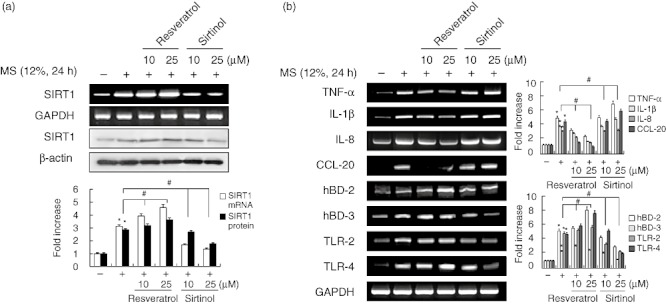
Effects of the Sirtuin 1 (SIRT1) activator resveratrol and SIRT1 inhibitor sirtinol on mechanical stress (MS)-induced immune gene expression in periodontal ligament (PDL) cells. Cells were pretreated with resveratrol or sirtinol for 2 h, and then exposed to MS (12%) for 24 h. mRNA and protein expression were examined by reverse transcription–polymerase chain reaction (RT–PCR) and Western blotting, respectively. The data are representative of three independent experiments. The bar graph shows the fold increase in protein or RNA expression compared to control cells. *Statistically significant differences compared with the control, P < 0·05.
Fig. 3
Fig. 3
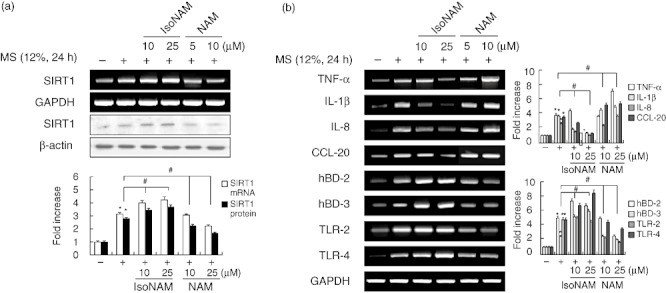
Effects of the Sirtuin 1 (SIRT1) activator isonicotinamide and SIRT1 inhibitor nicotinamide on mechanical stress (MS)-induced immune gene expression in periodontal ligament (PDL) cells. Cells were pretreated with isonicotinamide (IsoNAM) or nicotinamide (NAM) for 2 h, and then exposed to MS (12%) for 24 h. mRNA and protein expression levels were examined by reverse transcription–polymerase chain reaction (RT–PCR) and Western blotting, respectively. The data are representative of three independent experiments. The bar graph shows the fold increase in protein or mRNA expression compared to control cells. *Statistically significant differences compared with the control, P < 0·05.
Fig. 4
Fig. 4
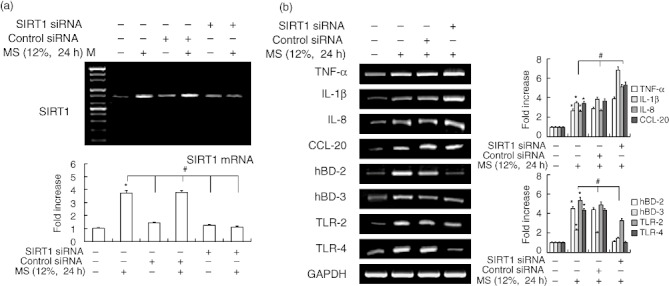
Effect of Sirtuin 1 (SIRT1) siRNA on mechanical stress (MS)-induced immune gene expression in periodontal ligament (PDL) cells. Cells were transfected with control siRNA or SIRT1 siRNA (80 nM), and then exposed to MS (12%) for 24 h. mRNA expression was examined by reverse transcription–polymerase chain reaction (RT–PCR). The data are representative of three independent experiments. The bar graph shows the fold increase in mRNA expression compared to control cells. Columns show mean values of triplicate samples and error bars represent the standard deviation. *Statistically significant differences compared with the control, P < 0·05.
Fig. 5
Fig. 5
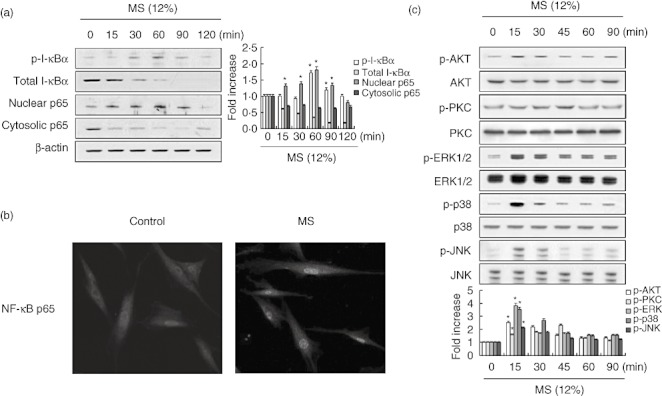
Effect of mechanical stress (MS) on the activation of NF-κB (a, b) and mitogen-activated protein kinase (MAPK), phosphoinositide 3 kinase (PI3K) and protein kinase C (PKC) (c) in periodontal ligament (PDL) cells. Cells were cultured without or with MS (12%) for the indicated time-periods. Cells were analysed by Western blotting (a,c) and confocal microscopy (b). The nuclear translocation of nuclear factor (NF)-κB was detected by indirect immunofluorescence labelling using monoclonal anti-NF-κB antibody followed by fluorescein isothiocyanate (FITC)-conjugated anti-mouse immunoglobulin (magnification ×400). The results are representative of three independent experiments. The bar graph shows the fold increase in protein expression compared to control cells. *Statistically significant differences compared with the control, P < 0·05.
Fig. 6
Fig. 6
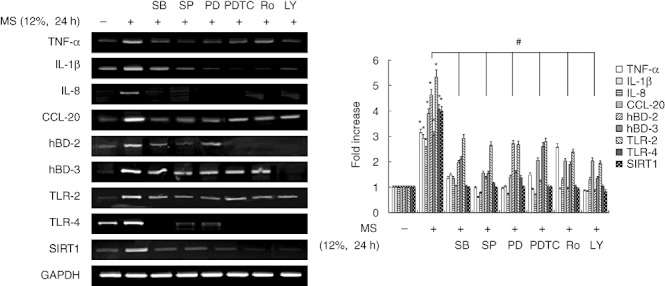
Effects of signal transduction inhibitors on mechanical stress (MS)-induced immune gene expression in periodontal ligament (PDL) cells. Cells were pretreated with the extracellular-regulated kinase (ERK) inhibitor SB203580 (20 µM), the p38 mitogen-activated protein kinase (MAPK) inhibitor PD98059 (20 µM), the c-Jun N-terminal kinase (JNK) inhibitor SP600125 (20 µM), the phosphoinositide 3 kinase (PI3K) inhibitor LY694002 (10 µM), the protein kinase C (PKC) inhibitor Ro-318220 (10 µM) or the nuclear factor (NF)-κB inhibitor pyrrolidine dithiocarbonate (PDTC) (10 µM) for 1 h, and then exposed to MS (12%) for 24 h. mRNA expression was examined by reverse transcription–polymerase chain reaction (RT–PCR). The data are representative of three independent experiments. The bar graph shows the fold increase in mRNA expression compared to control cells. *Statistically significant differences compared with the control, P < 0·05.
Fig. 7
Fig. 7
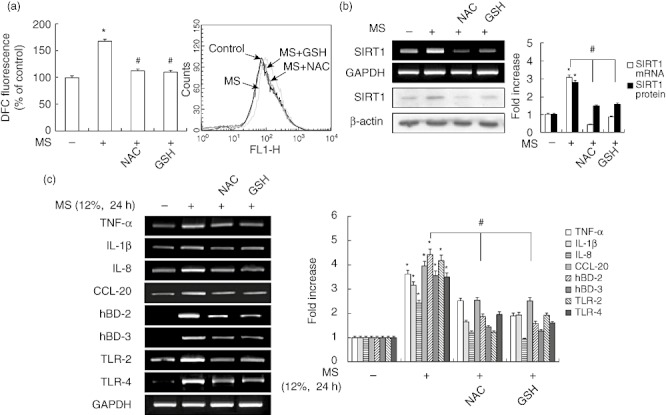
Effects of the anti-oxidants N-acetylcysteine (NAC) and glutathione (GSH) on mechanical stress (MS)-induced immune gene expression and reactive oxygen species (ROS) production in periodontal ligament (PDL) cells. Cells were pretreated with NAC (20 mM) or GSH (5 mM) for 2 h, and then exposed to MS (12%) for 24 h. ROS production was assayed by flow cytometry. mRNA and protein expression levels were examined by reverse transcription–polymerase chain reaction (RT–PCR) and Western blotting, respectively. The bar graph shows the fold increase in protein or mRNA expression compared to control cells. *P < 0·05 versus untreated control; #P < 0·05 versus cells exposed to MS.
Fig. 8
Fig. 8
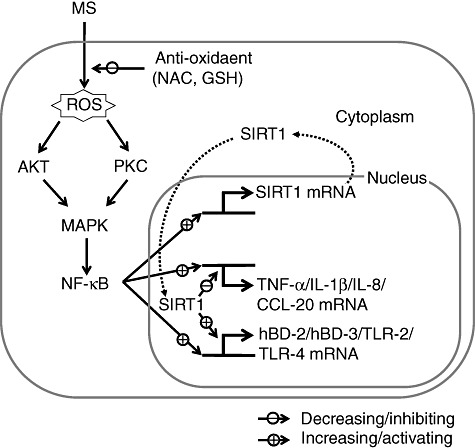
Schematic diagram illustrating the activation of immune genes [human β-defensin (hBD)-2, hBD-3, Toll-like receptor (TLR)-2 and TLR-4], cytokines, and chemokines [tumour necrosis factor (TNF)-α, interleukin (IL)-1β, IL-8 and monocyte chemoattractant protein (CCL)-20] via the Sirtuin 1 (SIRT1) pathway triggered by exposure to mechanical stress (MS) in periodontal ligament (PDL) cells.

References

    1. Davidovitch Z. Tooth movement. Crit Rev Oral Biol Med. 1991;2:411–50. - PubMed
    1. Tosi MF. Immune responses to infection. J Allergy Clin Immunol. 2005;116:241–9. - PubMed
    1. Charo IF, Ransohoff RM. The many roles of chemokines and chemokine receptors in inflammation. N Engl J Med. 2006;354:610–21. - PubMed
    1. Koyama Y, Mitsui N, Suzuki N, et al. Effect of compressive force on the expression of inflammatory cytokines and their receptors in osteoblastic Saos-2 cells. Arch Oral Biol. 2008;53:488–96. - PubMed
    1. Alhashimi N, Frithiof L, Brudvik P, Bakhiet M. Chemokines are upregulated during orthodontic tooth movement. J Interferon Cytokine Res. 1999;19:1047–52. - PubMed

Publication types

MeSH terms

Substances