


Assessment of the human faecal microbiota: II. Reproducibility and associations of 16S rRNA pyrosequences
- PMID: 22385292
- PMCID: PMC3369017
- DOI: 10.1111/j.1365-2362.2012.02659.x
Assessment of the human faecal microbiota: II. Reproducibility and associations of 16S rRNA pyrosequences
Abstract
Background: We conducted a pilot study of reproducibility and associations of microbial diversity and composition in faecal microbial DNA.
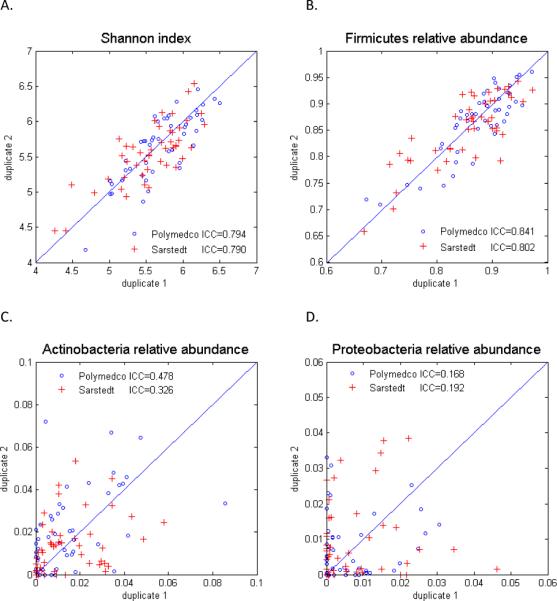
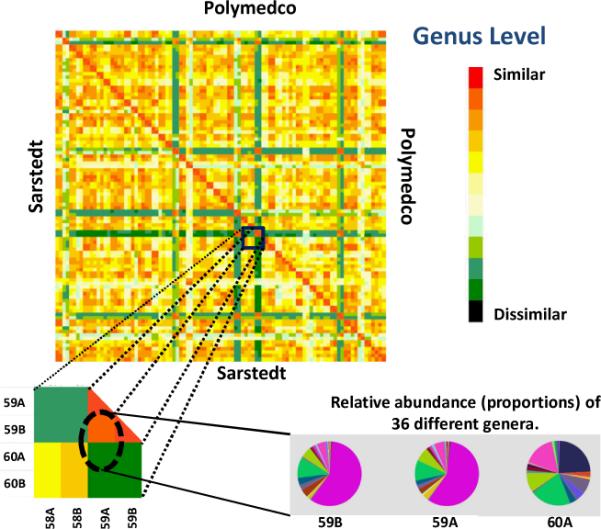
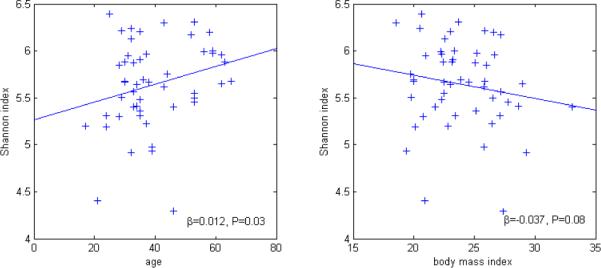
Methods and results: Participants (25 men and 26 women, aged 17-65 years) provided questionnaire data and multiple samples of one stool collected with two Polymedco and two Sarstedt devices preloaded with RNAlater. 16S rRNA genes in each faecal DNA aliquot were amplified, sequenced (Roche/454 Life Sciences) and assigned to taxa. Devices were compared for ease of use and reproducibility [intraclass correlation coefficient (ICC)] between duplicate aliquots on diversity and taxonomic assignment. Associations were tested by linear regression. Both collection devices were easy to use. Both alpha diversity (Shannon index) and beta diversity (UniFrac) were higher between than within duplicates (P ≤ 10(-8) ) and did not differ significantly by device (P ≥ 0·62). Reproducibility was good (ICC≥0·77) for alpha diversity and taxonomic assignment to the most abundant phyla, Firmicutes and Bacteroidetes (71·5% and 25·0% of sequences, respectively), but reproducibility was low (ICC≤0·48) for less abundant taxa. Alpha diversity was lower with nonantibiotic prescription medication (P = 0·02), with younger age (P = 0·03) and marginally with higher body mass index (P = 0·08).
Conclusions: With sampling from various parts of a stool, both devices provided good reproducibility on overall microbial diversity and classification for the major phyla, but not for minor phyla. Implementation of these methods should provide insights into how broad microbial parameters, but not necessarily rare microbes, affect risk of various conditions.
© 2012 The Authors. European Journal of Clinical Investigation © 2012 Stichting European Society for Clinical Investigation Journal Foundation.
Figures
References
Publication types
MeSH terms
Substances
Grants and funding
LinkOut - more resources
Full Text Sources
Other Literature Sources
Medical
