. 2012 Jun;136(2):231-40.
doi: 10.1111/j.1365-2567.2012.03575.x.

Mycobacterium tuberculosis Rv0652 stimulates production of tumour necrosis factor and monocytes chemoattractant protein-1 in macrophages through the Toll-like receptor 4 pathway

Affiliations

Mycobacterium tuberculosis Rv0652 stimulates production of tumour necrosis factor and monocytes chemoattractant protein-1 in macrophages through the Toll-like receptor 4 pathway

Kwangwook Kim et al. Immunology. 2012 Jun.

Abstract

Mycobacterial proteins interact with host macrophages and modulate their functions and cytokine gene expression profile. The protein Rv0652 is abundant in culture filtrates of Mycobacterium tuberculosis K-strain, which belongs to the Beijing family, compared with levels in the H37Rv and CDC1551 strains. Rv0652 induces strong antibody responses in patients with active tuberculosis. We investigated pro-inflammatory cytokine production induced by Rv0652 in murine macrophages and the roles of signalling pathways. In RAW264.7 cells and bone marrow-derived macrophages, recombinant Rv0652 induced predominantly tumour necrosis factor (TNF) and monocyte chemoattractant protein (MCP)-1 production, which was dependent on mitogen-activated protein kinases and nuclear factor-κB. Specific signalling pathway inhibitors revealed that the extracellular signal-regulated kinase 1/2 (ERK1/2), p38 and phosphatidylinositol 3-kinase (PI3K) pathways were essential for Rv0652-induced TNF production, whereas the ERK1/2 and PI3K pathways, but not the p38 pathway, were critical for MCP-1 production in macrophages. Rv0652-stimulated TNF and MCP-1 secretion by macrophages occurred in a Toll-like receptor 4-dependent and MyD88-dependent manner. In addition, Rv0652 significantly up-regulated the expression of the mannose receptor, CD80, CD86 and MHC class II molecules. These results suggest that Rv0652 can induce a protective immunity against M. tuberculosis through the macrophage activation.


Figures

Figure 1
Figure 1
SDS–PAGE analysis of purified Rv0652 protein. The protein was expressed in Escherichia coli and purified by Ni-NTA affinity chromatography. The gel was stained with Coomassie blue.
Figure 2
Figure 2
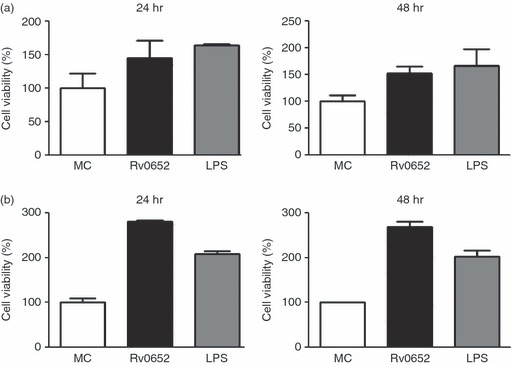
Rv0652 is not cytotoxic to RAW264.7 cells (a) and bone-marrow-derived macrophages (BMDM) (b). RAW264.7 cells and BMDM were treated with Rv0652 (10 μg/ml) or lipopolysaccharide (LPS; 100 ng/ml) for 24 or 48 hr. Cell viability was measured using a CCK-8 assay. Data are presented as means ± SD of three experiments. MC, medium control.
Figure 3
Figure 3
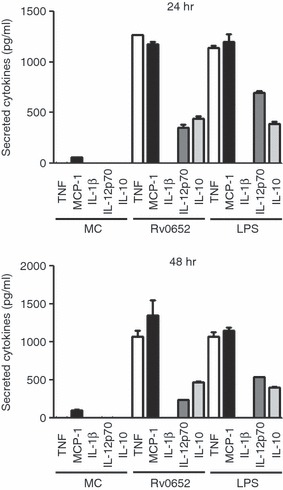
Rv0652-induced cytokine and chemokine production in bone-marrow-derived macrophages (BMDM). BMDM were stimulated with Rv0652 (5 μg/ml) or lipopolysaccharide (LPS; 100 ng/ml) for 24 or 48 hr. Levels of tumour necrosis factor (TNF), interleukin-1β (IL-1β), IL-12p70, IL-10 and monocyte chemoattractant protein 1 (MCP-1) in culture medium were measured by ELISA. Data are presented as means ± SD of three experiments. MC, medium control.
Figure 4
Figure 4
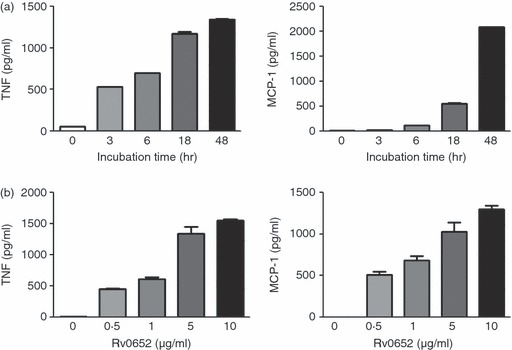
Rv0652-stimulated production of tumour necrosis factor (TNF) and monocyte chemoattractant protein 1 (MCP-1) in a time-dependent and dose-dependent manner in RAW264.7 cells. (a) RAW264.7 cells were stimulated with Rv0652 (5 μg/ml) for the times indicated. (b) RAW264.7 cells were stimulated with Rv0652 at the concentrations indicated for 18 hr. Levels of TNF and MCP-1 in culture medium were measured by ELISA. Data are presented as means ± SD of three experiments.
Figure 5
Figure 5
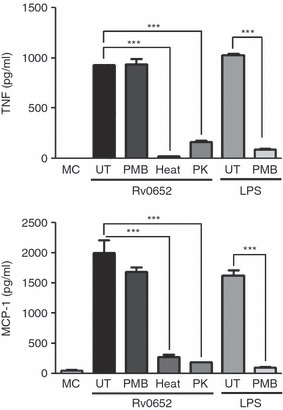
Rv0652-induced tumour necrosis factor (TNF) and monocyte chemoattractant protein 1 (MCP-1) production is not the result of lipopolysaccharide (LPS) contamination. Bone-marrow-derived macrophages (BMDM) were stimulated with Rv0652 (5 μg/ml), heat-treated Rv0652, or proteinase K (PK)-treated Rv0652. The BMDM were also incubated with polymyxin B (PMB, 10 μg/ml) for 30 min before treatment with Rv0652 (5 μg/ml) or LPS (100 ng/ml). Culture supernatants were harvested after 24 hr, and the levels of TNF and MCP-1 were measured by ELISA. Data are presented as means ± SD of three experiments. ***P < 0·001 versus untreated (UT) control. MC, medium control.
Figure 6
Figure 6
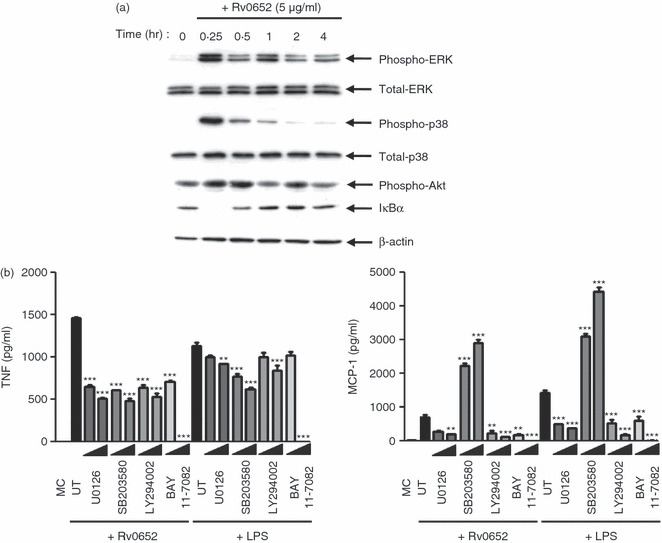
Rv0652 induces phosphorylation of mitogen-activated protein kinases (MAPK). (a) Bone-marrow-derived macrophages (BMDM) stimulated with Rv0652 for the times indicated were lysed, and the proteins in the total cell lysate samples were separated by SDS–PAGE, followed by immunoblot analysis using antibodies against phospho-extracellular signal-regulated kinase 1/2 (ERK1/2), ERK1/2, phospho-p38, p38, phospho-Akt, IκBα, and β-actin. This image is representative of three experiments showing similar results. (b) Effect of MAPKs, p38, phosphatidylinositol 3-kinase (PI3K) and nuclear factor-κB (NF-κB) inhibitors on lipopolysaccharide (LPS) -induced and Rv0652-induced tumour necrosis factor (TNF) and monocyte chemoattractant protein 1 (MCP-1) production. BMDM were treated with inhibitors of ERK (U0126, 5–20 μm), p38 (SB203580, 5–20 μm), PI3K (LY294002, 5–20 μm), or NF-κB (BAY 11-7082, 5–20 μm) for 1 hr before treatment with Rv0652 (5 μg/ml). After 24 hr, the levels of TNF and MCP-1 were measured by ELISA. Data are presented as means ± SD of three experiments. **P < 0·01 and ***P < 0·001 versus untreated controls. MC, medium control; UT, untreated control.
Figure 7
Figure 7
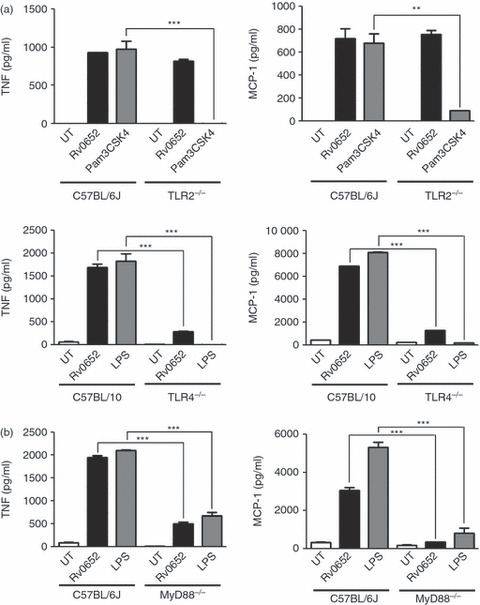
Rv0652 stimulates tumour necrosis factor (TNF) and monocyte chemoattractant protein 1 (MCP-1) release in a Toll-like receptor 4 (TLR4) -dependent and MyD88-dependent manner. (a) Bone-marrow-derived macrophages (BMDM) from C57BL/6J wild-type (WT), TLR2−/−, C57BL/10 WT, and TLR4−/− mice were stimulated with Rv0652 (5 μg/ml), Pam3 (100 ng/ml), or lipopolysaccharide (LPS; 100 ng/ml) for 24 hr. The levels of TNF and MCP-1 in the culture supernatants were measured by ELISA. (b) BMDM from C57BL/6J WT and MyD88−/− mice were stimulated with Rv0652 (5 μg/ml) or LPS (100 ng/ml) for 24 hr. The levels of TNF and MCP-1 in the culture supernatants were measured by ELISA. Data are presented as means ± SD of three determinations. ***P < 0·001 versus BMDM from WT mice.
Figure 8
Figure 8
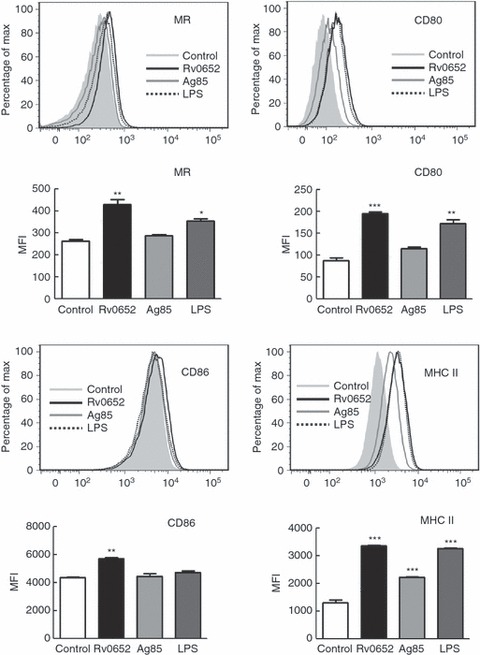
Rv0652 induces the expression of macrophage surface molecules on RAW264.7 macrophages. RAW264.7 cells were cultured for 24 hr in the presence of Rv0652 (5 μg/ml), Ag85 (5 μg/ml), or LPS (100 ng/ml), and the expression of the surface markers MR, CD80, CD86 and MHC class II was analysed by flow cytometry. Data are representative of three experiments showing similar results. Mean fluorescence intensities (MFI) calculated from histograms are presented as means ± SD of three independent experiments. *P < 0·05 or **P < 0·01 or ***P < 0·001 versus untreated cells.

Similar articles

Cited by

References

    1. World Health Organization. Report. Global Tuberculosis Control-Surveillance, Planning, Financing. Geneva, Switzerland: WHO; 2008. WHO/HTM/TB/2008.393.
    1. Colditz GA, Berkey CS, Mosteller F, Brewer TF, Wilson ME, Burdick E, Fineberg HV. Efficacy of BCG vaccine in the prevention of tuberculosis. Meta-analysis of the published literature. JAMA. 1994;271:698–702. - PubMed
    1. Flynn JL, Chan J. Immunology of tuberculosis. Annu Rev Immunol. 2001;19:93–129. - PubMed
    1. Russell DG. Mycobacterium tuberculosis and the intimate discourse of a chronic infection. Immunol Rev. 2011;240:252–68. - PMC - PubMed
    1. Schluger NW, Rom WN. The host immune response to tuberculosis. Am J Respir Crit Care Med. 1998;157:679–91. - PubMed

Publication types

MeSH terms

LinkOut - more resources