. 2012 Mar 2;10(3):337-44.
doi: 10.1016/j.stem.2012.01.005.

Low incidence of DNA sequence variation in human induced pluripotent stem cells generated by nonintegrating plasmid expression

Affiliations

Low incidence of DNA sequence variation in human induced pluripotent stem cells generated by nonintegrating plasmid expression

Linzhao Cheng et al. Cell Stem Cell. .

Abstract

The utility of induced pluripotent stem cells (iPSCs) as models to study diseases and as sources for cell therapy depends on the integrity of their genomes. Despite recent publications of DNA sequence variations in the iPSCs, the true scope of such changes for the entire genome is not clear. Here we report the whole-genome sequencing of three human iPSC lines derived from two cell types of an adult donor by episomal vectors. The vector sequence was undetectable in the deeply sequenced iPSC lines. We identified 1,058-1,808 heterozygous single-nucleotide variants (SNVs), but no copy-number variants, in each iPSC line. Six to twelve of these SNVs were within coding regions in each iPSC line, but ~50% of them are synonymous changes and the remaining are not selectively enriched for known genes associated with cancers. Our data thus suggest that episome-mediated reprogramming is not inherently mutagenic during integration-free iPSC induction.


Figures

Figure 1
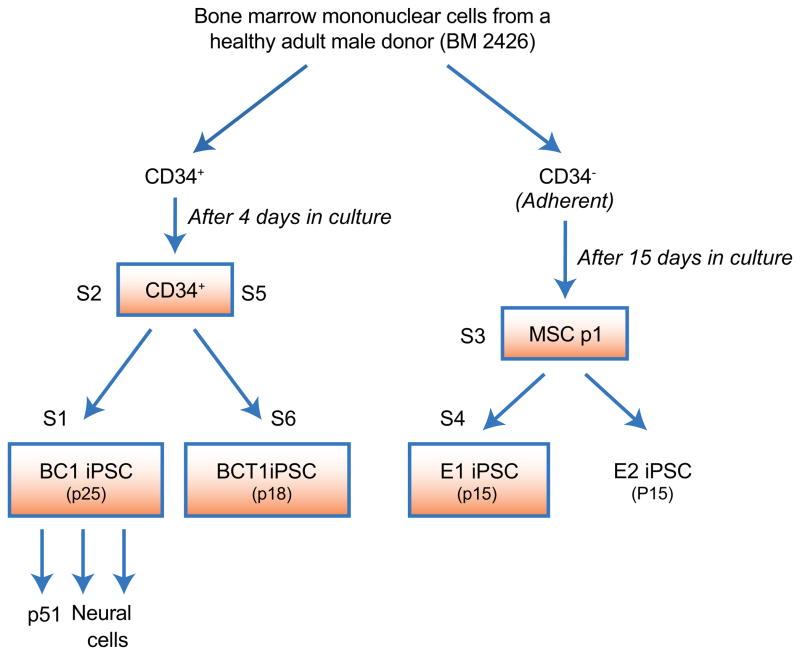
Figure 1. Relationship of iPSC lines and their parental somatic cells used in this study
Mononuclear cells from bone marrow (BM) of a healthy adult donor (2426) were separated into CD34+ cells (~1%) and CD34-depleted (CD34−) cells. The CD34+ cells were cultured for 4 days with hematopoietic cytokines before being reprogrammed by episomal vectors (left). The BC1 iPSC line was derived by using a single plasmid pEB-C5 while the BCT1 iPSC line was derived by addition of a second plasmid pEB-Tg. The BM CD34− cells were used to establish cultures of marrow stromal cells (also called mesenchymal stem cells or MSCs) by first selecting adherent cells followed by selective expansion of MSCs for additional 13 days (after primary and first passage). The harvested MSCs after first passage (p1) were used for reprogramming similarly by episomal vectors. Two independent iPSC lines, E1 and E2, were established and expanded for 15 passages (p15). Functional Characterizations of E1 and BCT1 iPSC lines are shown in Supplemental Figures 1 and 2, while characterization of BC1 iPSC line was published previously (Chou et al., 2011). Three expanded and characterized iPSC lines, BC1, BCT1 and E1 (boxed), were also analyzed by whole genome sequencing at a deep length. This was done in pair with the parental somatic cells (also boxed). While S1/S2 samples were sequenced at BGI as one pair, S3/S4 and S5/S6 samples were sequenced at NIH as two pairs.

References

    1. Ajay SS, Parker SC, Ozel Abaan H, Fuentes Fajardo KV, Margulies EH. Accurate and comprehensive sequencing of personal genomes. Genome Res. 2011;21:1498–505. - PMC - PubMed
    1. Araten DJ, Golde DW, Zhang RH, Thaler HT, Gargiulo L, Notaro R, Luzzatto L. A quantitative measurement of the human somatic mutation rate. Cancer Res. 2005;65:8111–7. - PubMed
    1. Bentley DR, Balasubramanian S, Swerdlow HP, Smith GP, Milton J, Brown CG, Hall KP, Evers DJ, Barnes CL, Bignell HR, et al. Accurate whole human genome sequencing using reversible terminator chemistry. Nature. 2008;456:53–59. - PMC - PubMed
    1. Chen K, Wallis JW, McLellan MD, Larson DE, Kalicki JM, Pohl CS, McGrath SD, Wendl MC, Zhang Q, Locke DP, et al. BreakDancer: an algorithm for high-resolution mapping of genomic structural variation. Nature Methods. 2009;6:677–81. - PMC - PubMed
    1. Cheng L, Hammond H, Ye Z, Zhan X, Dravid G. Human adult marrow cells support prolonged expansion of human embryonic stem cells in culture. Stem Cells. 2003;20:121–132. - PubMed

Publication types