


The effect of appointment rescheduling on monitoring interval and patient attendance in the glaucoma outpatient clinic
- PMID: 22388592
- PMCID: PMC3351056
- DOI: 10.1038/eye.2012.22
The effect of appointment rescheduling on monitoring interval and patient attendance in the glaucoma outpatient clinic
Abstract
Aim: To assess the effect of appointment rescheduling on monitoring intervals and patient attendance in the glaucoma clinic.
Methods: A retrospective review of 100 consecutive patients was conducted. Patients were categorised into groups based on risk of progressive visual loss. The monitoring interval requested by the clinician was compared with the interval recommended by national guidelines. One hundred consecutive patients who had had their appointment rescheduled were also examined to assess the effect of appointment rescheduling on the actual monitoring interval. Patient non-attendance rates and attendances at the emergency department were also examined.
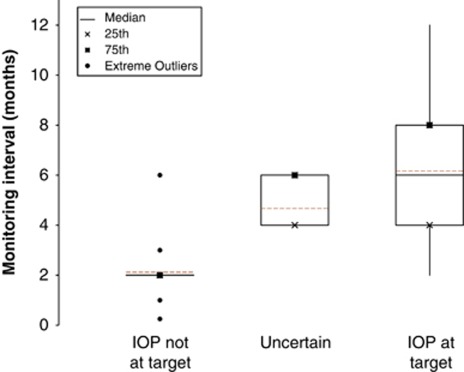
Results: After excluding patients with secondary glaucoma, glaucoma suspects, and those with short-term factors affecting monitoring interval, 54 patients with chronic open-angle glaucoma (COAG) were included. Forty-eight (89%) of patients had a monitoring interval requested in accordance with national guidelines (2 had longer intervals by 1-2 months and 4 had shorter time intervals). The monitoring interval was not influenced by disease severity (Kruskal-Wallis test, P=0.16), but was significantly shorter if the intraocular pressure was above target (P<0.0001) or the patient showed structural or functional progression (P<0.0001). Hospital-initiated appointment rescheduling led to significant lengthening of monitoring interval. The mean difference between intended and actual monitoring interval was 5.6 months. Eight percent (8/100) of patients with rescheduled appointments did not attend compared with 15% (39/265) without rescheduled appointments.
Conclusion: Clinical staff are selecting appropriate monitoring intervals for patients with COAG; however, hospital-initiated rescheduling of appointments is a major challenge to appropriate follow-up.
Figures
References
-
- Department of Health NICE glaucoma quality standard, March 2011 . http://www.nice.org.uk/guidance/qualitystandards/qualitystandards.jsp .
-
- National Institute of Clinical Excellence (NICE) guidance CG85 Glaucoma: diagnosis and management of chronic open angle glaucoma and ocular hypertension, April 2009 . http://guidance.nice.org.uk/CG85 .
-
- European Glaucoma Society Terminology and Guidelines for Glaucoma3rd edn.European Glaucoma Society: Safona, Italy; 2008
-
- American Academy of Ophthalmology Preferred Practice Pattern. Primary Open-Angle Glaucoma American Academy of Ophthalmology: San Francisco, CA; 2010. p25
-
- National Patient Safety Agency Preventing delay to follow-up for patients with glaucoma. Rapid Response Report 2009; NPSA/2009/RRR004. http://www.nrls.npsa.nhs.uk/resources/?entryid45=61908&p=2 .
MeSH terms
LinkOut - more resources
Full Text Sources
