


Effects of cumulative stress and impulsivity on smoking status
- PMID: 22389084
- PMCID: PMC3582663
- DOI: 10.1002/hup.1269
Effects of cumulative stress and impulsivity on smoking status
Abstract
Objective: The stress-vulnerability model of addiction predicts that environmental factors, such as cumulative stress, will result in individual adaptations that decrease self-control, increase impulsivity, and increase risk for addiction. Impulsivity and cumulative stress are risk factors for tobacco smoking that are rarely examined simultaneously in research.
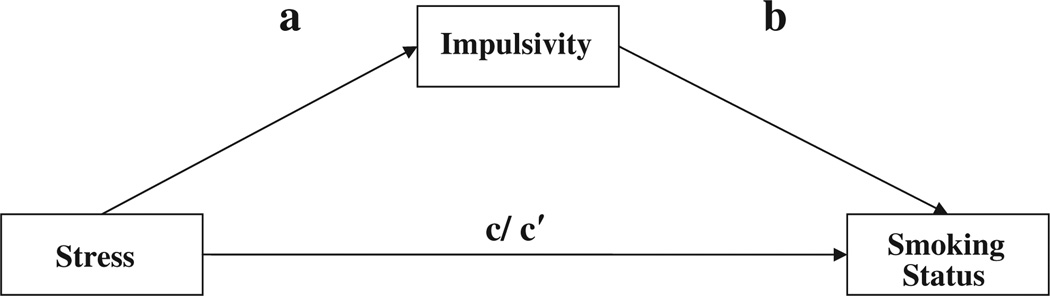
Methods: We examined the indirect and direct effects of cumulative adversity in a community sample consisting of 291 men and women who participated in an assessment of cumulative stress, self-reported impulsivity, and smoking history. Data were analyzed using bootstrapping techniques to estimate indirect effects of stress on smoking via impulsivity.
Results: Cumulative adversity is associated with smoking status via direct effects and indirect effects through impulsivity scores. Additional models examining specific types of stress indicate contributions of traumatic stress and recent life events as well as chronic relationship stressors.
Conclusions: Overall, cumulative stress is associated with increased risk of smoking via increased impulsivity and via pathways independent of impulsivity. These findings support the stress-vulnerability model and highlight the utility of mediation models in assessing how, and for whom, cumulative stress increases risk of current cigarette smoking. Increasing self-control is a target for interventions with individuals who have experienced cumulative adversity.
Copyright © 2012 John Wiley & Sons, Ltd.
Conflict of interest statement
CONFLICT OF INTEREST
No conflict of interest declared.
Figures
References
-
- Anestis MD, Selby EA, Joiner TE. The role of urgency in maladaptive behaviors. Behavior Research and Therapy. 2007;45:3018–3029. - PubMed
-
- Arnsten AFT, Goldman-Rakic PS. Noise stress impairs prefrontal cortical cognitive function in monkeys: Evidence for a hyperdopaminergic mechanism. Archives of General Psychiatry. 1998;55:362–369. - PubMed
-
- Braun K, Lange E, Metzger M, Poeggel G. Maternal separation followed by early social deprivation affects the development of monoaminergic fiber systems in the medial prefrontal cortex of Octodon degus. Neuroscience. 2000;95(1):309–318. - PubMed
Publication types
MeSH terms
Grants and funding
LinkOut - more resources
Full Text Sources
Medical
