


Reducing personal exposure to particulate air pollution improves cardiovascular health in patients with coronary heart disease
- PMID: 22389220
- PMCID: PMC3295351
- DOI: 10.1289/ehp.1103898
Reducing personal exposure to particulate air pollution improves cardiovascular health in patients with coronary heart disease
Abstract
Background: Air pollution exposure increases cardiovascular morbidity and mortality and is a major global public health concern.
Objectives: We investigated the benefits of reducing personal exposure to urban air pollution in patients with coronary heart disease.
Methods: In an open randomized crossover trial, 98 patients with coronary heart disease walked on a predefined route in central Beijing, China, under different conditions: once while using a highly efficient face mask, and once while not using the mask. Symptoms, exercise, personal air pollution exposure, blood pressure, heart rate, and 12-lead electrocardiography were monitored throughout the 24-hr study period.
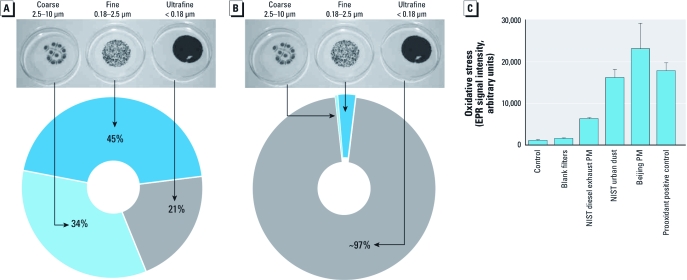
Results: Ambient air pollutants were dominated by fine and ultrafine particulate matter (PM) that was present at high levels [74 μg/m³ for PM(2.5) (PM with aerodynamic diamater <2.5 µm)]. Consistent with traffic-derived sources, this PM contained organic carbon and polycyclic aromatic hydrocarbons and was highly oxidizing, generating large amounts of free radicals. The face mask was well tolerated, and its use was associated with decreased self-reported symptoms and reduced maximal ST segment depression (-142 vs. -156 μV, p = 0.046) over the 24-hr period. When the face mask was used during the prescribed walk, mean arterial pressure was lower (93 ± 10 vs. 96 ± 10 mmHg, p = 0.025) and heart rate variability increased (high-frequency power: 54 vs. 40 msec², p = 0.005; high-frequency normalized power: 23.5 vs. 20.5 msec, p = 0.001; root mean square successive differences: 16.7 vs. 14.8 msec, p = 0.007). However, mask use did not appear to influence heart rate or energy expenditure.
Conclusions: Reducing personal exposure to air pollution using a highly efficient face mask appeared to reduce symptoms and improve a range of cardiovascular health measures in patients with coronary heart disease. Such interventions to reduce personal exposure to PM air pollution have the potential to reduce the incidence of cardiovascular events in this highly susceptible population.
Trial registration: ClinicalTrials.gov NCT00809653.
Conflict of interest statement
The authors declare they have no actual or potential competing financial interests.
Figures

Comment in
-
Air pollution intervention: study links use of face masks to improved cardiovascular outcomes.Environ Health Perspect. 2012 Mar;120(3):A122. doi: 10.1289/ehp.120-a122b. Environ Health Perspect. 2012. PMID: 22382446 Free PMC article. No abstract available.
References
-
- Barclay JL, Miller BG, Dick S, Dennekamp M, Ford I, Hillis GS, et al. A panel study of air pollution in subjects with heart failure: negative results in treated patients. Occup Environ Med. 2009;66(5):325–334. - PubMed
-
- Beijing Municipal Environmental Protection Bureau. Beijing Municipal Environmental Protection Bureau, Daily News of Air Quality in Beijing [in Chinese]. 2009. Available: http://www.bjepb.gov.cn/portal0/tab188/ [accessed May 2009]
-
- British Standards Institute. London: British Standards Institution. ISBN 978 0 580 62117 8; 2001. Respiratory protective devices. Filtering half masks to protect against particles. Requirements, testing, marking. BS EN 149:2001+A1:2009.
-
- Brook RD, Rajagopalan S, Pope CA, III, Brook JR, Bhatnagar A, Diez-Roux AV, et al. Particulate matter air pollution and cardiovascular disease. An update to the scientific statement from the American Heart Association. Circulation. 2010;121:2331–2378. - PubMed
Publication types
MeSH terms
Substances
Associated data
Grants and funding
LinkOut - more resources
Full Text Sources
Other Literature Sources
Medical