


Prevalence and risk factors for forced or coerced sex among school-going youth: national cross-sectional studies in 10 southern African countries in 2003 and 2007
- PMID: 22389362
- PMCID: PMC3293138
- DOI: 10.1136/bmjopen-2011-000754
Prevalence and risk factors for forced or coerced sex among school-going youth: national cross-sectional studies in 10 southern African countries in 2003 and 2007
Abstract
Objectives: To study prevalence at two time points and risk factors for experience of forced or coerced sex among school-going youth in 10 southern African countries.
Design: Cross-sectional surveys, by facilitated self-administered questionnaire, of in-school youth in 2003 and 2007.
Setting: Schools serving representative communities in eight countries (Botswana, Lesotho, Malawi, Mozambique, Namibia, Swaziland, Zambia and Zimbabwe) in 2003 and with Tanzania and South Africa added in 2007.
Participants: Students aged 11-16 years present in the school classes.
Main outcome measures: Experience of forced or coerced sex, perpetration of forced sex.
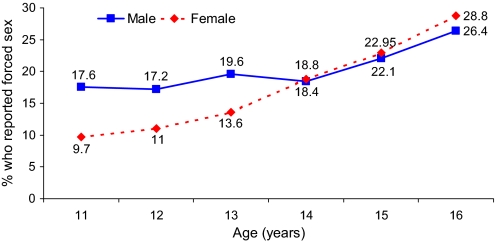
Results: In 2007, 19.6% (4432/25 840) of female students and 21.1% (4080/21 613) of male students aged 11-16 years reported they had experienced forced or coerced sex. Rates among 16-year-olds were 28.8% in females and 25.4% in males. Comparing the same schools in eight countries, in an analysis age standardised on the 2007 Botswana male sample, there was no significant decrease between 2003 and 2007 among females in any country and inconsistent changes among males. In multilevel analysis using generalised linear mixed model, individual-level risk factors for forced sex among female students were age over 13 years and insufficient food in the household; school-level factors were a lower proportion of students knowing about child rights and higher proportions experiencing or perpetrating forced sex; and community-level factors were a higher proportion of adults in favour of transactional sex and a higher rate of intimate partner violence. Male risk factors were similar. Some 4.7% of female students and 11.7% of male students reported they had perpetrated forced sex. Experience of forced sex was strongly associated with perpetration and other risk factors for perpetration were similar to those for victimisation.
Conclusions: Forced or coerced sex remained common among female and male youth in 2007. Experience of sexual abuse in childhood is recognised to increase the risk of HIV infection. The association the authors found between forced sex and school-level factors suggests preventive interventions in schools could help to tackle the HIV epidemic in southern Africa.
Conflict of interest statement
Figures
References
-
- Jenny C, Hooton TM, Bowers A, et al. Sexually transmitted disease in victims of rape. N Engl J Med 1990;322:713–16 - PubMed
-
- Glaser JB, Schachter J, Benes S, et al. Sexually transmitted disease in post-pubertal female rape victims. J Infect Dis 1991;164:726–30 - PubMed
-
- Meel BL. HIV infection among victims of sexual assault using condoms and other contraceptive methods: a comparative study. Med Sci Law 2007,47:341–4 - PubMed
-
- Koenig MA, Zablotska I, Lutalo T, et al. Coerced first intercourse and reproductive health among adolescent women in Rakai, Uganda. Int Fam Plan Perspect 2004;30:156–64 - PubMed
-
- Lindegren ML, Hanson IC, Hammett TA, et al. Sexual abuse of children: intersection with the HIV epidemic. Pediatrics 1998;102:E46. - PubMed
LinkOut - more resources
Full Text Sources
