


Editorial
doi: 10.1128/JB.00257-12.
Epub 2012 Mar 2.
Zinc starvation response in a cyanobacterium revealed
- PMID: 22389477
- PMCID: PMC3347212
- DOI: 10.1128/JB.00257-12
Item in Clipboard
Editorial
Zinc starvation response in a cyanobacterium revealed
J Bacteriol.
2012 May.
No abstract available
Figures
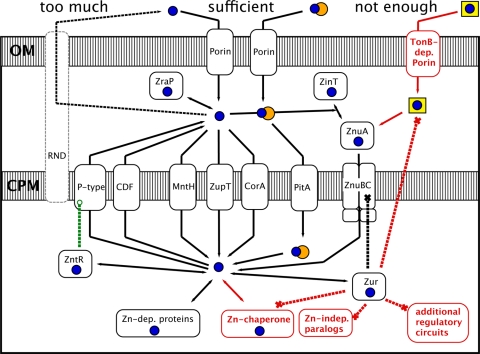
What we knew about zinc homeostasis and what is new. What was already known concerning bacterial zinc homeostasis is shown in black; the additional insights by Napolitano et al. (34) are in red. With sufficient zinc supply, zinc (blue dots) or zinc phosphate (adjacent blue and orange dots) diffuses via porins through the outer membrane (OM) into the periplasm between the OM and the cytoplasmic membrane (CPM), and is further transported across the CPM to the cytoplasm by fast and unspecific uptake systems such as ZupT, MntH, CorA, and PitA. Here, zinc is supplied to zinc-dependent proteins. Surplus zinc is moved back into the periplasm by CDF proteins or P-type ATPases that may be under the control of a ZntR-type regulator (green dashed line). In some bacteria, an RND-driven efflux system may export periplasmic zinc across the OM back to the outside (white box with dashed outline), or Zn2+ is bound by a periplasmic zinc chaperone such as ZraP. Under conditions of low zinc, Zur-type proteins upregulate expression of ZnuBC-like uptake systems that interact with ZnuA- and ZinT-type periplasmic metal binding proteins. In addition to this picture, Napolitano et al. (34) have found in Anabaena sp. strain PCC 7120 evidence for paralogs of zinc-dependent proteins, cytoplasmic zinc chaperones, additional regulatory circuits, and possibly zinc acquisition by a “zincophore” (or another kind of zinc chelate [yellow squares]) and its uptake by TonB-dependent outer membrane proteins, all under Zur control.
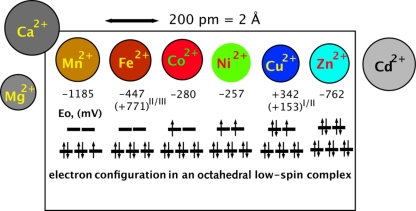
Comparison of the essential transition metal cations. The essential divalent transition metal cations have all similar radii and can be distinguished only if variations in the complex-forming and redox abilities are considered. Despite this fact, they perform different functions and have to be provided to different proteins, e.g., manganese to the water-splitting complex of photosystem II, copper to plastocyanin, iron to cytochromes, nonheme iron sites and iron-sulfur centers, cobalt to cobalamin, nickel to hydrogenase, and zinc to many enzymes, such as RNA polymerase.
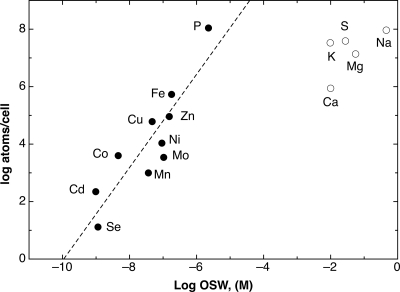
Plot of the elements per cell against their occurrence in seawater (OSW). A double logarithmical plot of the number of atoms in the cell of the bacterium C. metallidurans as determined by ICP-MS (24) against OSW as a model of a standard environment (61). Please note that the transition metals plus phosphate and selenium (black dots) reside on a line. Assuming the cell is a “tea bag” without internal metal-chelating capacity with a cellular volume of 0.57 fl (12), this line would represent accumulation of the shown metal cations with an energy of 93 ± 20 mV across the cytoplasmic membrane. The five major bioelements shown as open symbols in the upper-right corner are outside of this line and therefore much easier to acquire than the elements on the line.
Comment on
-
Characterization of the response to zinc deficiency in the cyanobacterium Anabaena sp. strain PCC 7120.J Bacteriol. 2012 May;194(10):2426-36. doi: 10.1128/JB.00090-12. Epub 2012 Mar 2. J Bacteriol. 2012. PMID: 22389488 Free PMC article.
References
-
- Andrews SC, Robinson AK, Rodriguez-Quinones F. 2003. Bacterial iron homeostasis. FEMS Microbiol. Rev. 27:215–237 - PubMed
-
- Argüello JM, Eren E, Gonzalez-Guerrero M. 2007. The structure and function of heavy metal transport P-1B-ATPases. Biometals 20:233–248 - PubMed
-
- Braun V, Braun M. 2002. Active transport of iron and siderophore antibiotics. Curr. Opin. Microbiol. 5:194–201 - PubMed
-
- Braun V, Hantke K. 2007. Acquisition of iron by bacteria, p 189–217 In Nies DH, Silver S. (ed), Molecular microbiology of heavy metals, vol 6 Springer-Verlag, Berlin, Germany
Publication types
MeSH terms
Substances
LinkOut - more resources
Full Text Sources
