


Text4Health: impact of text message reminder-recalls for pediatric and adolescent immunizations
- PMID: 22390457
- PMCID: PMC3483980
- DOI: 10.2105/AJPH.2011.300331
Text4Health: impact of text message reminder-recalls for pediatric and adolescent immunizations
Abstract
Objectives: We conducted 2 studies to determine the impact of text message immunization reminder-recalls in an urban, low-income population.
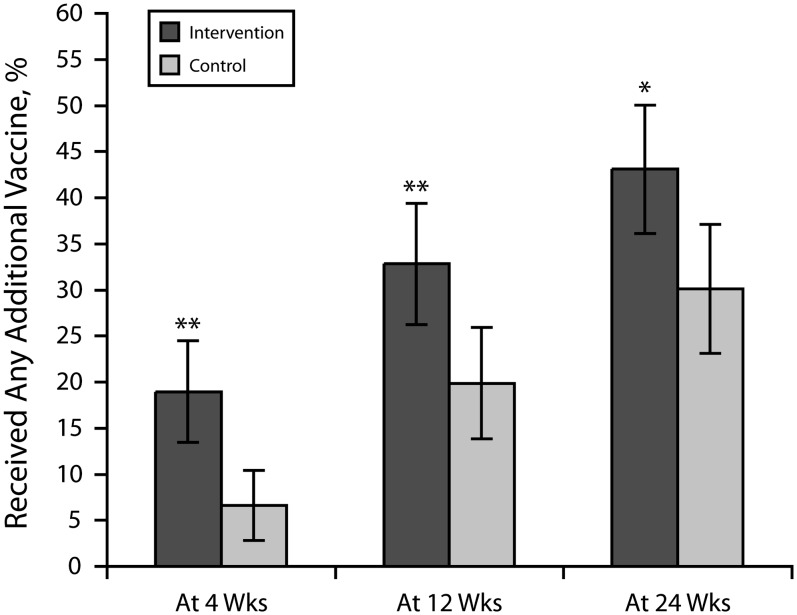
Methods: In 1 study, text message immunization reminders were sent to a random sample of parents (n = 195) whose children aged 11 to 18 years needed either or both meningococcal (MCV4) and tetanus-diphtheria-acellular pertussis (Tdap) immunizations. We compared receipt of MCV4 or Tdap at 4, 12, and 24 weeks with age- and gender-matched controls. In the other study, we compared attendance at a postshortage Haemophilus influenzae B (Hib) immunization recall session between parents who received text message and paper-mailed reminders (n = 87) and those who only received paper-mailed reminders (n = 87).
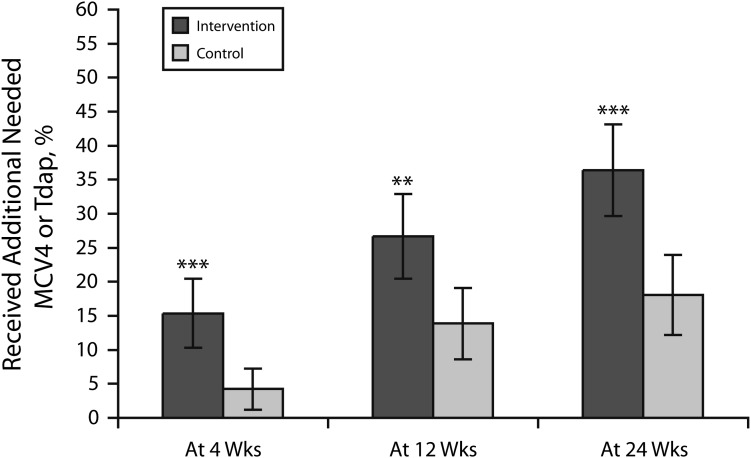
Results: Significantly more adolescents with intervention parents received either or both MCV4 and Tdap at weeks 4 (15.4% vs 4.2%; P < .001), 12 (26.7% vs 13.9%; P < .005), and 24 (36.4% vs 18.1%; P < .001). Significantly more parents who received both Hib reminders attended a recall session compared with parents who only received a mailed reminder (21.8% vs 9.2%; P < .05). After controlling for age, gender, race/ethnicity, insurance status, and language, text messaging was still significantly associated with both studies' outcomes.
Conclusions: Text messaging for reminder-recalls improved immunization coverage in a low-income, urban population.
Figures
References
-
- Centers for Disease Control and Prevention Recommendations of the Advisory Committee on Immunization Practices, the American Academy of Pediatrics, and the American Academy of Family Physicians: use of reminder and recall by vaccination providers to increase vaccination rates. MMWR Morb Mortal Wkly Rep. 1998;47(34):715–717 - PubMed
-
- National Vaccine Advisory Committee Standards for child and adolescent immunization practices. Pediatrics. 2003;112(4):958–963 - PubMed
-
- Middleman AB, Rosenthal SL, Rickert VI, Neinstein L, Fishbein DB, D'Angelo L.Adolescent immunizations: a position paper of the Society for Adolescent Medicine. J Adolesc Health. 2006;38(3):321–327 - PubMed
-
- Briss PA, Rodewald LE, Hinman ARet al.Reviews of evidence regarding interventions to improve vaccination coverage in children, adolescents, and adults. Am J Prev Med. 2000;18(1, suppl):97–140 - PubMed
Publication types
MeSH terms
Substances
Grants and funding
LinkOut - more resources
Full Text Sources
Medical
