. 2012 Aug;69(15):2621-33.
doi: 10.1007/s00018-012-0940-6. Epub 2012 Mar 6.

Let-7b is a novel regulator of hepatitis C virus replication

Affiliations

Let-7b is a novel regulator of hepatitis C virus replication

Ju-Chien Cheng et al. Cell Mol Life Sci. 2012 Aug.

Abstract

The non-coding microRNA (miRNA) is involved in the regulation of hepatitis C virus (HCV) infection and offers an alternative target for developing anti-HCV agent. In this study, we aim to identify novel cellular miRNAs that directly target the HCV genome with anti-HCV therapeutic potential. Bioinformatic analyses were performed to unveil liver-abundant miRNAs with predicted target sequences on HCV genome. Various cell-based systems confirmed that let-7b plays a negative role in HCV expression. In particular, let-7b suppressed HCV replicon activity and down-regulated HCV accumulation leading to reduced infectivity of HCVcc. Mutational analysis identified let-7b binding sites at the coding sequences of NS5B and 5'-UTR of HCV genome that were conserved among various HCV genotypes. We further demonstrated that the underlying mechanism for let-7b-mediated suppression of HCV RNA accumulation was not dependent on inhibition of HCV translation. Let-7b and IFNα-2a also elicited a synergistic inhibitory effect on HCV infection. Together, let-7b represents a novel cellular miRNA that targets the HCV genome and elicits anti-HCV activity. This study thereby sheds new insight into understanding the role of host miRNAs in HCV pathogenesis and to developing a potential anti-HCV therapeutic strategy.


Conflict of interest statement

None.

Figures
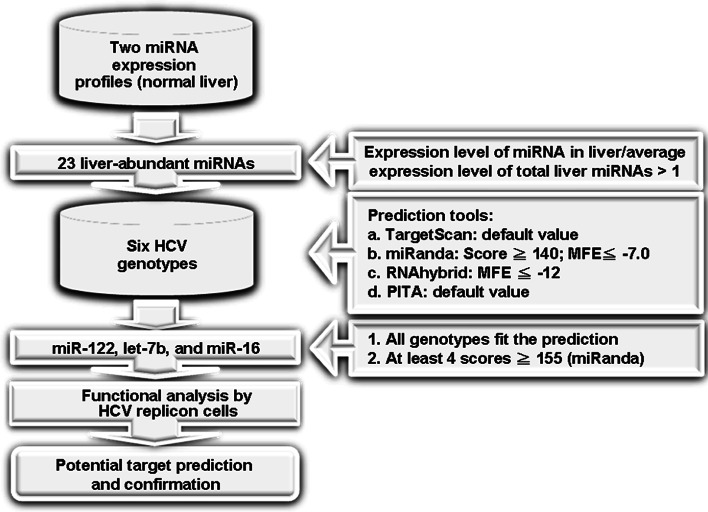
Fig. 1
Fig. 1
Bioinformatic strategy for identifying liver miRNAs with target sites on HCV genome. Two published normal liver tissue miRNA expression profiles were used to select liver-abundant miRNAs for bioinformatics analyses as described in “Materials and methods”
Fig. 2
Fig. 2
Characterization of miRNAs with putative target sites on HCV genome. a Genomic structures of HCV maintaining in Huh7/Rep-Feo and ConI cells. b The miRNA precursors or mutant let-7b (m7b) were transfected into Huh7/Rep-Feo cells. MTS and luciferase activity assays were then performed at 72 h post-transfection. c The miRNA precursors (left panel) or the mutant form of let-7b (right panel) were transfected into the ConI cells. Western-blot analysis was then performed using the anti-NS5A and anti-β-actin antibody at 72 h post-transfection. The ratios for the relative band intensities of NS5A after normalization with β-actin were shown. NC negative control miRNA. d The precursors of let-7b (left panel) or shHMGA2 (right panel) were transfected into ConI replicon cells. Western-blot analysis was then performed using the anti-NS5A and anti-β-actin antibody at 72 h post-transfection. NC negative control miRNA. e Real-time RT-PCR of let-7b was performed using the total RNAs from the indicated cells. RNU6B was used as an internal control for normalization. The data represented the mean ± SD (n = 3; *p < 0.05, **p < 0.01, ***p < 0.001). f The let-7b inhibitor (Anti-let-7b) or control inhibitor (Anti-NC) was transfected into Huh7 cells, respectively. HCV RNA expression was quantified by real-time RT-PCR using the total RNAs from the indicated transfected cells. The expression of GAPDH was used as a control for normalization. The data represented the mean ± SD (n = 3; *p < 0.05)
Fig. 3
Fig. 3
Let-7b reduces HCVcc infectivity. a The indicated miRNAs were transfected into Huh7.5 cells for 24 h followed by infection with J6/JFH-based HCVcc. After 72 h, the cells were stained by anti-Core antibody. Nuclei were visualized by DAPI staining. NC negative control. b The infectious foci were counted by fluorescence microscopy. The infectivity for the cells transfected with negative control miRNA (NC) was set as one. The data represented the mean ± SD (n = 3; *p < 0.05). c HCV RNA expression was quantified by real-time RT-PCR using the total RNAs from the indicated transfected cells. The expression of GAPDH was used as a control for normalization. The data represented the mean ± SD (n = 3; *p < 0.05). d The miRNA precursors or the mutant let-7b (m7b) were transfected into Huh7.5 cells for 24 h followed by infection with JC1-luc2A HCV reporter virus. After 72 h, cell viability was determined by MTS assay and the cell extracts were collected for luciferase activity assay. The relative firefly luciferase versus MTS activity was shown and the negative control miRNA was arbitrarily denoted as one. The data represented the mean ± SD (n = 3; *p < 0.05; ***p < 0.001)
Fig. 4
Fig. 4
Let-7b is associated with HCV genome in miRNP complex. a, b Huh7.5 cells were transfected with 100 pmol of miRNA along with 10 μg of either wild-type (miR-122-wt) or mutant (miR-122-mut) HCV subgenome RNA. The cell extracts were collected to perform co-immunoprecipitation with the anti-Ago2 antibody (Ago2-IP). HCV replicon RNA (panel a) and let-7b (panel b) were measured by real-time RT-PCR using total RNA sample from the Ago2-IP fraction. c ,d For knockdown of endogenous let-7b, Huh7.5 cells were transfected with 100 pmol of the indicated miRNA inhibitors (Anti-NC and Anti-let-7b) for 24 h followed by electroporation of the cells with 10 μg of miR-122-mut and 100 pmol of the indicated miRNA inhibitors. The cell extracts were collected to perform Ago2-IP and the HCV replicon RNA (panel c) and let-7b (panel d) were measured by real-time RT-PCR. The relative levels for HCV RNA and let-7b in the Ago2-IP complexes were shown. The data represented the mean ± SD (n = 3; *p < 0.05, **p < 0.01)
Fig. 5
Fig. 5
The MREs of let-7b are located at the NS5B coding sequences and 5′-UTR of HCV genome. a Schematic representation for the predicted MREs of let-7b on HCV genome. The number corresponds to the first nucleotide of the predictive seed region. b The precursor of let-7b or negative control miRNA (NC) was co-transfected with the indicated luciferase reporter plasmid and pRL-TK into 293T cells for 24 h. The luciferase activities were measured and the relative firefly versus Renilla luciferase activity was shown. The plasmid containing perfect complementary sequence of let-7b (c-let-7b) and the vector control reporter plasmid (luciferase activity arbitrarily denoted as one) was used as the positive and negative control, respectively. The data represented the mean ± SD (n = 3; *p < 0.05; **p < 0.01; ***p < 0.001; NS no significance). c The RNAs for wild-type (wt) HCV genome and the genome with mutations at the indicated MREs regions were obtained by in vitro transcription and were transfected individually into Huh7.5 cells along with let-7b precursor or negative control miRNA (NC) by electroporation. The luciferase activity was determined at 96 h post-transfection. The luciferase activity generated by wild-type HCV genome was arbitrarily denoted as 1 and the luciferase activity derived from each mutant HCV genome normalized by luciferase activity from wild-type was shown. The data represented the mean ± SD (n = 3; **p < 0.01)
Fig. 6
Fig. 6
Let-7b decreases HCV RNA expression independent on translation inhibition. a, b Huh7.5 cells were transfected with the indicated miRNAs (panel a) or miRNA inhibitors (panel b). Twenty-four hour later, HCV RNAs carrying GND mutation and Renilla luciferase coding sequence were transfected with a capped and polyadenylated firefly luciferase mRNA. At 4 h after transfection, the cell lysates were subject to dual luciferase activity assays. The relative firefly versus Renilla luciferase activity is shown. The data represented the mean ± SD (n = 3; **p < 0.01; ***p < 0.001; NS no significance)
Fig. 7
Fig. 7
Let-7b and IFNα-2a elicit synergistic inhibitory effects on HCV RNA accumulation. a Huh7/Rep-Feo cells (3 × 104) were treated with the indicated doses of IFN-2α for 72 h and the luciferase activity and cell viability were determined. b Huh7/Rep-Feo cells were transfected with 100 nM of let-7b or negative control miRNA (NC) by RNAiMAX for 4 h followed by treatment with INF-2α or medium control for additional 72 h. The luciferase activity and cell viability were determined. The data represented the mean ± SD (n = 3) with the luciferase activity normalized by the cell viability. (*p < 0.05; **p < 0.01)

References

    1. Poynard T, Yuen MF, Ratziu V, Lai CL. Viral hepatitis C. Lancet. 2003;362:2095–2100. doi: 10.1016/S0140-6736(03)15109-4. - DOI - PubMed
    1. Lavanchy D. The global burden of hepatitis C. Liver Int. 2009;29(Suppl 1):74–81. doi: 10.1111/j.1478-3231.2008.01934.x. - DOI - PubMed
    1. Manns MP, Wedemeyer H, Cornberg M. Treating viral hepatitis C: efficacy, side effects, and complications. Gut. 2006;55:1350–1359. doi: 10.1136/gut.2005.076646. - DOI - PMC - PubMed
    1. Sarrazin C, Kieffer TL, Bartels D, Hanzelka B, Muh U, Welker M, Wincheringer D, Zhou Y, Chu HM, Lin C, Weegink C, Reesink H, Zeuzem S, Kwong AD. Dynamic hepatitis C virus genotypic and phenotypic changes in patients treated with the protease inhibitor telaprevir. Gastroenterology. 2007;132:1767–1777. doi: 10.1053/j.gastro.2007.02.037. - DOI - PubMed
    1. De Francesco R, Migliaccio G. Challenges and successes in developing new therapies for hepatitis C. Nature. 2005;436:953–960. doi: 10.1038/nature04080. - DOI - PubMed

Publication types

MeSH terms

LinkOut - more resources
