Review
. 2012 Jun;14(2):244-51.
doi: 10.1208/s12248-012-9337-6. Epub 2012 Mar 6.

The solubility-permeability interplay and its implications in formulation design and development for poorly soluble drugs

Affiliations
Review

The solubility-permeability interplay and its implications in formulation design and development for poorly soluble drugs

Arik Dahan et al. AAPS J. 2012 Jun.

Abstract

While each of the two key parameters of oral drug absorption, the solubility and the permeability, has been comprehensively studied separately, the relationship and interplay between the two have been largely ignored. For instance, when formulating a low-solubility drug using various solubilization techniques: what are we doing to the apparent permeability when we increase the solubility? Permeability is equal to the drug's diffusion coefficient through the membrane times the membrane/aqueous partition coefficient divided by the membrane thickness. The direct correlation between the intestinal permeability and the membrane/aqueous partitioning, which in turn is dependent on the drug's apparent solubility in the GI milieu, suggests that the solubility and the permeability are closely associated, exhibiting a certain interplay between them, and the current view of treating the one irrespectively of the other may not be sufficient. In this paper, we describe the research that has been done thus far, and present new data, to shed light on this solubility-permeability interplay. It has been shown that decreased apparent permeability accompanies the solubility increase when using different solubilization methods. Overall, the weight of the evidence indicates that the solubility-permeability interplay cannot be ignored when using solubility-enabling formulations; looking solely at the solubility enhancement that the formulation enables may be misleading with regards to predicting the resulting absorption, and hence, the solubility-permeability interplay must be taken into account to strike the optimal solubility-permeability balance, in order to maximize the overall absorption.


Figures

Fig. 1
Fig. 1
Schematic illustration of the quasi-equilibrium transport model describing the effect of cyclodextrins or surfactants on the drug transport through the unstirred water layer and the intestinal membrane, developed by Dahan et al. (26) and Miller et al. (35)
Fig. 2
Fig. 2
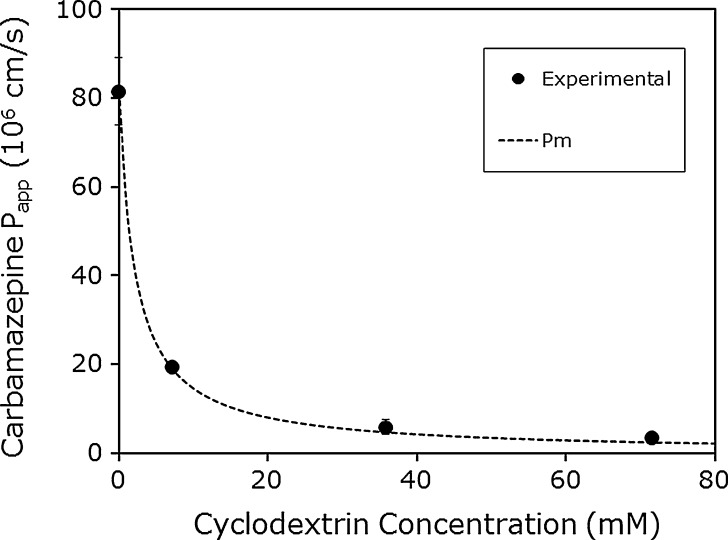
The apparent permeability (P app; in centimeters per second) of carbamazepine as a function of HPβCD concentration in the PAMPA model. The theoretical line was calculated via the transport model shown in Fig. 1 (26,35), and the experimental data points were derived from Brewster et al. (30)
Fig. 3
Fig. 3
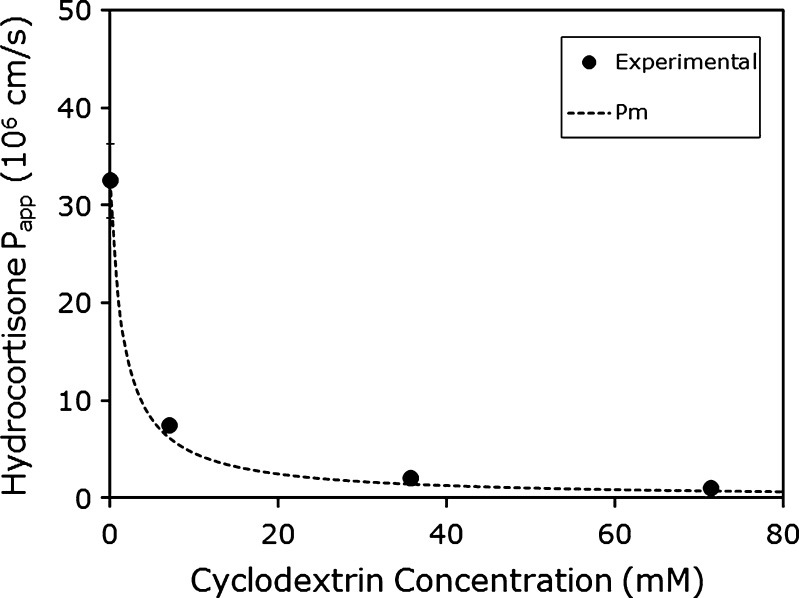
The apparent permeability (P app; in centimeters per second) of hydrocortisone as a function of HPβCD concentration in the PAMPA model. The theoretical line was calculated via the transport model shown in Fig. 1 (26,35), and the experimental data points were derived from Brewster et al. (30)
Fig. 4
Fig. 4
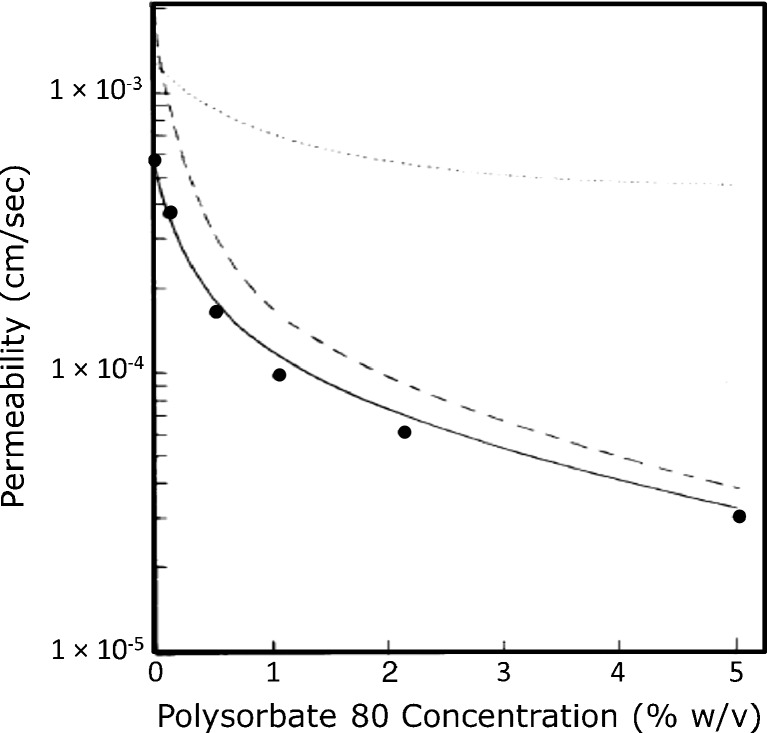
Theoretical predictions of P eff (solid line) and P m (dashed line) as a function of polysorbate 80 concentration. Black circle, experimentally determined P eff. Data derived from Amidon et al. (31)
Fig. 5
Fig. 5
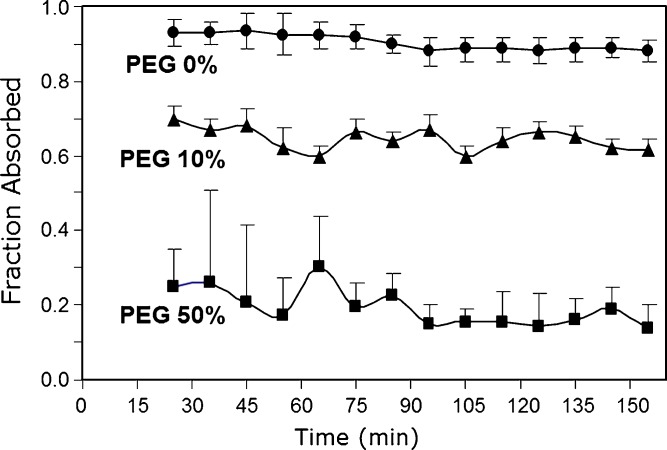
The effect of PEG-400 concentration on carbamazepine intestinal permeability in rabbit colon perfusion. Data derived from Riad and Sawchuk (46)
Fig. 6
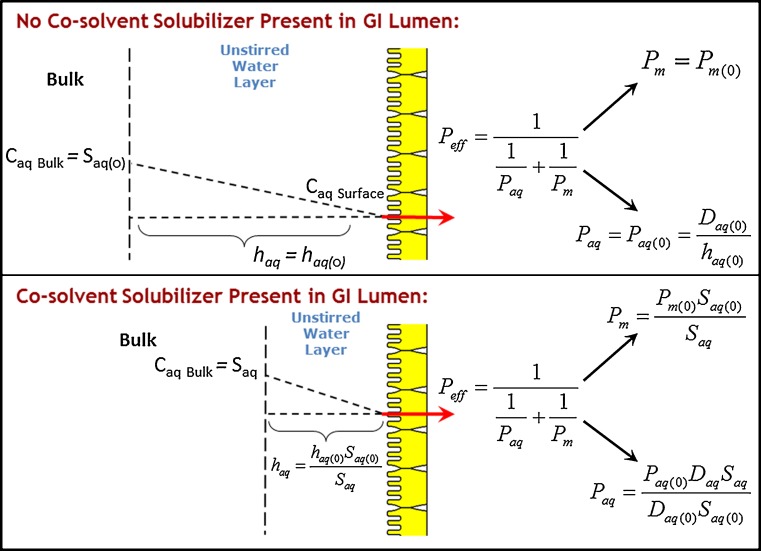
Fig. 6
Schematic illustration of the quasi-equilibrium transport model describing the effect of cosolvent on the drug transport through the unstirred water layer and the intestinal membrane. Complete derivation of the equations can be found in Miller et al. (47)
Fig. 7
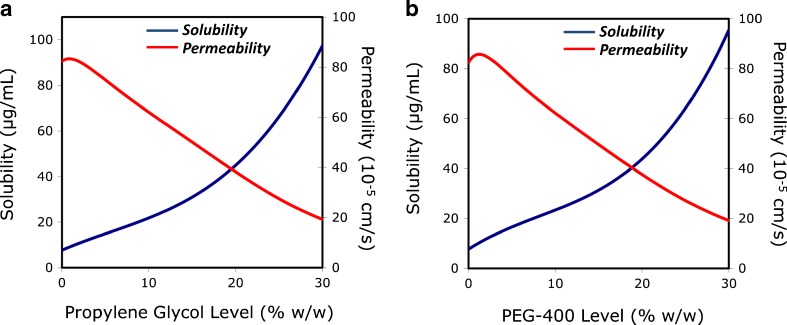
Fig. 7
The effects of increasing propylene glycol (a, left panel) and PEG-400 (b, right panel) concentration on progesterone apparent aqueous solubility and intestinal permeability based on the theoretical quasi-equilibrium transport model shown in Fig. 6 (47)
Fig. 8
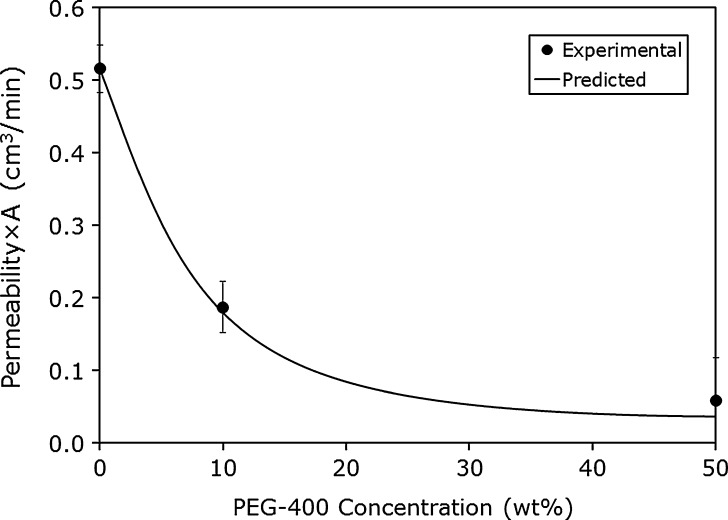
Fig. 8
The effective permeability (P eff; in centimeters per second) of carbamazepine as a function of PEG-400 concentration in the rabbit intestinal perfusion model. The theoretical line was calculated via the transport model shown in Fig. 6 (47), and the experimental data points were derived from Riad and Sawchuk (46)

References

    1. Lennernas H. Human intestinal permeability. J Pharm Sci. 1998;87(4):403–410. doi: 10.1021/js970332a. - DOI - PubMed
    1. Yu LX, Lipka E, Crison JR, Amidon GL. Transport approaches to the biopharmaceutical design of oral drug delivery systems: prediction of intestinal absorption. Adv Drug Deliv Rev. 1996;19(3):359–376. doi: 10.1016/0169-409X(96)00009-9. - DOI - PubMed
    1. Sun D, Yu LX, Hussain MA, Wall DA, Smith RL, Amidon GL. In vitro testing of drug absorption for drug ‘developability’ assessment: forming an interface between in vitro preclinical data and clinical outcome. Curr Opin Drug Discov Devel. 2004;7(1):75–85. - PubMed
    1. Amidon GL, Lennernas H, Shah VP, Crison JR. A theoretical basis for a biopharmaceutic drug classification: the correlation of in vitro drug product dissolution and in vivo bioavailability. Pharm Res. 1995;12(3):413. doi: 10.1023/A:1016212804288. - DOI - PubMed
    1. Dahan A, Amidon GL. Segmental dependent transport of low permeability compounds along the small intestine due to P-glycoprotein: the role of efflux transport in the oral absorption of BCS class III drugs. Mol Pharmaceutics. 2009;6(1):19–28. doi: 10.1021/mp800088f. - DOI - PubMed

Substances